Key Points:
- Araghchi warns against military escalation in the region.
- Iran links recent developments in Hormuz to political crisis.
- Tehran cautions US against being drawn into regional quagmire.
- UAE also urged to avoid actions worsening instability.
- Iran says military approach would deepen, not resolve crisis.
- IRGC warns US intervention in Hormuz will face retaliation.
- Iran rejects US influence attempts in Strait of Hormuz.
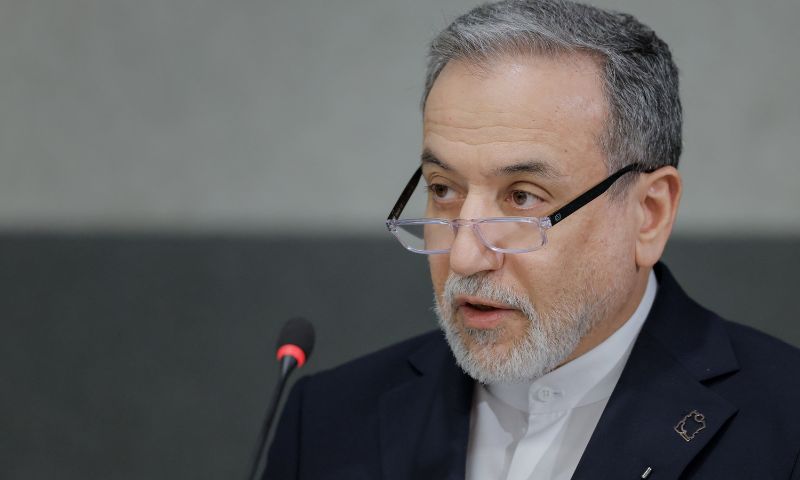
ISLAMABAD: Iran’s Foreign Minister Seyed Abbas Araghchi has said that recent developments in the Strait of Hormuz underscore the absence of any viable military solution to ongoing regional political tensions, calling instead for sustained diplomacy.
In a statement posted on X (formerly Twitter), Araghchi said that “events in Hormuz make clear that there’s no military solution to a political crisis,” amid heightened concerns over maritime security in the Gulf region.
Without providing further operational details, the Iranian foreign minister pointed to ongoing diplomatic efforts, noting that talks were making “progress with Pakistan’s gracious effort.” He did not elaborate on the format or participants of the discussions, but praised Islamabad’s role in facilitating engagement.
Araghchi also cautioned the United States against what he described as being “dragged back into quagmire by ill-wishers,” urging Washington to avoid escalation in an already volatile environment. He extended a similar caution to the United Arab Emirates, referencing broader regional sensitivities tied to recent security incidents in Gulf waters.
Concluding his remarks, the Iranian diplomat said, “Project Freedom is Project Deadlock,” suggesting that military-driven approaches would only deepen instability rather than resolve underlying disputes.
The statement comes amid rising tensions in the Gulf, including reports of attacks on commercial shipping routes near the Strait of Hormuz and concerns over regional spillover effects. Diplomatic channels, however, appear to remain active as regional and global stakeholders seek to prevent further escalation.
IRGC signals retaliation
At the same time an Iranian Islamic Revolutionary Guard Corps (IRGC) official has warned that any US attempt to intervene in the Strait of Hormuz would face a “decisive and crushing response.”
Yadollah Javani, deputy political officer of the IRGC, said Washington’s focus on the strategic waterway reflects its current geopolitical pressure on Iran.
Speaking to Iran’s ISNA news agency, Javani claimed that US President Donald Trump had repeatedly sought leverage over Iran during and after recent regional conflicts but had failed to achieve his objectives.
He said the US is attempting to gain influence over the Strait of Hormuz through pressure tactics, but insisted such efforts would not succeed.
“This means that America is no longer a superpower; it has faced a superpower,” he said, echoing earlier statements by Iran’s Foreign Ministry spokesperson.
Javani further warned that any US military or strategic escalation would ultimately backfire, adding that American losses would outweigh those of Iran.
“The US will test its strength, bring all its might to bear, and will ultimately be defeated,” he said.