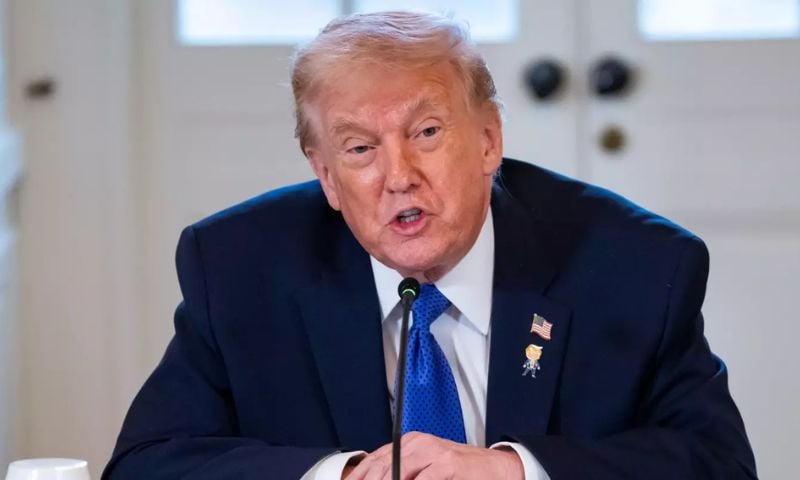
WASHINGTON: US President Donald Trump said on Sunday that “very positive discussions” were underway with Iran on finding a solution to the war, but added that American forces would soon begin escorting ships out of the blocked Strait of Hormuz.
Earlier, Iran’s foreign ministry spokesman Esmaeil Baqaei said Tehran had submitted a 14-point plan focused on ending the conflict, adding that Washington had responded through Pakistani mediators.
“I am fully aware that my representatives are having very positive discussions with the country of Iran, and that these discussions could lead to something very positive for all,” Trump said on his Truth Social platform.
The United States and Israel launched attacks on Iran on February 28, killing the Islamic Republic’s supreme leader, prompting Tehran to retaliate with strikes on US bases and Israeli targets across the region.
A ceasefire came into effect on April 8, followed by one round of direct talks in Islamabad.
Since the start of the war, Iran has maintained a stranglehold on the Strait of Hormuz, disrupting major flows of oil, gas, and fertiliser, while the United States has imposed a counter-blockade on Iranian ports.
Trump said “countries from all over the world” had requested US assistance to navigate the waterway.
“For the good of Iran, the Middle East, and the United States, we have told these countries that we will guide their ships safely out of these restricted waterways,” he said.
“This process, Project Freedom, will begin Monday morning, Middle East time.”
He described the operation as a “humanitarian gesture”, saying many vessels were running low on food and essential supplies.
The US military’s regional command, United States Central Command, said it would support the mission with guided-missile destroyers, more than 100 aircraft, unmanned platforms, and around 15,000 personnel.
“Our support for this defensive mission is essential to regional security and the global economy as we also maintain the naval blockade,” said Admiral Brad Cooper, CENTCOM commander.
According to maritime intelligence firm AXSMarine, more than 900 commercial vessels remained in the Gulf as of April 29, down from more than 1,100 at the start of the conflict.