ISLAMABAD: The OPEC+ group — a coalition of major oil-producing countries — on Sunday raised its production quotas in a widely expected move to signal stability in global markets following the United Arab Emirates’ withdrawal.
Saudi Arabia, Russia, Iraq, Kuwait, Kazakhstan, Algeria, and Oman adjust production and reaffirm commitment to market stability, OPEC+ said in a statement.
The seven major producers will add “188,000 barrels per day” to their total production quota for June, as part of “their collective commitment to support oil market stability,” according to a statement published by OPEC+.
The seven OPEC+ countries, which previously announced additional voluntary adjustments in April and November 2023, met virtually on 3 May 2026 to review global market conditions and outlook.
“In their collective commitment to support oil market stability, the seven participating countries decided to implement a production adjustment of 188 thousand barrels per day from the additional voluntary adjustments announced in April 2023,” OPEC+ stated in a press release.
Saudi Arabia, Russia, Iraq, Kuwait, Kazakhstan, Algeria, and Oman adjust production and reaffirm commitment to market stability
Read Press Release ➡️https://t.co/FX9u07426n
— OPEC (@OPECSecretariat) May 3, 2026
“The countries will continue to closely monitor and assess market conditions, and in their continuous efforts to support market stability,” the group stated.
They reaffirmed the importance of adopting a cautious approach and retaining full flexibility to increase, pause or reverse the phase out of the voluntary production adjustments, including reversing the previously implemented voluntary adjustments announced in November 2023.
The seven OPEC+ countries will hold monthly meetings to review market conditions, conformity, and compensation.
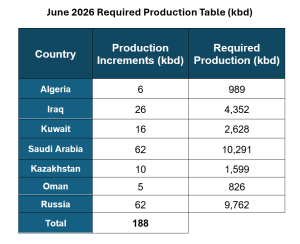
Oil market analysts had widely expected the increase of 188,000 barrels, which is similar to the 206,000-barrel daily increases OPEC+ announced in both March and April.
The production hike comes at a time when global oil markets remain highly sensitive to geopolitical risk in the Middle East, with disrupted maritime routes through the Strait of Hormuz continuing to restrict the movement of crude shipments.
The UAE’s withdrawal from OPEC and OPEC+ earlier this week has reshaped the bloc’s internal balance, reducing the spare capacity coordination mechanism and shifting more weight to remaining producers.
Meanwhile, oil prices have remained elevated in recent trading, reflecting sustained risk premiums tied to supply uncertainty.
Brent crude has recently traded above the $110 mark in volatile sessions, while US West Texas Intermediate (WTI) has remained above $100, underscoring persistent tightness in global supply conditions.