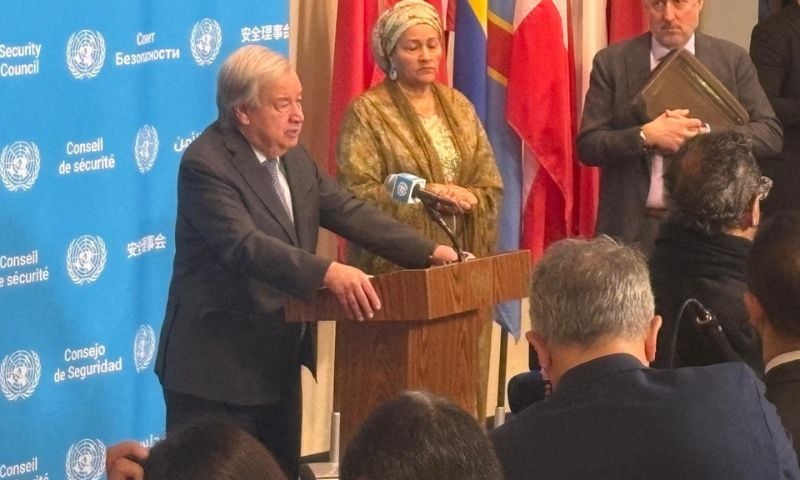
UNITED NATIONS: UN Secretary-General António Guterres on Thursday warned that disruptions in the Strait of Hormuz are “strangling the global economy” and could trigger severe and long-lasting global economic consequences.
Speaking to reporters, Guterres said the ongoing restriction of navigational rights and freedoms in the strategic waterway is impeding global trade and energy flows, worsening economic instability worldwide.
I am deeply concerned about the curtailment of navigational rights and freedoms in the area of the Strait of Hormuz.
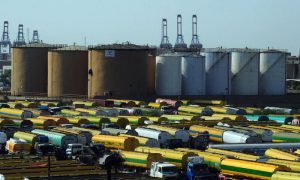
Impeding the delivery of oil, gas, fertilizer, and other critical commodities. Disrupting energy, transport, manufacturing, and food markets.
– @antonioguterres pic.twitter.com/bvAbskgvOl
— UN Spokesperson (@UN_Spokesperson) April 30, 2026
‘Global economy being strangled’
“The delivery of oil, gas, fertiliser and other critical commodities is being impeded, disrupting energy, transport, manufacturing, and food markets,” Guterres said.
“As with every conflict, the whole of humanity is paying the price — even if a few are reaping huge profits,” he added.
“The pain will be felt for a long time to come.”
The UN chief stressed that even if restrictions were lifted immediately, global supply chains would take months to recover, prolonging lower economic output and higher prices.
Economic fallout
Guterres outlined multiple scenarios based on international forecasts, warning that prolonged disruption could push the global economy into severe contraction.
In the worst-case scenario, where restrictions persist through the end of the year, he said global inflation could rise above 6 percent while growth could fall to 2 percent.
He warned of “immense suffering” for vulnerable populations, rising poverty, and a potential global recession with “dramatic impacts on people, the economy, and political and social stability.”
“These consequences are not cumulative. They are exponential,” Guterres said.
“The longer this vital artery is choked, the harder it will be to reverse the damage.”
Reopen Strait of Hormuz
Guterres urged all parties to restore freedom of navigation in the Strait of Hormuz immediately, in line with UN Security Council resolutions.
“Open the Strait. Let all ships pass. Let the global economy breathe again,” he said.
He also called for shipping to be made safe, predictable and insurable, while urging restraint to avoid undermining the fragile ceasefire between the United States and Iran.
My message to all parties is clear:
Navigational rights and freedoms must be restored immediately, as affirmed by the Security Council in Resolution 2817.
Open the Strait.
Let all ships pass.
Let the global economy breathe again.
– @antonioguterres pic.twitter.com/jpbZlO8mFs
— UN Spokesperson (@UN_Spokesperson) April 30, 2026
Humanitarian and UN response efforts
The UN chief said he has been in contact with multiple parties through his envoy, Jean Arnault, to support diplomatic efforts.
He noted that the International Maritime Organization is developing a framework for the safe evacuation of ships and seafarers from the region if needed.
Meanwhile, the UN Office of Project Services is leading a task force exploring a possible humanitarian corridor in case conditions worsen further.
US-Iran conflict
The warnings come as tensions between Iran and the United States continue to escalate over control of the Strait of Hormuz.
Iran has maintained restrictions on shipping through the waterway, citing a US naval blockade of its oil exports.
The Strait normally carries around one-fifth of global oil and gas supplies.
Iranian officials have warned of retaliation against any renewed US military action.
Oil prices have surged sharply since the conflict began, with Brent crude earlier hitting levels above $126 per barrel before easing, according to market data.
Global economic risks
The UN chief said prolonged disruption would hit developing countries hardest, deepening debt burdens, job losses, and food insecurity.
He warned that tens of millions could face poverty and extreme hunger if the crisis continues, while global trade and investment flows remain under strain.
“The world is waiting,” Guterres said, urging immediate diplomatic engagement and a return to dialogue to prevent further escalation.