


PESHAWAR, Pakistan: For Ahmed Khan, a 21-year-old business student at the University of Peshawar, exam season brought more than academic pressure, triggering overwhelming anxiety.
As his symptoms worsened, Khan eventually consulted a mental health professional, who identified anxiety linked to academic stress. His grades declined during that period, but he is learning, slowly but surely, to manage his condition.
Khan’s experience reflects a growing, largely invisible crisis among the youth of Khyber Pakhtunkhwa (KP) — a crisis marked by mounting pressure, social silence, and a healthcare system struggling to stay afloat.
For years, mental health struggles have been dismissed as temporary moods, phases, or personal weakness — brushed under the carpet as if they barely exist.
The numbers speak volumes
Recent data highlights the scale of the issue.
According to Dr Muhammad Firaz Khan, Director and Associate Professor at the Institute of Public Mental Health and Behavioural Sciences, Khyber Medical University, a World Bank-commissioned household survey conducted in Khyber Pakhtunkhwa (2023–24) found that 21 per cent of women suffer from generalised anxiety disorder, while 28 per cent show signs of depression. Among pregnant women, the figure rises sharply to 58 per cent — a worrying spike that cannot be ignored.
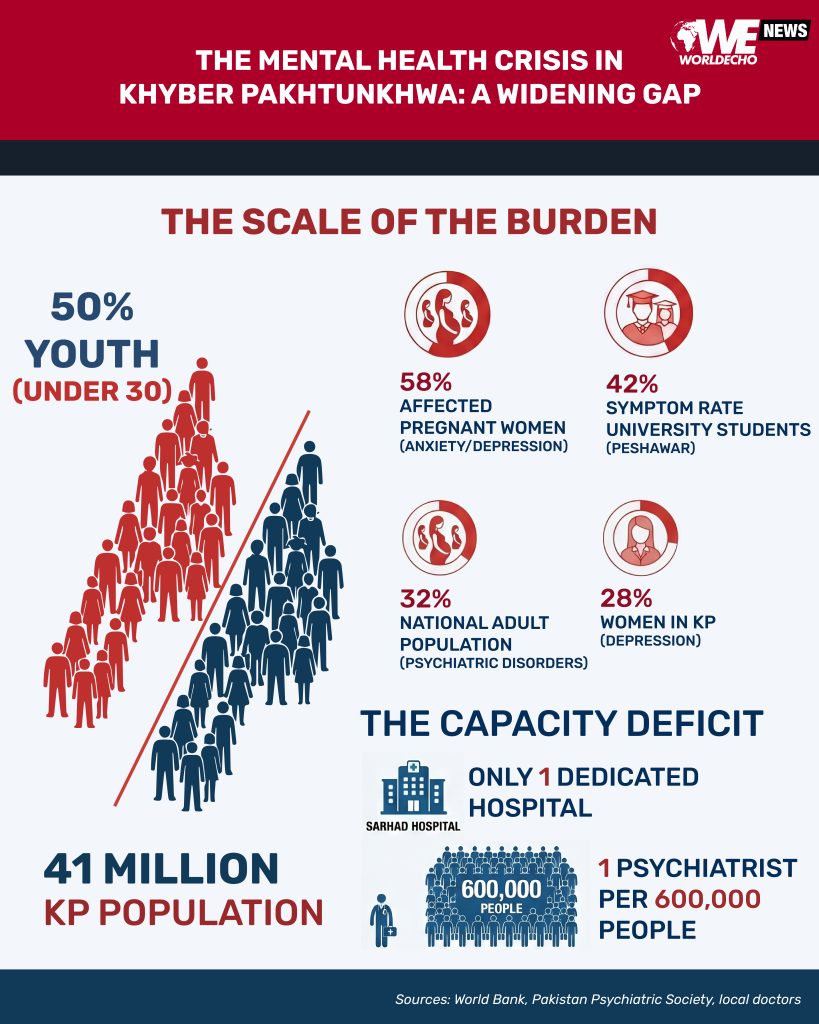
Studies among young people paint an equally concerning picture. Dr Firaz says that research conducted in Peshawar indicates that up to 42 per cent of university students experience symptoms of anxiety or depression, driven by academic stress, financial pressure, and social expectations.
“I couldn’t breathe properly before exams. My heart would race, my hands would shake. When I told my family, they said you’re overthinking.” – Ahmed Khan, a university student
At the national level, the Pakistan Psychiatric Society’s National Psychiatric Morbidity Survey (2019–2022) estimates that over 32 per cent of adults in Pakistan are living with a psychiatric disorder, underlining the widespread nature of the crisis.
A generation under strain
With an estimated population of around 41 million, nearly half of Khyber Pakhtunkhwa’s population is under the age of 30 — meaning millions of young people are navigating critical life stages under increasing psychological strain.
From academic competition to unemployment and financial instability, pressures are mounting at an unprecedented pace.
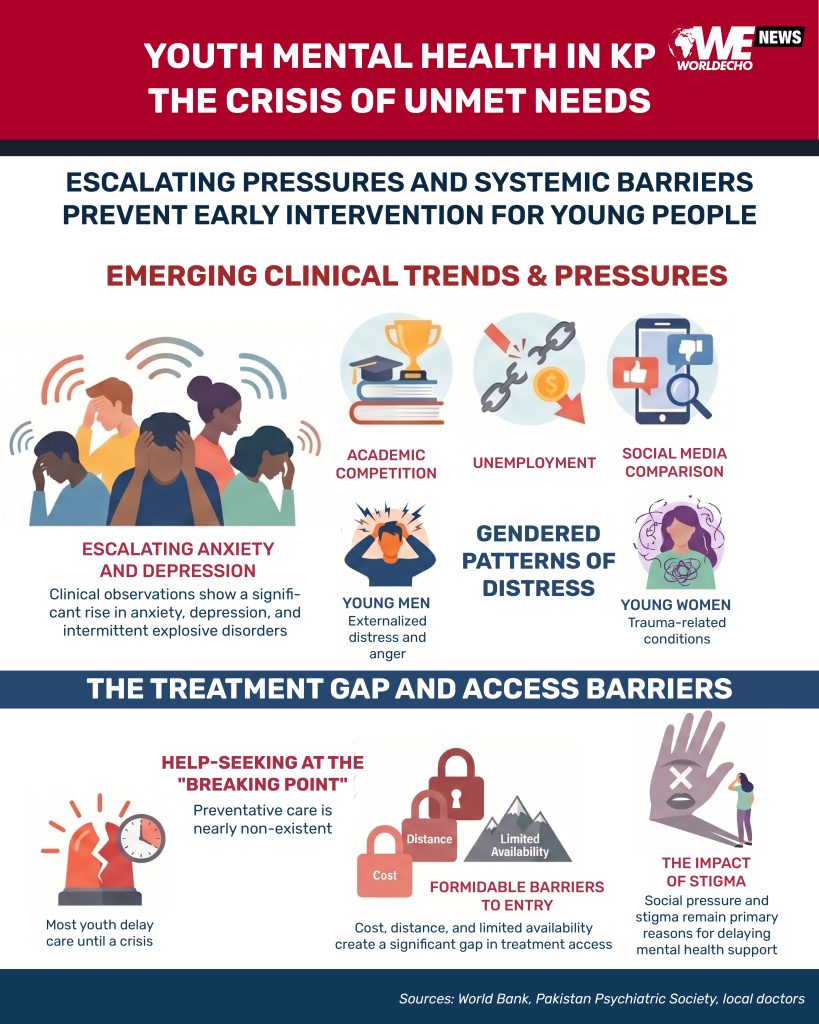
Academic competition, rising unemployment, financial instability, family expectations, and social comparison through digital platforms have created a pressure-cooker environment with increasingly high stakes.
Many young people feel they must perform perfectly, without space to fail, rest, or speak openly — often leaving them emotionally exhausted.
Adding to this, Dr. Huma Kanwal Atta, Head of the Institute of Public Mental Health & Behavioural Sciences at Khyber Medical University, notes that beyond anxiety and depression, conditions like social anxiety, intermittent explosive disorder, and performance anxiety are increasingly common among youth, complicating the mental health landscape further.
“Young men often express internal distress through anger because it is more socially acceptable than vulnerability,” she explains. “Among young women, we frequently see complex trauma-related conditions.”
Late-stage intervention
According to Dr Huma Kanwal Atta, most young people in Khyber Pakhtunkhwa seek help only at a breaking point. “For males, it is often triggered by academic or job failure.
For females, it may be family conflict or a physical condition with psychological roots,” she says, adding that preventative mental health care is almost non-existent.
“In Khyber Pakhtunkhwa, stigma is a barrier to social survival. Young people learn to function outwardly while struggling internally.” – Dr Huma Kanwal Atta, Institute of Public Mental Health & Behavioural Sciences, Peshawar
This delay is deeply tied to stigma — a hurdle too high for many to cross.
“In Khyber Pakhtunkhwa, stigma is a barrier to social survival,” she adds. “Young people learn to function outwardly while struggling internally.”
Invisible inner struggles
One of the biggest challenges young people face is having their struggles recognised.
For Fatima Ali, a 24-year-old graduate from Peshawar, the struggle went unnoticed for months.
Her condition, triggered by prolonged academic stress and uncertainty about her future, was later identified through professional consultation as depression.
“The hardest part wasn’t therapy; it was admitting that something was wrong,” she adds.
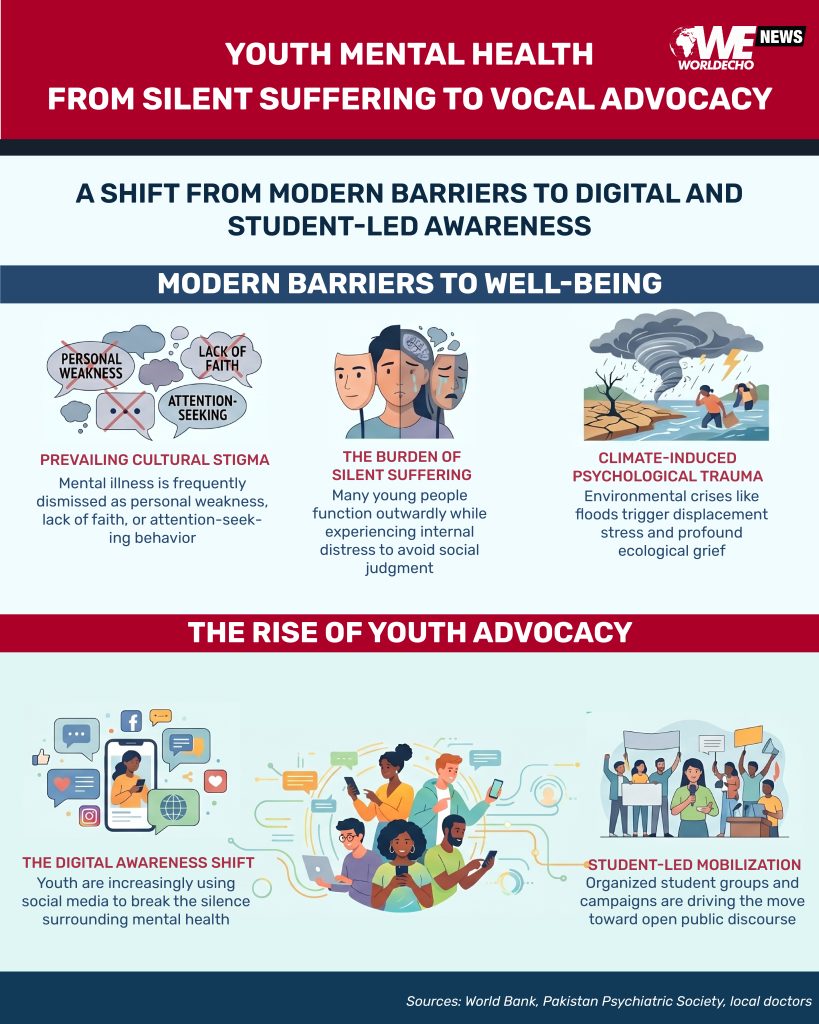
“Depression and anxiety don’t always look dramatic,” explains Dr Malaika Zafar, a psychologist in Peshawar. “Many young people appear normal while suffering silently.”
The idea, Dr Khoula Ismail says, that mental health is just a phase dismisses real neurological and emotional struggles that young people face every day. “We need early intervention and community awareness to truly help.”
Family and social pressures
Mental health stigma remains deeply rooted in Khyber Pakhtunkhwa — hardwired into social attitudes. Many households view psychological distress as weakness, lack of faith, or attention-seeking behaviour.
“Students today are under far more pressure than previous generations. They are expected to succeed academically, secure jobs, and meet family expectations all while being discouraged from expressing distress.” – Dr Khoula Ismail, Clinical Psychologist
“I used to think depression was just sadness,” admits Farhana Majeed, a mother of a 20-year-old. “But after talking with a counsellor, I realised it’s a health issue.”
Parents often discourage open discussion, fearing social judgement or future consequences, such as marriage prospects — keeping things under wraps. Young women face additional scrutiny, which often prevents them from seeking help.
“When young people are told not to talk about their emotions, they internalise guilt and shame.”
Educational institutions, too, are still adapting to rising mental health concerns. Where counselling services exist, students are often unaware of them or hesitant to seek help due to confidentiality concerns.
System under strain
Mental health services in Khyber Pakhtunkhwa remain limited in scope, particularly outside major urban centres.
“There is a significant treatment gap in Khyber Pakhtunkhwa. Even when young people want help, access is limited by cost, distance, and availability,” says Dr Shariq Zaman, a public health expert.
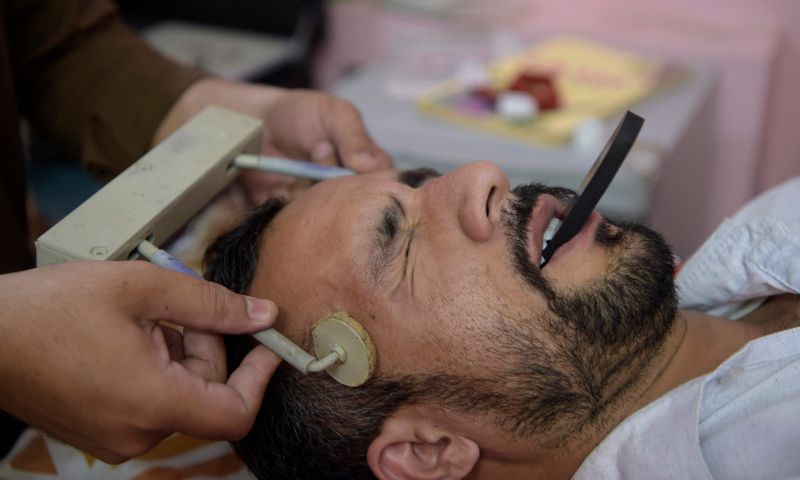
Dr Muhammad Firaz Khan notes that Khyber Pakhtunkhwa has only one dedicated psychiatric hospital — Sarhad Hospital for Psychiatric Diseases — along with eight to 10 tertiary hospitals providing psychiatric services, mostly in urban areas.
At the district level, services remain limited, with only 12–15 hospitals offering basic psychiatric outpatient care.
The shortage of professionals is equally alarming.
“Khyber Pakhtunkhwa has approximately one psychiatrist for every 600,000 to 650,000 people — far below international standards,” Dr Khan explains.
Broken support system
Despite the growing burden, mental health remains underfunded.
“There is no dedicated mental health budget in Khyber Pakhtunkhwa’s public health system,” says Dr Khan.
He adds that while Rs2.52 billion was allocated for constructing the Institute of Mental Health and Behavioural Sciences in Peshawar, sustained operational funding remains absent.
“I stopped enjoying things I loved. I felt drained all the time. But because I was still going to university, people thought I was fine.” – Fatima Ali, a student
Although the Khyber Pakhtunkhwa Mental Health Act 2017 provides a legal framework, its implementation has been slow, with key institutions yet to become functional.
Dr Khan highlights broader systemic challenges, including shortage of trained professionals; urban-centred services; lack of integration into primary healthcare; and absence of school-based mental health programmes.
“These structural gaps prevent timely access to care,” he says.
New stressors are also shaping mental health trends.
Dr Huma Kanwal Atta points to climate change as an emerging psychological trigger.
“For young people, floods and environmental crises are not abstract, but lived experiences. “This leads to trauma, displacement stress, and what we call ecological grief,” she remarks.
Misunderstanding mental health
In Khyber Pakhtunkhwa, conversations around mental health are deeply intertwined with tradition and long-standing cultural beliefs. For many families, emotional distress is not immediately understood as a medical or psychological condition, but rather as a spiritual weakness, or a temporary lapse in resilience.
Kiran Aftab, a student at Khyber Medical College, Peshawar, says that when she tries to talk about anxiety and depression, she is often met with responses like “pray more,” “have patience,” or “you’re just overthinking.”
She explains that while these remarks are usually meant with concern, they can unintentionally downplay the seriousness of what someone is going through.
“Prayer and therapy are not opposites,” explains psychiatrist Dr Mohid Gul. “Mental health conditions have biological, psychological, and social dimensions. Ignoring one aspect delays recovery. Faith can support healing, but it cannot replace medical assessment when someone is clinically depressed or experiencing severe anxiety.”
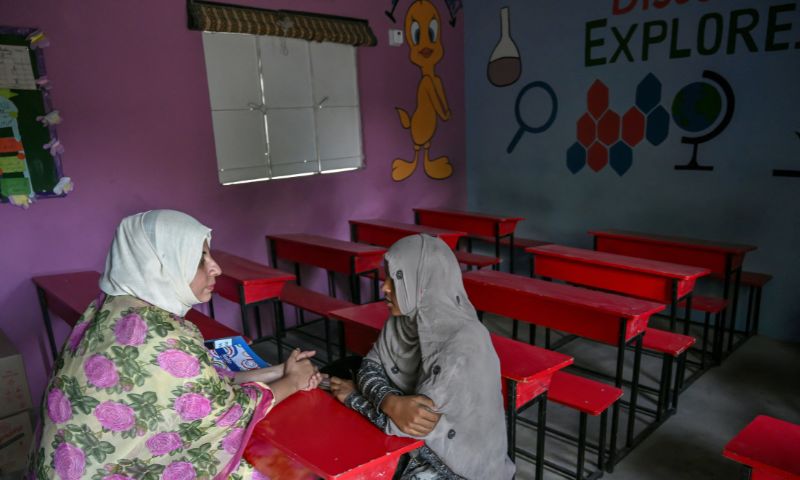
In some cases, families turn to unqualified healers before seeking professional care, delaying appropriate treatment.
“Imams [prayer leaders] and community elders hold influence. If they acknowledge that mental illness is real and encourage people to seek professional help alongside spiritual support, it can significantly reduce stigma,” says Dr Shariq Zaman.
“Families don’t realise that silence worsens the problem. When young people are told not to talk about their emotions, they internalise guilt and shame.” – Maliha Khan, mental health activist
For many young people, the challenge is not choosing between faith and therapy, it is navigating a cultural environment where seeking professional help is sometimes seen as unnecessary or shameful.
In conservative settings, particularly for young women, concerns about reputation and marriage prospects further discourage open discussion.
Silence starts cracking
Despite challenges, Khyber Pakhtunkhwa’s youth are increasingly speaking out. Social media platforms, student-led initiatives, and local awareness campaigns are creating spaces for open conversation about mental health.
Sara Rehman, a young professional in Peshawar, says she shared her experience on Instagram when she was struggling with persistent sadness and did not know how to process or express her emotions.
“I posted about how I was feeling low and confused all the time,” she says. “I didn’t even have the words for it back then.” The response, she adds, was overwhelming. “People messaged me saying they felt the same but were afraid to speak.”
Not a phase, but a reality
For Ahmeds, acknowledging his anxiety was the first step towards healing.
“I still struggle. But now I know I’m not weak, I’m dealing with something real,” he maintains.
Mental health challenges do not disappear with time or denial. For Khyber Pakhtunkhwa’s youth, recognising anxiety and depression as legitimate health issues rather than dismissing them as phases could be the difference between silence and support, between suffering and recovery.
Mental health is not a trend or a temporary phase. It is a fundamental aspect of human well-being. And in Khyber Pakhtunkhwa, young voices rising against stigma and silence are slowly reshaping the conversation.