
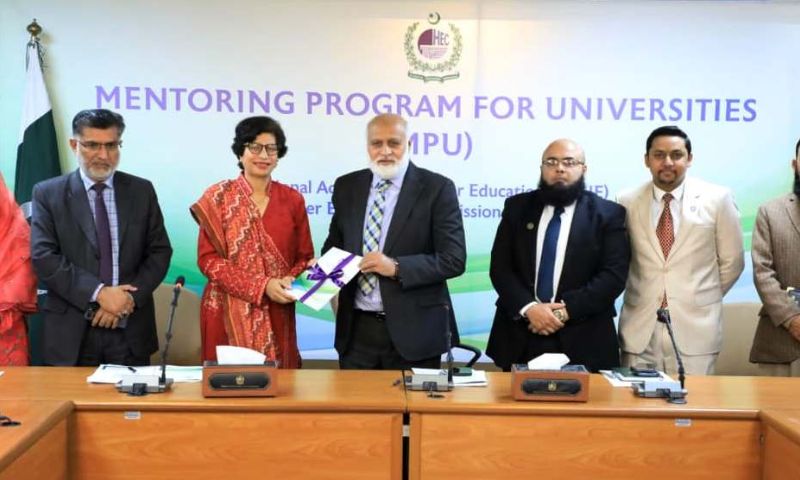



ISLAMABAD: Higher Education Commission (HEC) Pakistan has launched the Mentoring Programme for Universities (MPU), a comprehensive nationwide initiative designed to train leadership and faculty across all higher education institutions in the country.
Initiated through the National Academy of Higher Education (NAHE), the program represents an expanded version of HEC’s Women Empowerment and Mentoring Program, which was originally launched in November 2024 for 18 women universities.
Gender-inclusive initiative aims to transform academic landscape
The Mentoring Program for Universities is a gender-inclusive initiative designed to support faculty members and academic leaders from both public and private sector universities. The program seeks to foster a culture of mentorship, collaboration, and knowledge sharing across Pakistan’s higher education landscape.
By strengthening leadership capacity and professional development within higher education institutions (HEIs), the MPU aims to create a robust support system that benefits the entire academic ecosystem.
Chairman HEC @DrNiazAhmadSI launches the Mentoring Program for Universities (MPU) to train faculty & leaders across public & private universities nationwide. #HECPak #AcademicLeadership pic.twitter.com/aNf0Um4j8F
— HEC Pakistan (@hecpkofficial) March 17, 2026
HEC leadership graces launch ceremony
Chairman HEC Engr. Prof. Dr. Niaz Ahmad Akhtar (S.I) graced the launch ceremony, held at the HEC Secretariat on Tuesday, with his presence alongside members of HEC’s senior management committee. Vice Chancellors of all universities also joined the event virtually, demonstrating widespread institutional support for the initiative.
Chairman HEC termed mentoring of academic leadership and faculty a crucial part of institutional development. Highlighting the significance of readiness for mentorship, he emphasized that the country’s academia possesses no shortage of learned figures with high capability to deliver in this specific area.
“The program will help exploit the expertise of such senior academicians,” Dr. Niaz asserted.
Building on proven success
Dr. Niaz appreciated NAHE for the success of the Women Empowerment and Mentoring Program and for expanding the scope of this initiative to all universities.
“This was very much needed, and it was high time to further extend the program,” he asserted, acknowledging the timely nature of this expansion.
Managing Director NAHE Dr. Noor Amna Malik shed light on the program’s background and underlined the achievements of the Women Empowerment and Mentoring Program.
“The initiative garnered huge success and repute, paving the way for its expansion to all universities across the country,” she affirmed.
Impressive track record
Dr. Malik revealed that as many as 890 mentors and mentees were produced through the Women Empowerment and Mentoring Program.
“The initiative proved to be a support system within our own ecosystem, as it has been institutionalized and internalized where people assist and uplift one another,” she emphasized, highlighting the organic growth of mentorship culture.
Addressing professional barriers
Dr. Malik underscored that the Mentoring Program for Universities will help remove interpersonal and psychological barriers facing academic leadership and faculty.
She explained that the program will provide guidance to its beneficiaries to deal with institutional challenges, develop leadership capacities, and enhance their ability to contribute to their own growth alongside the growth and transformation of their respective academic institutions.
“The initiative will support emerging leaders in the higher education sector by maximizing their potential, developing their skills, and enhancing their performance,” she added.
Flexible, need-based approach
Discussing the program modules, Dr. Malik noted that NAHE has kept an open window for universities to include need-based areas to solve their respective problems, ensuring the program remains relevant and responsive to diverse institutional contexts.
Institutional impact recognised
Vice Chancellor Lahore College for Women University (LCWU) Dr. Uzma Quraishi shared her views on the impact of the Women Empowerment and Mentoring Program at her institution.
She stated that the program established the need for mentorship in a professional setup, as it focused on personal and professional growth regardless of gender.
Dr. Quraishi informed the audience that the program produced 240 mentors in three cohorts at LCWU who are now cascading their learning and making a tangible difference across their respective spheres of influence.
She revealed that the initiative enables universities to include new modules in line with their own needs, and asserted that the program has “great potential to transform the entire academic ecosystem by empowering the academicians and learners.”