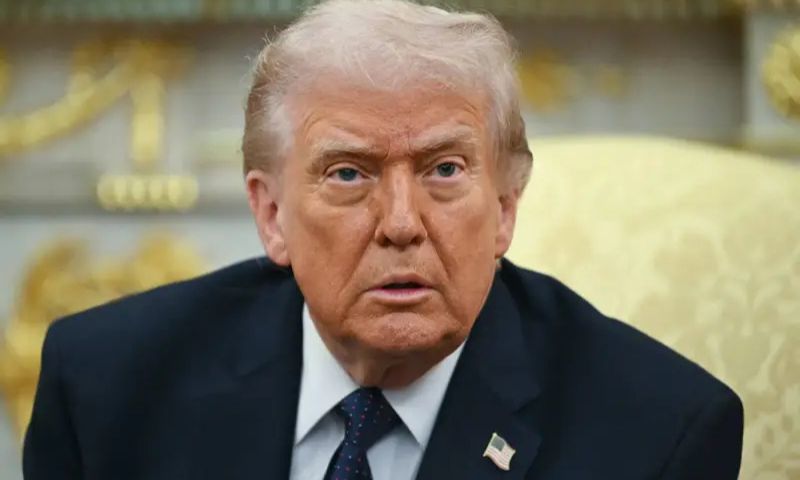



WASHINGTON: US President Donald Trump warned NATO allies that the alliance could face a “very bad future” if member states refuse to help secure the Strait of Hormuz, intensifying pressure on partners to support efforts to reopen the strategic waterway amid the conflict with Iran.
In an interview with the Financial Times published on Sunday, Trump said countries that benefit from energy shipments through the Gulf should contribute to safeguarding the vital maritime corridor.
“It’s only appropriate that people who are the beneficiaries of the strait will help to make sure that nothing bad happens there,” Trump said.
“If there’s no response or if it’s a negative response I think it will be very bad for the future of NATO.”
The warning comes as global oil markets remain under strain after Iran effectively blocked the strait in response to military strikes launched by the United States and Israel against Iran on February 28.
Pressure on allies to deploy naval assets
Trump said Washington expects allies to contribute naval capabilities, including minesweepers and other vessels needed to ensure safe passage for commercial shipping.
“Whatever it takes,” he said when asked what assistance the United States expected from partners.
On Saturday, Trump publicly called on countries including China, France, Japan, South Korea and Britain to send ships to escort oil tankers through the strait.
The US president also revived his longstanding criticism of NATO burden-sharing, arguing that Washington had strongly supported European allies during the war in Ukraine and now expected reciprocal backing.
“We’ve been very sweet,” Trump said.
EU and allies weigh response
European governments have reacted cautiously to Washington’s call for support.
Germany’s foreign minister, Johann Wadephul, said he was sceptical that expanding the European Union’s naval mission would improve security in the region.
Wadephul also questioned whether NATO should play any role in addressing the crisis.
“I don’t see that NATO has made any decision in this direction or could assume responsibility for the Strait of Hormuz,” he said ahead of a meeting of EU foreign ministers in Brussels.
A German government spokesperson later said the war involving Iran had “nothing to do with NATO” and that Berlin would not participate in any military effort to keep the waterway open while the conflict continued.
Greece also ruled out taking part in any military operations in the strait, with government spokesman Pavlos Marinakis saying Athens would not engage in such missions.
A NATO official said the alliance was aware that individual member states were discussing possible steps with the United States and other partners regarding security in the waterway.
“Allies have already stepped up to provide additional security in the Mediterranean,” the official said, adding that consultations between countries were ongoing.
Britain seeks collective plan
British Prime Minister Keir Starmer said London was working with allies on a “viable collective plan” to restore freedom of navigation through the Strait of Hormuz, but stressed that the effort would not be led by NATO.
“Ultimately, we have to reopen the Strait of Hormuz to ensure stability in the oil market. That is not a simple task,” Starmer told reporters on Monday.
“So we’re working with all of our allies, including our European partners, to bring together a viable collective plan that can restore freedom of navigation in the region as quickly as possible and ease the economic impact,” he said.
Starmer said he spoke with Trump by phone on Sunday night and described their discussion as constructive.
“We are strong allies; have been for decades,” he said, adding that he maintained a “good relationship” with the US president.
However, the British leader stressed that the United Kingdom would not allow itself to be drawn into a broader Middle East war.
“Our first priority is to protect our people in the region,” he said.
Starmer said de-escalating the conflict was ultimately the most effective way to ease economic pressures.
“The best way to combat the cost of living is to de-escalate the conflict,” he said.
Iran declares Strait ‘closed to enemies’
Iran has warned that the strategic waterway would remain closed to countries involved in the military campaign against it.
Iranian Foreign Minister Abbas Araghchi said the strait was effectively “closed to our enemies”.
“After 15 days of war, they have resorted to others to ensure the security of the Strait of Hormuz,” Araghchi said.
“From our perspective, the strait is open, but it is closed to our enemies, closed to those who carried out this cowardly aggression against us and to their allies,” he added.
Oil shipments and market impact
Despite the tensions, some shipping traffic has resumed through the waterway.
US Treasury Secretary Scott Bessent said Washington had allowed Iranian oil tankers to transit the strait in order to help maintain global supplies.
“The Iranian ships have been getting out already, and we’ve let that happen to supply the rest of the world,” Bessent told CNBC.
He said additional vessels from countries including India and China were also beginning to pass through the corridor and that traffic could increase further.
Bessent added that Washington’s broader military objective remained to weaken Iran’s military capabilities, including its navy and its ability to project power beyond its borders.
Calls for de-escalation
Italy’s foreign minister Antonio Tajani said diplomacy remained the best path to resolving the crisis.
“As far as Hormuz is concerned, I believe diplomacy needs to prevail,” Tajani told reporters on the sidelines of the Brussels meeting.
He added that Italy was involved in defensive naval missions in the Red Sea but did not see any current operations that could be extended to the Strait of Hormuz.
Strategic global energy route
The Strait of Hormuz, a narrow waterway between Iran and Oman, carries roughly one-fifth of the world’s oil and a large share of global liquefied natural gas shipments.
The disruption of traffic through the corridor has pushed crude prices above $100 per barrel and heightened concerns about the stability of global energy markets as the conflict in the Middle East continues to escalate.