Key points
- Pakistan urges immediate de-escalation of Middle East conflict.
- Pakistan backs draft resolutions by Bahrain and Russia.
- Pakistan voices concern over escalation and instability in Iran.
- Conflict disrupts Pakistan’s fuel supplies and aviation links.
- Two Pakistani nationals killed in attacks in United Arab Emirates.
- Pakistan stresses adherence to United Nations Charter and international humanitarian law.
ISLAMABAD: Pakistan has called for an urgent de-escalation of hostilities in the Middle East, warning that the ongoing conflict risks widening into a broader regional crisis with serious humanitarian, economic and security consequences.
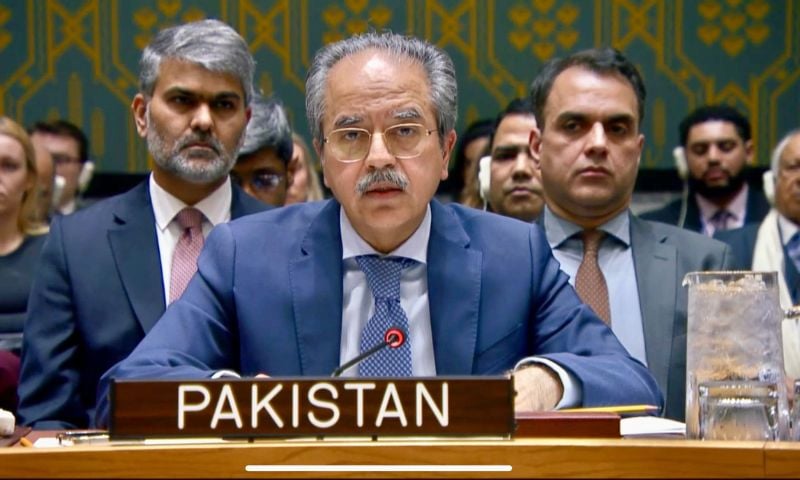
Speaking at a United Nations Security Council meeting on the agenda item “Situation in the Middle East,” Pakistan’s Permanent Representative to the United Nations, Asim Iftikhar Ahmed, urged all parties to immediately halt military actions and return to dialogue.
“The consequences of the conflict that we are witnessing right now are clear — everyone is impacted. This is a conflict that should never have happened.” – Asim Iftikhar Ahmed, Pakistan’s Permanent Representative to the UN
The Pakistani envoy voiced Islamabad’s support for draft resolutions introduced by Bahrain and the Russian Federation, both aimed at curbing the escalation and encouraging diplomatic engagement.
“The consequences of the conflict that we are witnessing right now are clear — everyone is impacted. This is a conflict that should never have happened,” Iftikhar told the Council, warning that the crisis has already taken on regional and global dimensions.
“When international law is violated, peace is imperilled, not advanced. We call for an immediate and complete cessation of hostilities and a return to the dialogue table. Only a peaceful settlement will serve everyone’s interests,” he added.
Solidarity with Gulf states
Asim Iftikhar said Pakistan’s support for Bahrain’s resolution reflects its strong solidarity with Gulf countries that have come under attack, including Kuwait, Oman, Qatar, Saudi Arabia, the United Arab Emirates, and Jordan.
He condemned attacks targeting civilians, civilian infrastructure and critical facilities, reaffirming Pakistan’s support for the sovereignty, territorial integrity and political independence of the affected countries.
Pakistan also expressed hope that attacks on these countries would cease immediately and that navigation rights in the Strait of Hormuz would remain protected.
“Pakistan stands in complete solidarity with their governments and people.” – Asim Iftikhar
The envoy said it was particularly unfortunate that these countries, which had supported diplomatic engagement and restraint during rising tensions, ultimately became targets of attacks.
“Pakistan stands in complete solidarity with their governments and people,” he said.
Concern over Iran tensions
Asim Iftikhar also welcomed the draft resolution introduced by the Russian Federation, noting that it aligns with Pakistan’s position by urging an end to military activities and a return to negotiations.
Referring to attacks launched against Iran on February 28, he said the escalation has seriously jeopardised international peace and security and risks destabilising the wider region.
“As a brotherly neighbouring country, Pakistan supports the sovereignty and territorial integrity of Iran. We are deeply concerned by the instability in Iran,” he said.
Impact on Pakistan
The Pakistani diplomat also highlighted the conflict’s wider humanitarian and economic repercussions, noting that Pakistan itself has already been affected.
At least two Pakistani nationals were killed in attacks in the United Arab Emirates, while millions of Pakistani expatriates living across Gulf countries remain at risk.
The conflict has also disrupted Pakistan’s fuel supplies, forcing the government to adopt emergency conservation measures for oil, gas and electricity. Several aviation routes have been suspended, while others continue to face operational disruptions.
Humanitarian concerns
Asim Iftikhar said Pakistan is deeply concerned about the growing civilian toll caused by missile and drone strikes targeting schools, residential areas, oil and port facilities, desalination plants and other critical infrastructure.
He expressed condolences over civilian casualties, including the deaths of children in an elementary school in the Iranian city of Minab.
The envoy stressed that any use of force outside the framework of the United Nations Charter is unlawful and must be condemned, urging all parties to strictly adhere to international humanitarian law.
Call for diplomacy
Asim Iftikhar concluded by reiterating Pakistan’s call for restraint and renewed diplomacy.
“We call for a swift return to dialogue and diplomacy to pursue a peaceful resolution of all contentious issues,” he said, adding that sincere political will is required to restore trust and ensure peaceful coexistence in the region.
He also welcomed mediation efforts by various countries and said Pakistan’s leadership remains in close contact with regional partners in an effort to help ease tensions.
“Pakistan urges all sides to immediately de-escalate the situation, exercise maximum restraint, and resume diplomacy for a negotiated and lasting resolution to the crisis,” he said.