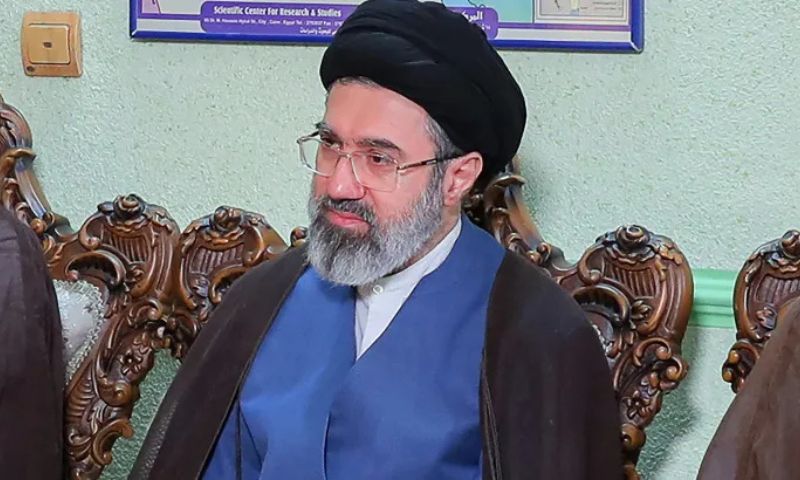
TEHRAN, Iran: Iran’s new Supreme Leader Mojtaba Khamenei said on Thursday that Tehran would seek compensation from the United States and Israel for losses caused by the ongoing war, warning that Iran would seize or destroy their assets if reparations were not paid.
In his first public message since assuming office, Khamenei said Iran would pursue justice for the damage inflicted during the conflict, which began on February 28 when the United States and Israel launched joint air strikes on Iran.
In a written statement read on state television, Khamenei said Iran would “obtain compensation from the enemy”, referring to the United States and Israel.
“If it refuses, we will take from its assets to the extent we deem appropriate, and if that is not possible, we will destroy its assets to the same extent,” he said.
Khamenei took office after his father, Ayatollah Ali Khamenei, Iran’s longtime supreme leader, was killed in a joint US-Israeli attack on the first day of the conflict.
Strait of Hormuz should remain closed
Khamenei said the Strait of Hormuz, a critical global energy corridor, should remain closed as a tool to pressure Iran’s adversaries.
“Certainly, the lever of blocking the Strait of Hormuz should still be used,” he said in remarks cited by the semi-official Tasnim news agency.
Iran has warned it will attack any US, Israeli or allied ship attempting to cross the narrow waterway, through which around one-fifth of the world’s oil supply normally passes.
Iran’s attacks on shipping and energy infrastructure in the Gulf have already disrupted global markets and pushed oil prices above $100 per barrel on Thursday.
Iran seeks friendly ties with neighbours
Khamenei said Iran would continue targeting United States military bases across the region, even if those bases are located in neighbouring countries.
“All United States military bases should be immediately closed in the region, or they will continue to be attacked,” he said.
However, he insisted Iran sought friendly relations with neighbouring states.
“We believe in friendship with our neighbours and only targeted the bases,” he said, adding that Iran’s attacks were directed solely at US military installations.
According to his statement, Iran believes the “resistance front” remains an inseparable part of the values of the Islamic Revolution.
Iran vows revenge for deaths
The new supreme leader also vowed to avenge those killed in the war, including victims of a deadly strike on a school in Iran.
He said Iran would “not abandon the pursuit of justice” for the victims.
“I assure everyone that we will not abandon the pursuit of justice for the blood of your martyrs,” he said.
Khamenei said particular vengeance would be sought for “the blood of our children” killed in the Shajareh Tayyebeh elementary school in Minab.
According to a US official and three sources familiar with a preliminary US military investigation, outdated intelligence likely led to the American missile strike on the school during the opening phase of the conflict, NBC News reported.
The investigation found that US ordnance was probably responsible, although the compound had reportedly served as an Islamic Revolutionary Guard Corps (IRGC) base about 15 years earlier.
The strike killed 170 people, mostly children, according to Iranian authorities.
Iran signals long war
Iranian leaders indicated the conflict could continue for an extended period.
Earlier, President Masoud Pezeshkian said Iran’s attacks would continue until Tehran receives security guarantees against future assaults.
He said the war could end only if the world recognises Iran’s “legitimate rights”, pays reparations, and provides assurances against further attacks.
Iran has intensified strikes on energy infrastructure and shipping routes across the Gulf, aiming to impose economic pressure on the United States and Israel.
Meanwhile, Iranian officials have threatened severe consequences if Washington expands its military campaign.
Ali Larijani, secretary of Iran’s Supreme National Security Council, warned that the entire region could face power outages if the United States targets Iran’s electricity network.
“If they do that, the whole region will go dark in less than half an hour,” Larijani wrote on the social media platform X.
Trump has said "we can take apart Iran's electric capacity within one hour, but we have not done it."
Well, if they do that, the whole region will go dark in less than half an hour and darkness provides ample opportunity to hunt down US servicemen running for safety.
— Ali Larijani | علی لاریجانی (@alilarijani_ir) March 12, 2026
Trump vows to continue military campaign
US President Donald Trump has vowed to continue military operations against Iran despite the escalating economic consequences.
Trump said he was determined to prevent Iran from acquiring nuclear weapons.
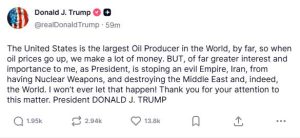
“When oil prices go up, we make a lot of money,” Trump wrote in a post on his Truth Social platform.
“But of far greater interest and importance to me, as President, is stopping an evil Empire, Iran, from having nuclear weapons.”
Trump also told supporters that the United States had already inflicted severe damage on Iran but promised to “finish the job”.
International concerns over Hormuz crisis
The conflict has raised alarm internationally because of the risk to global energy supplies.
The Strait of Hormuz, linking the Gulf to the Indian Ocean, carries a substantial share of the world’s crude oil exports.
With maritime traffic severely disrupted, global energy markets have experienced sharp volatility.
German Foreign Minister Johann Wadephul said the situation could only be resolved through diplomacy.
“A reliable and sustainable solution can only be achieved through diplomatic channels,” he said during a visit to Turkiye.
Security analysts say the new Iranian leader’s statement signals a continuation of Tehran’s existing strategy.
Rob Geist Pinfold, a lecturer in international security at King’s College London, said Khamenei’s message largely repeated Iran’s established positions.
“This is very much the repetition of the standard Iranian lines,” he told Al Jazeera.
Pinfold said the message emphasised that Iran does not intend to back down, that the Strait of Hormuz should remain closed, and that US bases in the region must be removed.
“Rather than what the Trump administration might have been hoping for – a change in rhetoric – what we’re actually hearing here is more of the same,” he said.