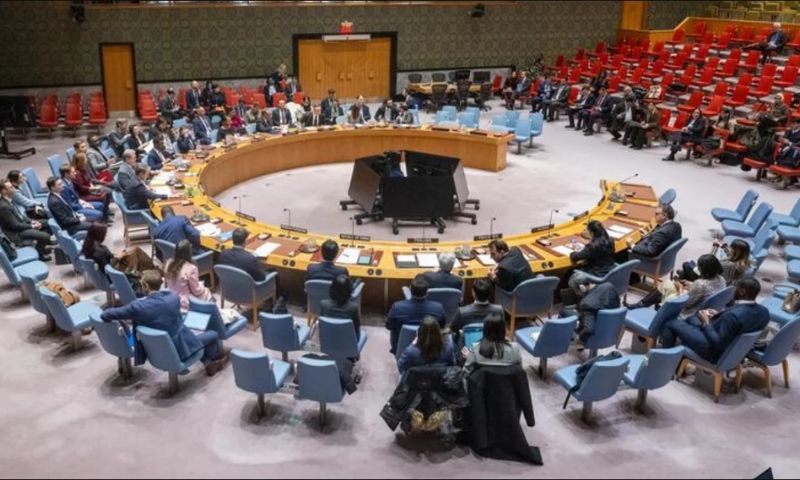
NEW YORK: The United Nations Security Council has adopted a resolution condemning Iran for its recent attacks on countries in the Gulf region, describing the actions as violations of international law and a threat to regional stability.
The resolution, passed by 13 votes with two abstentions, “demands the immediate cessation of all attacks by the Islamic Republic of Iran against Bahrain, Kuwait, Oman, Qatar, Saudi Arabia, the United Arab Emirates, and Jordan.”
It also “condemns any actions or threats Iran aimed at closing, obstructing, or otherwise interfering with international navigation through the Strait of Hormuz.”
The resolution reflects growing concern among members of the international community over escalating tensions in the Gulf and the potential risks to global security. Council members emphasised the importance of respecting international norms and safeguarding peace in the strategically vital region.
The resolution called on Iran to immediately halt its hostile activities and avoid further escalation that could destabilise the region. It also urges all parties to pursue diplomatic engagement and dialogue to resolve their differences peacefully.
The move comes amid rising tensions following missile and drone attacks targeting several Gulf states, prompting heightened security concerns across the region. The Security Council stressed that maintaining stability in the Gulf remains critical for international peace, global energy security, and the protection of civilian populations.
US vetoes Russian UNSC resolution on Iran war
Meanwhile, the US vetoed a Russian-drafted resolution addressing the military escalation in the Middle East, preventing its adoption by the UN Security Council.
The resolution received four votes in favor—from Russia, China, Somalia, and Pakistan—while the United States and Latvia voted against it.
Nine members abstained, including the United Kingdom, France, Bahrain, Colombia, Democratic Republic of Congo, Denmark, Greece, Liberia, and Panama.
Iran slams ‘misuse’ of UN Security Council after vote to stop Gulf attacks
Iran’s ambassador to the United Nations criticised as politically motivated a resolution passed by the Security Council that demanded an immediate halt to Iranian attacks on Gulf states.
“Today’s action represents a blatant misuse of the Security Council mandate in pursuit of the political agendas of the certain members, the various states responsible for the brutal war of aggression against my country,” Amir Saeid Iravani told the Council.
Iran threatens to target US-Israeli economic interests
Earlier, Iran warned it will target economic and financial interests linked to the United States and Israel across the region after an overnight attack on one of its major banks, escalating tensions in the widening Middle East conflict.
A spokesperson for Iran’s central operational military command, Khatam al-Anbiya, said on Wednesday that Tehran now considers banks and economic centres associated with Washington and Israel as legitimate targets.
“The enemy has given us free rein to target economic centres and banks belonging to the United States and the Zionist regime,” the command said in a statement carried by Iranian state television.
The warning came after an administrative building linked to Bank Sepah, one of Iran’s largest state-owned banks, was struck overnight in Tehran, according to the semi-official Mehr news agency.
Iran seeks int’l guarantees against future attacks
Iranian President Masoud Pezeshkian has outlined Tehran’s conditions for ending the war, saying the country expects reparations and firm guarantees against any future attacks.
In a post on X he said that he had spoken with the leaders of Russia and Pakistan and “reaffirmed Iran’s commitment to peace in the region.”
He went on to say: “The only way to end this war — ignited by the Zionist regime & US — is recognizing Iran’s legitimate rights, payment of reparations, and firm [international] guarantees against future aggression.”
Strait of Hormuz tensions
Iran has also escalated threats around the Strait of Hormuz, a critical global oil shipping route.
Iran’s military warned that ships belonging to the United States, Israel or their allies passing through the strait could be targeted, according to AFP.
Separately, Alireza Tangsiri, commander of the Islamic Revolutionary Guard Corps (IRGC) Navy, said vessels must obtain permission from Iran before transiting the waterway.