


ISLAMABAD: Pakistan has reiterated its firm commitment to support Saudi Arabia amid rising tensions in the Middle East, with a senior government spokesperson saying Islamabad would stand by Riyadh “no matter what, no matter when”.
Prime Minister’s Spokesperson for Foreign Media Mosharraf Zaidi made the remarks in an interview with Bloomberg TV on Wednesday when asked whether Pakistan would come to Saudi Arabia’s aid amid the conflict triggered by recent US and Israeli strikes on Iran.
“The question is not whether Pakistan might come to Saudi Arabia’s aid,” Zaidi said.
“Both countries, even before the strategic mutual defence agreement, have operated on a principle of being there for the other before they need the other.”
“So, there is no question that we might; we will. No matter what, no matter when,” he added.
Big: Pakistan vows unconditional support for Saudi Arabia against Iran amidst rising tensions!
In a Bloomberg TV interview, PM’s spokesperson Mosharraf Zaidi declared:
“There is no question — we might, we will [come to Saudi Arabia’s aid] no matter what and no matter when.” pic.twitter.com/pp3FWXL3qy
— Megh Updates 🚨™ (@MeghUpdates) March 11, 2026
Longstanding strategic partnership
Pakistan and Saudi Arabia maintain close strategic, economic and defence ties that have evolved over decades.
Riyadh has long been a key source of financial assistance and energy supplies for Pakistan, while military cooperation between the two countries has remained strong.
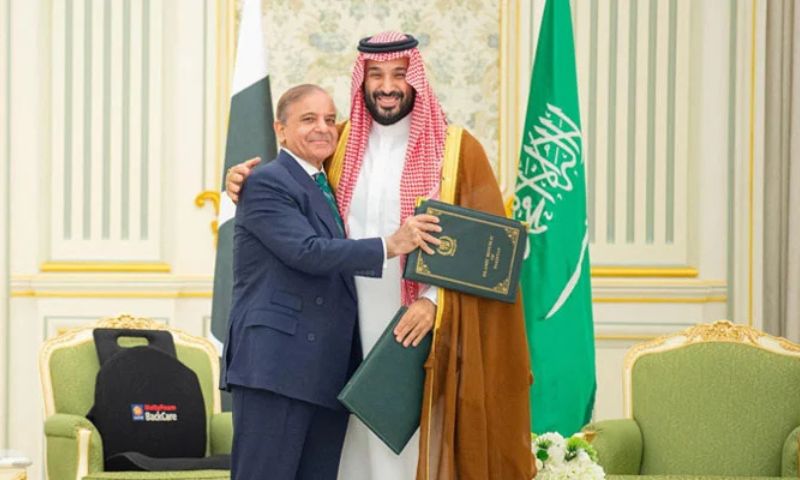
In September last year, Pakistan’s Prime Minister Shehbaz Sharif and Saudi Crown Prince and Prime Minister Prince Mohammed bin Salman signed a Strategic Mutual Defence Agreement in Riyadh.
Under the agreement, any attack on either country would be treated as an act of aggression against both.
Zaidi said the relationship between the two countries went beyond formal arrangements.
“Saudi Arabia has already made arrangements to support Pakistan’s supply chain stability in terms of oil, diesel and crude,” he said.
“Both countries are tied to each other, formally and informally.”
As the Iran conflict escalates, Pakistan’s longstanding defense pact with Saudi Arabia is under renewed scrutiny. On Insight with @haslindatv, Mosharraf Zaidi, the Pakistani Prime Minister’s Spokesperson for Foreign Media, stresses that Pakistan’s support for Riyadh is… pic.twitter.com/Jqxov4n65d
— Bloomberg (@business) March 11, 2026
Diplomatic efforts to prevent escalation
Zaidi said Pakistan was actively engaged with regional and global partners to prevent the conflict from escalating further.
He recalled the recent visit of Pakistan’s Chief of Defence Forces and Chief of the Army Staff Field Marshal Asim Munir to Saudi Arabia, where he met Saudi Defence Minister Prince Khalid bin Salman to discuss the situation.
Pakistan has also remained in contact with Iranian leaders.
According to Zaidi, Deputy Prime Minister and Foreign Minister Ishaq Dar has held several conversations with Iranian Foreign Minister Abbas Araghchi in recent weeks.
“These conversations and others are the reasons why you have seen conciliatory efforts that Iran has made towards Gulf countries,” Zaidi said.
He added that Pakistan maintained communication with all countries involved.
“We don’t like our friends getting into quarrels with each other, and we certainly don’t like innocent people dying needlessly,” he said.
Zaidi also noted that Pakistan appreciated the restraint shown by Gulf states, which have so far avoided direct involvement in the conflict despite external pressure.
“One of the things Pakistan admires is the way Saudi Arabia and other Gulf states have resisted being drawn in,” he said.
Pakistan monitoring fuel situation
Zaidi also addressed the global fuel market disruption caused by the conflict.
He said Pakistan’s fuel situation remained “stable to good” despite rising international prices.
The government had recently increased petrol and diesel prices to prepare for possible supply disruptions, he said.
“That decision hit consumers really hard,” Zaidi acknowledged, adding that it was taken to prevent potential shortages.
“Our task is to ensure that, no matter what the price, the Pakistani consumer should not have to face any kind of dangerous shortage of fuel supply,” he said.
He explained that alternative supply chains could extend delivery times from the usual five or six days to nearly three weeks.
“That really creates a gap,” he said.
To manage the crisis, the government has introduced austerity measures including a four-day work week, remote working arrangements and a reduction in the use of official vehicles.
“Every crisis is an opportunity for change,” Zaidi added.
Naval escorts limited to Pakistani waters
Zaidi also dismissed suggestions that Pakistan could escort commercial vessels through the Strait of Hormuz, a key maritime route through which about one-fifth of global crude oil supplies normally pass.
He said Pakistan’s navy was currently focused on securing the country’s own maritime domain.
“First and foremost, Pakistan is responsible for its own territory, and that includes our maritime naval domain,” he said.
The Pakistan Navy is already providing escorts to commercial vessels within Pakistani waters, he said.
Any broader escort mission would have to take place within a multilateral framework.
“The Strait of Hormuz is tricky, and we are nowhere near making any sort of support missions for such escorts at this time,” Zaidi said.
He added that authorities were closely monitoring the security situation and ensuring the safety of shipping in Pakistan’s maritime zone over the past several days.
Pakistan’s position, he said, remains focused on preventing further escalation while maintaining strong strategic ties with its regional partners.