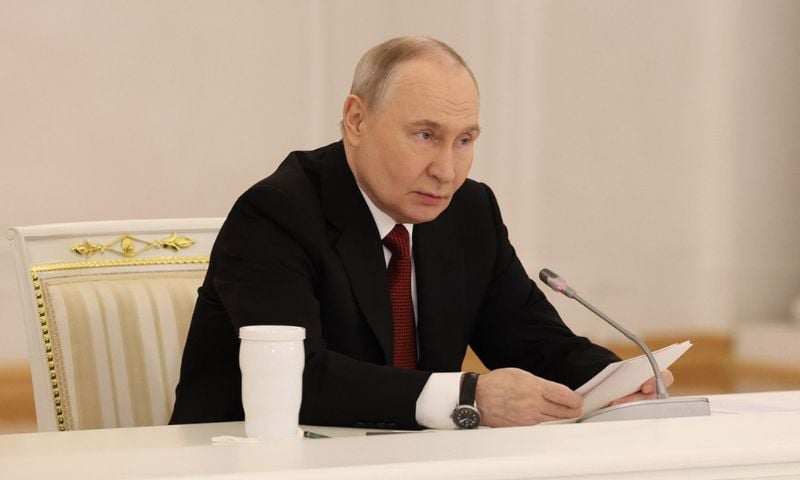



MOSCOW: Russian President Vladimir Putin said Monday that Russia would supply oil and gas to European buyers, provided such co-operation was “long-term” and did not put political pressure on Moscow.
Oil prices have skyrocketed since the United States and Israel began striking Iran on February 28, trading above $100 this week for the first time since the Russia-Ukraine war started in 2022.
In a televised meeting, Putin said Moscow would continue to supply oil to “reliable” partners in Asia, as well as EU members Hungary and Slovakia.
“If European companies and European buyers suddenly decide to reorient themselves and provide us with long-term, sustainable cooperation, devoid of political pressures, free from political pressures, then go ahead. We’ve never refused,” Putin said.
“We’re ready to work with Europeans, but we need some signals from them that they’re ready and willing to work with us and will ensure this sustainability and stability,” he added.
The European Union banned maritime imports of Russian crude in 2022, while Russia’s pipeline exports to Hungary and Slovakia have been halted since January due to damage to the Druzhba oil pipeline via Ukraine.
Putin’s comments came hours after Hungarian Prime Minister Viktor Orban urged the European Union to suspend sanctions on Russian oil and gas to counter prices sent soaring by the war in the Middle East.
G7 ‘not there yet’ on release of oil reserves
Meanwhile, France’s finance minister said the G7 was “not there yet” in terms of any release of strategic oil reserves.
Earlier Monday, French President Emmanuel Macron, whose country holds the rotating presidency of the Group of Seven advanced economies, said the G7 would this week discuss a possible release of strategic oil reserves.
A possible meeting of G7 leaders on the energy issue could take place this week, Macron told journalists on his way to Cyprus.
However, speaking to reporters after chairing a video meeting of G7 finance ministers, French Finance Minister Roland Lescure said the group was “not there yet”.
Asked if they had agreed on releasing stockpiles to lower prices, Lescure said from Brussels: “What we’ve agreed upon is to use any necessary tools, if need be, to stabilise the market, including the potential release of necessary stockpiles.”
Such a measure can only be effective if it is implemented in a “coordinated” manner, Lescure added.
The war triggered by US-Israeli strikes on Iran is fuelling fears for the global economy, with global stock markets sinking and oil rocketing above $100 a barrel.
The Financial Times reported earlier Monday that the finance ministers of the G7, which also includes Canada, Germany, Italy, Japan, the United Kingdom and the United States, were scheduled to discuss a joint release of strategic oil reserves coordinated by the International Energy Agency (IEA).
The report said three G7 countries, including the United States, had so far backed the idea.
France is also seeking to put together a meeting of G7 energy ministers that would take place on the sidelines of a nuclear energy summit in Paris on Tuesday.
“I wanted us to be able to mobilise close coordination at the G7 level to better manage energy issues,” said Macron.
A G7 release of strategic oil reserves “would offset around 2 to 3 weeks of normal Strait of Hormuz flows”, said Lee Hardman, a senior currency analyst at Japanese bank MUFG.
“It would be a temporary fix to help prevent an even more disruptive surge in the price of oil in the coming weeks,” he added.