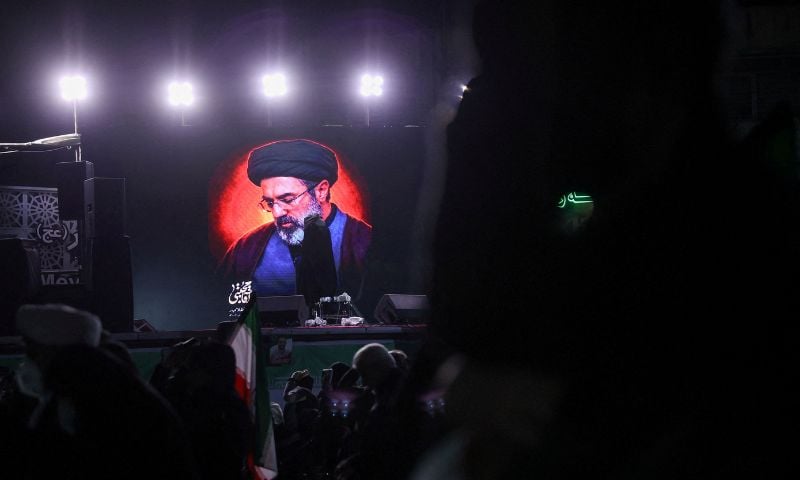



BEIJING: China said on Monday that it opposes any attempt to target Iran’s newly appointed Supreme Leader Mojtaba Khamenei, stressing that the leadership decision is an internal matter for Tehran.
According to AFP, Beijing made the remarks after Iran named Mojtaba Khamenei as the country’s new supreme leader following the killing of his father, Ali Khamenei, during the initial wave of US and Israeli strikes on Iran.
Israel’s military has warned that it could target any successor to the former Iranian leader. Meanwhile, US President Donald Trump previously dismissed Mojtaba Khamenei as a “lightweight” and said Washington should have a role in selecting Iran’s next leader.
Speaking to reporters, Chinese foreign ministry spokesman Guo Jiakun said Iran’s decision to appoint Mojtaba Khamenei was “based on its constitution”.
“China opposes interference in other countries’ internal affairs under any pretext, and Iran’s sovereignty, security, and territorial integrity should be respected,” Guo said when asked about threats directed at the new Iranian leader.
Repeated strikes
The remarks came as the conflict between Iran, Israel and the United States continued to intensify. Israel and US forces have carried out repeated strikes on Iranian targets in recent days, while Tehran has responded with missile and drone attacks on Israel and Gulf countries.
China, which maintains close ties with Iran, previously condemned the killing of the former supreme leader. At the same time, Beijing has also criticised Iranian strikes against Gulf states.
China’s special envoy to the Middle East Zhai Jun called for de-escalation during talks with Saudi Foreign Minister Prince Faisal bin Farhan on Sunday.
“China urges all parties to immediately cease military operations, prevent further escalation of tensions, and avoid causing greater harm to the people of regional countries,” Zhai said.
Global energy markets
Chinese Foreign Minister Wang Yi also commented on the conflict, stating that the war “should never have happened” and urging all sides to end the fighting.
The ongoing conflict has raised concerns over global energy markets and trade routes, including the Strait of Hormuz, a key transit point for oil shipments.
Data from analytics firm Kpler shows that more than 80% of Iranian oil exports were shipped to China last year. However, this represented only about 13% of China’s total seaborne oil imports.
At the same time, more than half of China’s total seaborne crude imports originate from the broader Middle East region, highlighting Beijing’s heavy reliance on oil shipments passing through the Strait of Hormuz.