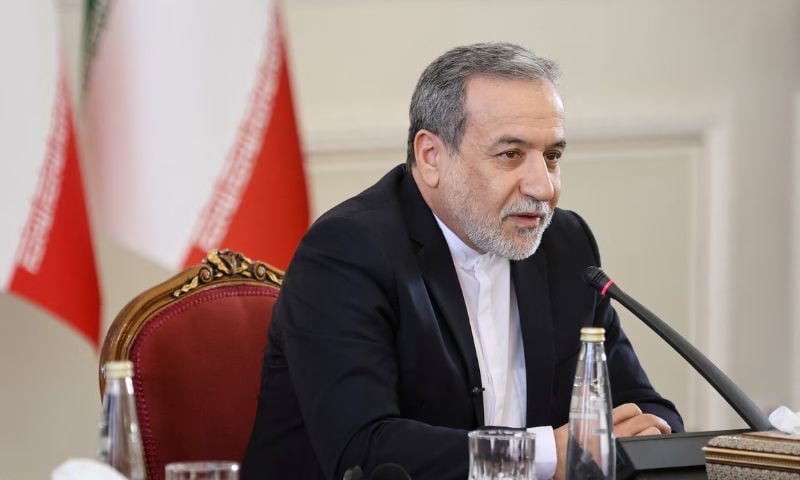



TEHRAN, Iran: Iran’s foreign minister on Sunday rejected calls for a ceasefire in the ongoing conflict with the United States and Israel, saying Tehran would continue fighting until the war ends permanently.
Speaking to NBC’s programme Meet the Press, Iranian Foreign Minister Abbas Araghchi said the war could not end through temporary pauses in fighting.
“There needs to be a permanent end to the war,” Araghchi told NBC. “Unless we get to that, I think we need to continue fighting for the sake of our people and our security.”
He accused the United States and Israel of attacking civilian targets. “They are killing our people, they are killing girl students, you know, they are attacking hospitals,” he said.
Araghchi added that Washington and Tel Aviv had already violated a ceasefire that ended last year’s brief conflict.
“They already shattered the ceasefire that ended last year’s 12-day war,” he said. “And now you want to ask for a ceasefire again? This doesn’t work like this.”
Iran rejects US role in leadership transition
Araghchi also rejected remarks by US President Donald Trump suggesting he should play a role in selecting Iran’s next supreme leader following the killing of Ayatollah Ali Khamenei during the February 28 strikes.
“We allow nobody to interfere in our domestic affairs,” Araghchi said.
“This is up to the Iranian people to elect their new leader.”
Iran’s Assembly of Experts, the body responsible for appointing the supreme leader, has reportedly agreed on a candidate but has not yet announced a name, according to Iranian state media.
“Nobody knows,” Araghchi said when asked who might replace Khamenei. “There are lots of rumours around. But we have to wait for the Assembly of Experts to convene.”
Araghchi also called on Trump to apologise for the war.
“Trump should apologise to the people of the region and the Iranian people for the killings and destruction they have done against us,” he said.
Iran apologises to Gulf neighbours
Iranian President Masoud Pezeshkian sought to calm tensions with Gulf states following Iranian strikes on several Gulf countries.
Speaking on Saturday, Pezeshkian said Iran would not attack neighbouring countries unless they facilitated US or Israeli operations against Tehran.
He also apologised for the impact of Iranian strikes.
“I personally apologise to neighbouring countries that were affected by Iran’s actions,” Pezeshkian said.
Araghchi said Iran had not deliberately targeted neighbouring countries.
“We are attacking American bases, American installations, American assets, which are unfortunately located in the soils of our neighbours,” he said.
He added that the president had apologised for “the inconveniences they have faced because of this aggression by the United States and retaliation by us”.
Pezeshkian warned that Iran would respond if any neighbouring state allowed attacks on its territory.
“Responding does not mean we have disputes with that country or wish to harm its people — we would be responding out of necessity,” he said in remarks broadcast by Iranian state television.
Missile, drone strikes on Gulf countries
The conflict has spread across the Middle East, with missile and drone strikes reported in several countries.
Saudi Arabia’s defence ministry said its air defences intercepted 15 drones that attempted to strike targets including the diplomatic quarter in the capital Riyadh.
In Kuwait, two border guards were killed while on duty, the interior ministry said. The military reported that fuel tanks at Kuwait International Airport were targeted in a drone attack.
Bahrain said three people were wounded by falling missile debris and a desalination plant was damaged.
The United Arab Emirates said its air defences detected 17 ballistic missiles on Sunday and intercepted 16 of them, while one fell into the sea.
Explosions were also reported in the UAE capital Abu Dhabi, witnesses told AFP.
Iranian missile attacks on Israel
In Israel, six people were wounded at blast sites in central areas after new Iranian missile launches, first responders said.
Earlier, at least ten explosions were heard over Tel Aviv after incoming missiles were detected, AFP reported.
Lebanon’s health ministry said Israeli strikes over the past week have killed 394 people, including 83 children and 42 women.
The minister also said nine rescue workers were among the dead and condemned attacks on ambulances and medical teams.
In southern Lebanon, eight people were killed in strikes on more than 20 towns and villages, authorities said.
Attacks across Iran
Inside Iran, explosions were reported in several regions as US and Israeli strikes continued.
State media said blasts were heard in Yazd province in central Iran, though it was not immediately clear what targets had been hit.
Earlier explosions were reported in Tehran and in Isfahan province.
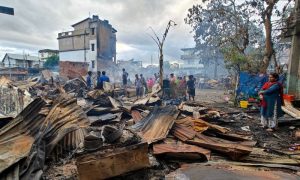
Fuel distribution in Tehran was temporarily halted after strikes hit five depots in and around the capital, officials said.
Large fires burned across the affected areas, sending thick smoke across parts of the city.
Iran’s Revolutionary Guards said the country’s forces could sustain an “intense war” for six months and warned that more advanced missiles would be deployed in the coming days.