WASHINGTON: A classified assessment by the US National Intelligence Council (NIC) concluded that even a large-scale US military campaign against Iran would be unlikely to dismantle the country’s deeply entrenched clerical and military establishment, The Washington Post reported, citing officials familiar with the document.
The intelligence analysis, prepared shortly before the United States and Israel launched military operations against Iran on February 28, examined various scenarios ranging from targeted strikes on Iranian leaders to broader attacks on state institutions.
In each case, analysts concluded that Iran’s political and military structures are resilient enough to preserve continuity of power.
Iran’s structure seen as resilient
The National Intelligence Council — a body that synthesizes intelligence from all 18 US intelligence agencies — assessed that even if Iran’s top leadership were eliminated, established mechanisms within the country’s system would ensure a succession process to maintain governance.
Sources familiar with the report indicated that Iran’s clerical leadership and the powerful Islamic Revolutionary Guard Corps (IRGC) would likely follow institutional protocols designed to prevent a collapse of authority.
The intelligence findings also suggested that Iran’s fragmented opposition groups lack the organization and influence needed to take control of the country in the event of leadership disruption.
Questions over the power structure change strategy
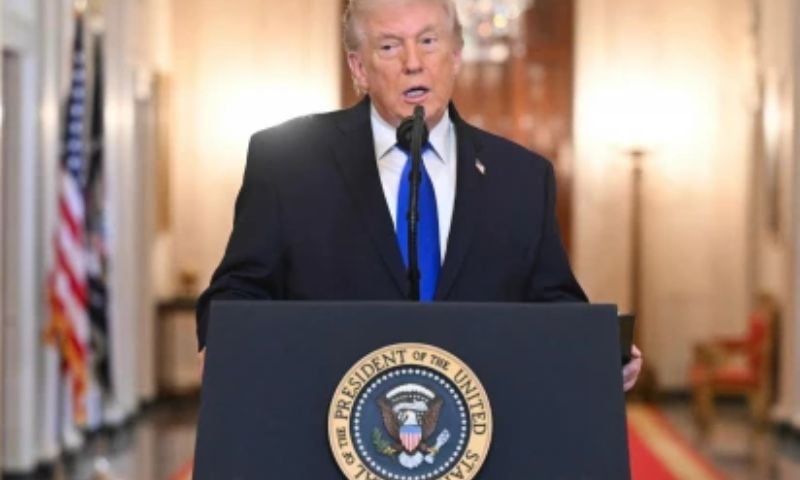
The assessment raises doubts about US President Donald Trump’s stated objective of removing Iran’s leadership and installing a new government aligned with Washington.
While the Trump administration has described its military campaign — reportedly called “Operation Epic Fury” — as only the beginning of broader efforts to weaken Tehran’s military capabilities, intelligence analysts warn that regime change through military force may be far more difficult than expected.
White House officials have said the operation aims to destroy Iran’s missile infrastructure, dismantle its naval capabilities, prevent support for regional proxy groups, and stop Tehran from acquiring nuclear weapons.
Regional tensions intensify
The conflict escalated dramatically after US and Israeli airstrikes reportedly killed Iran’s Supreme Leader Ayatollah Ali Khamenei and several senior officials. Tehran responded with missile and drone attacks targeting US military bases and facilities across the Gulf region.
Despite the assassination of key leaders, Iran quickly activated its succession mechanisms. Under Iran’s political system, the Assembly of Experts is responsible for selecting a new supreme leader, while senior security institutions continue to maintain stability during transitions.
Limited signs of internal revolt
US officials and analysts say there is currently little evidence of a widespread uprising within Iran that could threaten the ruling system. Recent protests in Iran were met with a strong response from security forces, reportedly resulting in numerous casualties and weakening organized opposition groups.
Experts note that Iran’s leadership is driven by ideological cohesion and a strong security apparatus, making it resistant to external pressure.
War’s outcome remains uncertain
As the conflict enters its second week, the intelligence report highlights the uncertainty surrounding the long-term outcome of the war. While US and Israeli forces continue air and naval operations against Iranian targets, analysts suggest that military pressure alone may not be enough to dismantle Iran’s entrenched political structure.
The report ultimately concludes that no internal faction currently appears capable of challenging the regime’s remaining power, suggesting that Iran’s clerical and military establishment could survive even a prolonged war.