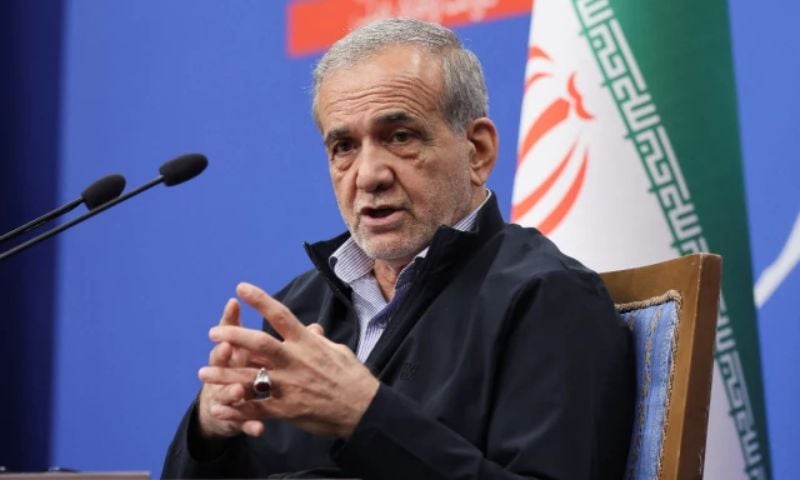
TEHRAN: Iranian President Masoud Pezeshkian said on Saturday that Iran would not target neighbouring countries unless attacks against the country originated from their territory during the ongoing conflict with the United States and Israel.
“The interim leadership council agreed yesterday that no more attacks will be made on neighbouring countries and no missiles will be fired unless an attack on Iran originates from those countries,” Pezeshkian said in a speech broadcast on state television.
During the same address, the Iranian president apologised for strikes that had affected neighbouring states during the conflict. “I apologise… to the neighbouring countries that were attacked by Iran,” he said, stressing Tehran’s intention to avoid further escalation beyond its borders.
The interim leadership council has been overseeing the country since US and Israeli strikes killed Supreme Leader Ayatollah Ali Khamenei last week, triggering a wider conflict across the Middle East.
Iran also confirmed that a new supreme leader would be chosen through the country’s constitutional process and “without any foreign interference.” Iran’s ambassador to the United Nations, Amir Saeid Iravani, said the decision would be taken “solely by the will of the Iranian people.”
Unconditional surrender
The statement followed remarks by US President Donald Trump, who demanded Tehran’s “unconditional surrender” and suggested Washington should play a role in determining Iran’s next leader. His comments came after Pezeshkian hinted on social media that several countries had begun mediation efforts aimed at resolving the conflict.
“There will be no deal with Iran except UNCONDITIONAL SURRENDER!” Trump wrote on Truth Social on Friday. “After that, and the selection of a GREAT & ACCEPTABLE Leader(s), we, and many of our brave allies and partners, will work tirelessly to bring Iran back from the brink of destruction, making it economically bigger, better, and stronger than ever before,” he added.
The conflict has had a severe humanitarian impact. “We’re sleeping here in the streets—some in cars, some on the street, some on the beach,” said Jamal Seifeddin, 43, who fled Beirut’s southern suburbs.
The Norwegian Refugee Council estimates that about 300,000 people have been displaced, while Lebanese authorities say 123 people have been killed and 683 wounded in Israeli strikes.
Financial markets
Financial markets have also reacted sharply. European and US stock markets declined, while oil prices surged to multi-year highs as the Strait of Hormuz—a route through which around one-fifth of the world’s daily oil supply passes—has effectively been closed.
Washington said it would provide reinsurance coverage of up to $20 billion in the Gulf to support oil and gas shipments, and Trump suggested the US Navy could escort vessels through the region.
Iran’s Revolutionary Guards responded that Tehran “welcomes” any US presence, while reports indicate Russia is supplying intelligence to Iran regarding US military movements.
Tehran has described the war as an unprovoked attack and characterised the killing of Khamenei as an assassination.
Weapons production
Meanwhile, the Trump administration has accelerated weapons production as military stockpiles diminish. On Friday, Trump met executives from seven defence contractors to speed up output.
White House spokesperson Karoline Leavitt said the United States still has sufficient weapons for the campaign, which is expected to continue for four to six weeks.
The US State Department has also approved $151.8 million in munitions sales to Israel under emergency procedures, bypassing the usual congressional review.
Separately, US military investigators are examining a strike on an Iranian girls’ school that killed dozens on the first day of the war. Officials told Reuters it is likely that US forces carried out the strike, although a final conclusion has not yet been reached.