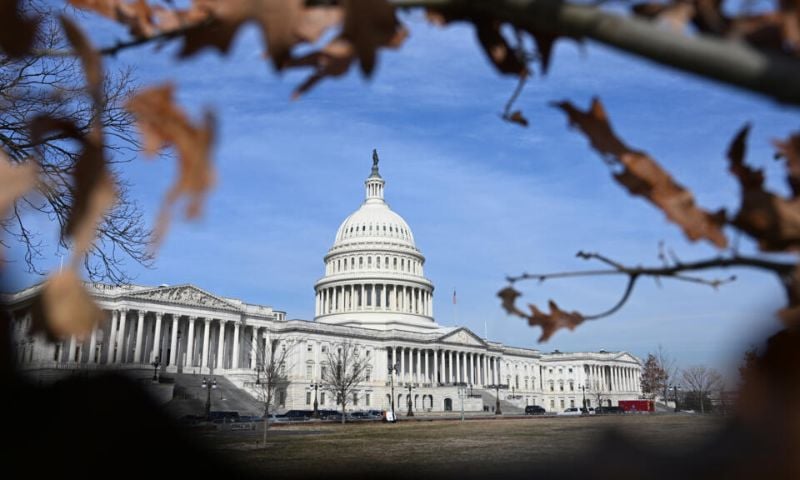



WASHINGTON: The US Congress is set to debate fresh efforts to limit President Donald Trump’s authority to expand military operations against Iran without formal approval from lawmakers, as political divisions sharpen over escalating hostilities in the Middle East.
In the Senate, Tim Kaine has introduced a resolution under the War Powers Resolution of 1973, legislation originally passed during the Vietnam War to check unilateral presidential war-making powers. If approved, the measure would require the administration to end US military involvement against Iran unless Congress explicitly authorises it.
“The Constitution is clear that Congress must vote before the nation goes to war,” Kaine said, urging lawmakers to reconvene and formally debate the issue, citing risks to American troops.
In the House of Representatives, a bipartisan proposal led by Ro Khanna and Thomas Massie similarly calls for the withdrawal of US forces from hostilities with Iran unless lawmakers grant approval.
What happened to the peace president? What happened to bringing costs down?
@SenTimKaine pic.twitter.com/MUhqkVI8Hx— Senate Democrats (@SenateDems) March 3, 2026
However, a more measured approach has emerged from centrist Democrats, including Josh Gottheimer, who stopped short of demanding an immediate halt to military operations but stressed the need for the president to comply with existing war powers law and consult Congress.
The debate follows coordinated US and Israeli strikes targeting Iranian military and political facilities, an escalation that reportedly caused American casualties and heightened fears of a wider regional conflict.
Democratic leaders have largely framed their concerns around congressional oversight rather than immediate disengagement. Senate Minority Leader Chuck Schumer called for transparency from the administration, urging Secretary of State Marco Rubio to clarify the objectives of the strikes and outline next steps.
Trump: The goal for Iran is regime change
Hegseth: This is not a so-called regime change war
Rubio: This is about crippling Iran’s missilesIt was “defensive.” Then it was “preemptive.” Which is it?
People don’t want another aimless war of choice in the Middle East.
Americans…
— Chuck Schumer (@SenSchumer) March 3, 2026
House Minority Leader Hakeem Jeffries echoed that demand, insisting the administration provide a clear national security justification and a strategy to avoid a prolonged military entanglement.
Progressive lawmakers have taken a firmer stance. Senators Bernie Sanders and Jeff Merkley publicly opposed military escalation, declaring their resistance to war with Iran.
Yet the Democratic Party remains divided. Senator John Fetterman dismissed the Senate resolution as symbolic, saying it was unnecessary and unlikely to alter policy.
Among Republicans, backing for the president appears strong. Senator Tom Cotton, who chairs the Senate Intelligence Committee, predicted broad Republican support for the administration’s actions. Still, Massie argued that deeper involvement in the conflict contradicts the “America First” principles associated with Trump’s foreign policy stance.
Senator Mark Warner, the leading Democrat on the Senate Intelligence Committee, questioned the clarity of the administration’s objectives, suggesting that stated goals had shifted multiple times.
Even if either chamber approves a resolution, overriding a potential presidential veto would require a two-thirds majority in both the House and Senate – a high bar given Republican control of Congress.
The current push mirrors a 2020 congressional effort to limit presidential war powers following the US strike that killed Iranian General Qasem Soleimani, an attempt that ultimately failed to curb executive authority.
As tensions persist and partisan divides deepen, the upcoming votes will serve as a critical test of Congress’s willingness to assert its constitutional authority over matters of war.