
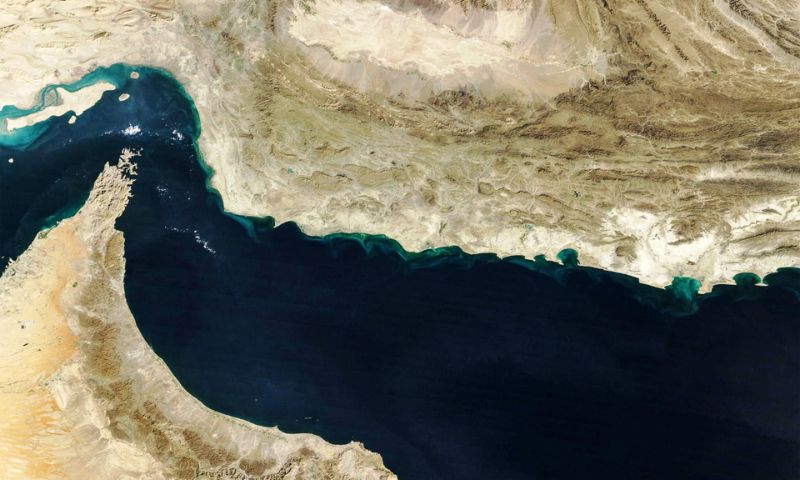
LONDON/DUBAI: Oil and gas shipping through the Strait of Hormuz has slowed dramatically, with dozens of tankers halting, diverting or reversing course after Iranian media reported the strategic waterway was “practically closed” following U.S and Israeli strikes on Iran.
Multiple vessels reported receiving VHF radio broadcasts purportedly from Iran’s navy and the Islamic Revolutionary Guard Corps (IRGC) stating that transit through the strait was banned.
While Tehran has not issued a formal legal declaration closing the passage, shipping companies and maritime authorities are treating the situation as a de facto shutdown.
The Strait of Hormuz, which links the oil-rich Arabian Gulf to the Gulf of Oman and the Arabian Sea, handles roughly 20% of the world’s seaborne crude oil and liquefied natural gas (LNG) flows each day. Even temporary disruption is considered seismic for global energy markets.
Tankers turn back, traffic thins
Ship-tracking data showed oil tankers piling up on both sides of the strait. At least three vessels halted outbound journeys from the Arabian Gulf, while a flotilla of eight or more tankers accumulated outside the Gulf of Oman over the past two weeks. Others aborted voyages mid-transit.
The very large crude carrier KHK Empress, part-loaded with Omani crude and originally bound for Basra, made a U-turn in the strait and reset its destination to New Mangalore, India. The tanker Desh Abhimaan also appeared to reverse course midway through Hormuz, according to the Japan Times.

The supertanker Shaden stopped while approaching the strait with Saudi crude, while the Chinese-owned New Vision appeared to continue outward transit despite erratic speed signals. By late Saturday London time, tracking systems still showed limited two-way tanker movement, though volumes were far below normal levels.
LNG shipments at risk
Hormuz is also a vital corridor for LNG exports, particularly from Qatar, the world’s second-largest LNG exporter. At least 14 LNG carriers have shown signs of slowing, halting or U-turning near the strait, raising concerns about supply risks to Asian and European buyers.
Qatar accounts for around 20% of global LNG exports, and all its shipments must transit Hormuz to reach open seas.
Shipping giants suspend transit
Major shipping and energy companies have begun suspending operations in the region. Hapag-Lloyd AG said it was halting all vessel transit through the Strait of Hormuz until further notice, citing the “official closure.”
AP Moller – Maersk A/S said it was coordinating with security partners, though cargo acceptance in the Middle East remained open. France’s CMA CGM instructed vessels in or heading toward the Gulf to seek shelter.
Tanker owners, oil majors and trading houses have suspended crude, fuel and LNG shipments via Hormuz, according to trading sources. Satellite imagery showed vessels backed up near major hubs including Fujairah in the United Arab Emirates.
Conflicting advisories
According to Reuters, an official from the EU naval mission Aspides said vessels had received transmissions from Iran’s Revolutionary Guards declaring that “no ship is allowed to pass the Strait of Hormuz.” However, the official noted Iran had not formally confirmed such an order.
The British Navy said any such Iranian broadcast was not legally binding but advised vessels to transit with caution.
The United States warned commercial ships to remain at least 30 nautical miles away from its military assets in the region, while the U.S. Navy indicated it could not guarantee safe navigation across the Gulf, Gulf of Oman, North Arabian Sea and Hormuz.
Greece’s shipping ministry urged vessels to avoid the region and advised readiness to use conventional navigation methods in case of electronic interference. Japan’s Nippon Yusen also instructed its fleet to avoid the strait.
Oil prices jump
With futures markets closed over the weekend, price discovery was limited. However, a retail trading product run by IG Group indicated U.S. benchmark West Texas Intermediate crude was trading more than 8% higher Saturday evening in London.
Energy traders cautioned that the market response next week will depend on whether disruptions widen, including potential retaliatory strikes by Iran or port shutdowns in the Gulf.
Legal and commercial fallout
Some shipowners are reportedly considering invoking war-risk clauses in charter contracts to cancel voyages to the Middle East, which could further tighten vessel availability and sustain elevated freight rates that have already climbed to multi-year highs. While traffic through Hormuz has not completely stopped, shipbroker assessments describe disruptions as building rapidly.
Maritime risk analysts say prolonged interruption would have far-reaching consequences for oil supply chains, LNG deliveries, insurance costs and global inflation.
For now, uncertainty persists as military tensions soar between the United States, Israel and Iran, and shipping companies continue to await clearer guidance from Tehran and international maritime authorities on the status of the world’s most critical energy chokepoint.
What is the Strait of Hormuz?
The Strait of Hormuz is a narrow but strategically crucial waterway connecting the Arabian Gulf with the Gulf of Oman and, ultimately, the Arabian Sea. It serves as the main maritime outlet for oil and gas exports from Gulf countries.
Importance: About 20% of the world’s seaborne oil and a large share of liquefied natural gas (LNG) pass through it daily. Saudi Arabia, Iran, Iraq, Kuwait, United Arab Emirates (UAE), Qatar, and other international traders rely on it.
Legal ownership and status
It is not owned by any single country.
International straits rules: According to the United Nations Convention on the Law of the Sea (UNCLOS), straits used for international navigation allow “transit passage”, meaning ships and aircraft of all nations can pass through sovereign waters without obstruction as long as they comply with international law.
Bordering countries: Iran controls the northern coast and some waters, while Oman controls the southern coast. Both exercise some sovereignty over territorial waters (up to 12 nautical miles from their coastlines).
Key point: Even though Iran and Oman have territorial claims along the coasts, the strait itself is internationally recognized for free passage, and no nation “owns” it outright.
Geography and dimensions
Its length is 39 kilometers (24 miles) wide at its broadest point, while its narrowest point is 33 kilometers (21 miles) wide.
Shipping lanes: There are designated inbound and outbound lanes, each about 2–3 kilometers wide, separated by a buffer zone to prevent collisions.
Its depth varies between 60 to 120 meters, deep enough for large oil tankers and LNG carriers.
Summary
The Strait of Hormuz is a narrow international waterway of immense strategic importance. It lies between Iran and Oman, and while the bordering nations exercise control over their coastal waters, no single country owns the strait. International law guarantees passage for global shipping, making it a critical chokepoint for energy exports.