
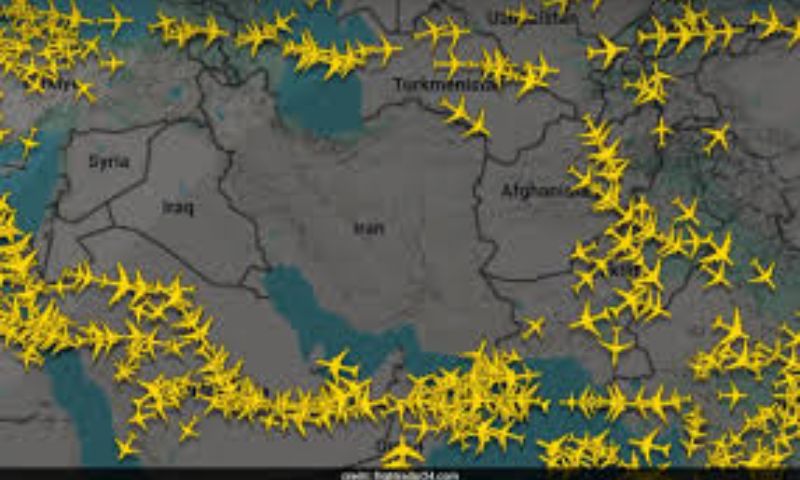



ISLAMABAD: Global air travel has been thrown into chaos following the outbreak of a major military conflict centered on Iran involving strikes by the United States and Israel and swift Iranian retaliation.
The disruption has led to widespread flight cancellations and airspace closures across the Middle East and far beyond, affecting passengers worldwide and prompting urgent advisories from airlines and aviation authorities.
Global flight cancellations and disruptions
Airspace closures trigger cancellations: Multiple countries across the Middle East – including Iran, Israel, Iraq, Qatar, Kuwait, Bahrain, and the United Arab Emirates – have closed or restricted their airspace to civilian aviation amid the escalating conflict, a move that has severely disrupted international air routes that normally connect Europe, Asia, Africa, and the Americas.
Aviation analytics firm Cirium reported that on Saturday alone, nearly 1,800 flights were disrupted, with approximately 966 cancellations on inbound services to the region and outbound operations also affected equating to nearly a quarter of all scheduled flights.
On Sunday (March 1), over 700 flights across the Gulf and Middle East were confirmed canceled as airlines updated schedules in real time.
Major hubs shut down or limited
Key aviation hubs such as Dubai International Airport, Abu Dhabi’s Zayed International Airport, and Hamad International Airport (Doha) faced temporary closures or limited operations in the wake of attacks on regional infrastructure and widespread airspace restrictions.
Emirates, Etihad, Qatar Airways, and other Gulf carriers were forced to suspend flights, leaving tens of thousands of passengers stranded or rerouted.
Some services were halted mid-journey, while others were cancelled before departure, with airlines implementing contingency plans for refunds and rebooking.
Global airline responses
Airlines from Europe, Asia, Africa, and North America have curtailed operations to conflict-adjacent destinations. Turkish Airlines canceled flights to several Middle Eastern nations until at least March 2.
European carriers including Lufthansa, British Airways, Air France, and others announced cancellations or suspensions to destinations such as Tel Aviv, Beirut, and Amman.
Several U.S. and Indian airlines also suspended flights into the region amid safety concerns.
Industry analysts warn that the effects could persist for days or even weeks if airspace restrictions remain in place, as many long-haul routes traditionally overfly the affected region.
PAKISTAN: Flights cancelled, but airspace stays open
PIA suspends Gulf operations: Pakistan International Airlines (PIA), the national carrier, has joined the global response by suspending flights to key Gulf destinations, including United Arab Emirates (UAE), Qatar (Doha), Bahrain and Kuwait.
The airline has cancelled flights to these destinations until at least Sunday evening or until airspace restrictions around the conflict zone are lifted.
PIA also announced that flights to Saudi Arabia have been rerouted to avoid conflict-affected skies, and that passengers should contact the airline for refunds, rebookings, or further updates.
Despite regional turmoil, aviation authorities in Pakistan have confirmed that Pakistan’s national airspace remains open, operational, and safe for civilian flights.
Foreign and domestic airlines continue to use Pakistani routes where feasible, although many carriers are choosing alternative flight paths to avoid conflict-adjacent airspace.
In recent days, Pakistani aviation officials handled around 27 flights affected by diversions, returns, or technical landings, reflecting precautionary operational changes rather than outright closures.
Passenger impact and advice
Stranded and rerouted: Hundreds of thousands of travelers have been directly impacted by the cancellations and airspace shutdowns. Airports in major European cities reported passengers stranded after flights to the Middle East were grounded or diverted.
Airlines are advising passengers to check flight statuses frequently, register for alerts, and allow extra time for rerouting or refunds.
Safety first
Aviation safety authorities emphasize that cancellations are a precautionary measure aimed at protecting passengers and crew. Operations may resume gradually as military action subsides and stable corridors are re-established.
Outlook and implications
The Iran-related conflict has delivered one of the most disruptive shocks to global air travel in years, underscoring the vulnerability of international aviation networks to geopolitical crises – especially in regions that serve as critical airspace bridges between continents.
The coming days will be pivotal in determining how quickly flight operations can normalize and whether long-term rerouting or schedule restructuring will be required.