
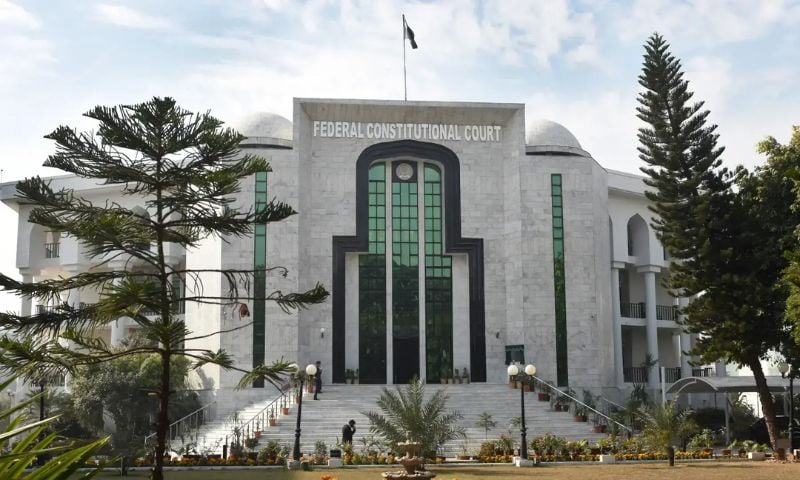
ISLAMABAD: Pakistan’s Federal Constitutional Court (FCC) has ruled that tax officials are legally authorised to carry out searches and raids on business premises under Section 175 of the Income Tax Ordinance, 2001, even if no formal proceedings are underway against a taxpayer.
A three-member bench led by Justice Aamer Farooq dismissed a petition filed by M/s Sceptre Pvt Ltd, which had challenged a December 24, 2025 verdict of the Sindh High Court that upheld a tax raid conducted on its premises.
The company had argued that Section 175 should only be invoked when legal proceedings are already in progress. It maintained that a notice issued under Section 176 – which seeks documents or information – could not justify a search operation.
In the written judgement authored by Justice Farooq, the court clarified that Section 175 grants the commissioner authority to ensure compliance with any provision of the ordinance.
The ruling highlighted that lawmakers deliberately used the term “enforcement,” which implies action in response to a breach of law.
Had the statute used the word “implementation,” the interpretation might have differed, the court observed.
The bench stated that the wording of Section 175 is explicit and leaves little room for alternative interpretation.
It affirmed that the Sindh High Court had correctly dismissed the petitioner’s claim, relying on precedent from the earlier Agha Steels Industries case.
Although the FCC noted reservations regarding certain aspects of the Agha Steels ruling, it concluded that the petition still lacked merit.
Justice Farooq remarked that even if procedural requirements outlined in the earlier judgement were not strictly adhered to, the tax commissioner or an authorised officer retains the statutory power to enforce the law under Section 175.
The court found no legal flaw in the Sindh High Court’s decision that would justify overturning it.
Emphasising principles of statutory interpretation, Justice Farooq said courts must rely primarily on the clear and ordinary meaning of legislative language to determine lawmakers’ intent.
Laws are often drafted to address specific circumstances in direct and unambiguous terms, and judges are not permitted to stretch or reinterpret such wording beyond its plain meaning.
He noted that when legislation explicitly declares an act “null and void to all intents and purposes whatsoever,” courts cannot selectively validate it under certain conditions.
Similarly, when Parliament has clearly authorised the commissioner or designated officers to access premises, accounts, documents, and electronic records at any time without prior notice for enforcement purposes, courts cannot impose additional conditions – such as requiring pending proceedings – that are not mentioned in the law.
The judgement concluded that courts must avoid granting relief that contradicts the clear and express language of a statute.
Expert opinion and constitutional perspective
Legal and constitutional experts say the ruling significantly strengthens the enforcement arm of tax authorities but also raises important questions about safeguards and fundamental rights.
Some constitutional lawyers argue that while Parliament has clearly empowered tax officials under Section 175, the exercise of such authority must still align with constitutional guarantees, particularly the right to privacy and protection against arbitrary state action under Articles 4 and 14 of the Constitution.
Experts point out that broad enforcement powers, if left unchecked, could potentially lead to misuse or harassment of businesses. They stress the need for transparent standard operating procedures (SOPs), internal accountability mechanisms, and judicial oversight to ensure that raids are conducted strictly for legitimate enforcement purposes.
Others note that the judgement reflects a pro-revenue and textualist approach, reinforcing the principle that courts cannot dilute clear statutory language. However, they add that future litigation may test the boundaries of Section 175 if allegations of mala fide intent or abuse of authority arise.
Tax law specialists also observe that the decision may prompt businesses to strengthen compliance practices, maintain updated documentation, and adopt robust digital record-keeping systems, given that the law permits real-time electronic access during enforcement actions.
Overall, while the FCC ruling clarifies the legal position in favour of tax authorities, experts emphasise that effective enforcement must be balanced with procedural fairness, proportionality, and respect for constitutional protections.