ISLAMABAD: Pakistan and three European states, Italy, Spain and Greece agreed on Thursday to promote legal pathways to “effectively combat illegal migration”.
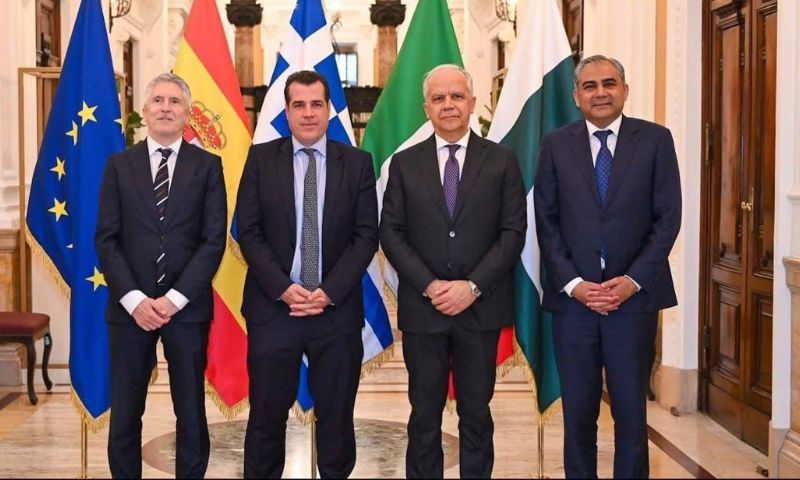
Pakistan’s Interior Minister Mohsin Naqvi confirmed the development in a post on the social media platform X, stating that ministers from the three European countries were in attendance.
“Productive meeting in Rome with my counterparts from Italy, Spain and Greece at the four-nation conference on curbing illegal migration,” he said.
Productive meeting in Rome with my counterparts from Italy, Spain and Greece at the 4-nation conference on curbing illegal migration.
Pakistan, Italy, Spain & Greece agreed on a coordinated strategy against illegal migration, human smuggling and narcotics, including a joint… pic.twitter.com/46ruUqNCyb
— Mohsin Naqvi (@MohsinnaqviC42) February 26, 2026
The consensus focuses on promoting legal migration channels as the primary method to effectively counter the flow of illegal immigration.
The meeting underscores the growing collaboration between Pakistan and key European states facing migration pressures from the region.
“Pakistan, Italy, Spain and Greece agreed on a coordinated strategy against illegal migration, human smuggling and narcotics, including a joint policy framework and rapid-response mechanism,” Mohsin Naqvi said.
Interior Minister Mohsin Naqvi stated that the conference also reached a consensus on “promoting legal pathways to effectively counter illegal migration [and] repatriation of criminals to face the law.”
He noted that European partners acknowledged Pakistan’s efforts, pointing to a “47 per cent reduction in illegal migration,” and agreed to facilitate “enhanced European Union-supported capacity building.”
A separate interior ministry statement revealed that the three European ministers endorsed Naqvi’s proposal to establish legal pathways as a key strategy against illegal migration and human smuggling.
Italy’s Matteo Piantedosi, Spain’s Fernando Grande-Marlaska, and Greece’s Athanasios Plevris agreed that regulated legal channels were the “most effective way to dismantle the networks of human smugglers and discourage dangerous irregular journeys.”
Endorsing the Pakistani proposal, they decided to “extend full support” for EU-facilitated capacity building.
The participants further agreed to adopt a “coordinated strategy at all levels” and finalised a joint policy framework to counter illegal migration, human smuggling, and narcotics trafficking.
Moreover, the interior ministry’s statement confirmed an agreement that criminals involved in “serious offences” would be repatriated from Europe to Pakistan to face legal proceedings.
The four ministers stressed the need for stronger coordination and an enhanced joint rapid response mechanism to curb illegal migration.
They also decided to hold the next meeting in Pakistan later this year.
According to the statement, Naqvi informed the European ministers that mafias involved in illegal migration had been brought under the law.
He noted that Europe was one of the regions most affected by illegal migration and emphasised that a coordinated mechanism could effectively address this challenge.
The three European countries “appreciated Pakistan’s efforts for curbing illegal migration and lauded the 47 per cent reduction” in such cases, the statement added.
It quoted the Italian minister as saying that “Pakistani institutions have taken excellent steps” against illegal migration.
Meanwhile, the Spanish minister commended the “exemplary actions taken under Naqvi’s leadership,” the statement concluded.
Last December, Pakistan unveiled plans to introduce an artificial intelligence–powered immigration screening system in Islamabad.
Earlier, in September, the Federal Investigation Agency published a list of over 100 “most wanted” human smugglers and highlighted key trafficking hotspots across the country.