


TEL AVIV: Indian Prime Minister Narendra Modi arrived in Israel on Wednesday for a two-day visit amid the ongoing Israeli military offensive in Gaza and escalating tensions between the United States and Iran.
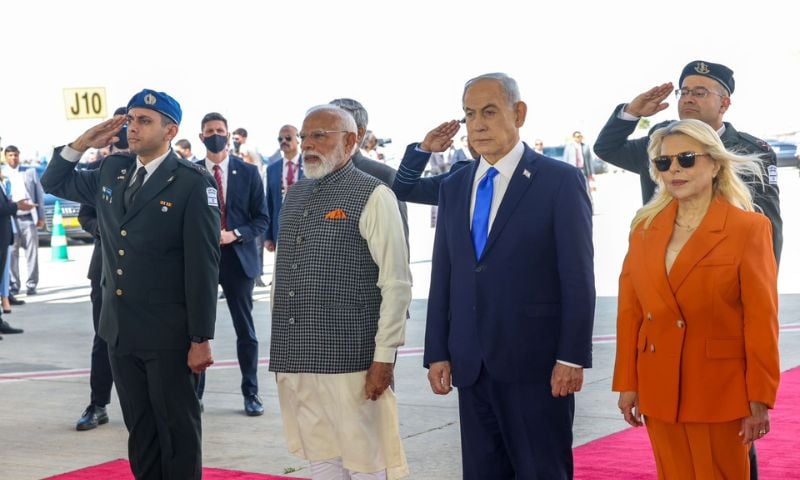
Modi was given a red-carpet welcome at the airport by Israeli Prime Minister Benjamin Netanyahu and his wife, Sara.
The two leaders exchanged a warm handshake and embrace as Modi stepped off the plane.
In a post on X, Modi said he was “extremely honoured” to be received by Netanyahu and looked forward to “bilateral discussions and fruitful outcomes that strengthen the India-Israel friendship”.
Landed in Israel.
I am extremely honoured to be received by Prime Minister Netanyahu and Mrs. Netanyahu at the airport. I look forward to engaging in bilateral discussions and fruitful outcomes that strengthen the India-Israel friendship.@netanyahu pic.twitter.com/FYGDv0M3Xy
— Narendra Modi (@narendramodi) February 25, 2026
Netanyahu described the visit as “historic”, writing on X that the bond between the two countries was a “powerful alliance between two global leaders” and that they were partners in “innovation, security and a shared strategic vision”.
My wife Sara and I welcomed today our good friend, Prime Minister of India Narendra Modi, who has arrived for another historic visit to Israel.
Prime Minister Modi previously visited Israel in 2017, and I later paid a reciprocal visit to India that was truly exceptional.
We… pic.twitter.com/d7mrCa3tQR
— Benjamin Netanyahu – בנימין נתניהו (@netanyahu) February 25, 2026
Modi is due to hold talks with Netanyahu and meet Israeli President Isaac Herzog.
He is also expected to address the Knesset at 4:30pm (1430 GMT). No meeting with Palestinian leaders is on his schedule.
Strategic partnership
Ahead of his departure, Modi said India and Israel shared a “robust and multifaceted strategic partnership” and that ties had “significantly strengthened in the last few years”.
Full diplomatic relations were established in 1992. Relations deepened after Modi took office in 2014.
He became the first Indian prime minister to visit Israel in 2017. Netanyahu made a reciprocal visit to India the following year.
India is among the largest buyers of Israeli arms. Analysts say defence cooperation has expanded rapidly, alongside collaboration in agriculture, cybersecurity and technology.
Between 2020 and 2024, India spent $20.5 billion on Israeli weapons, according to analysts cited in media reports, accounting for more than a third of Israel’s arms exports.
The two countries are expected to pursue further agreements, including a reported $8.6 billion deal for Israeli-made systems such as Air Lora air-to-surface ballistic missiles, as well as cooperation on air defence and cybersecurity.
Talks on an India-Israel Free Trade Agreement opened in New Delhi this week, the Indian government said, noting that total merchandise trade reached $3.62 billion in 2024–25.
The two sides signed a new bilateral investment treaty in September last year, replacing a 1996 accord to provide greater protection for investors.
At a cabinet meeting days before Modi’s arrival, Netanyahu spoke of a proposed “hexagon of alliances” that would include India, Greece, Cyprus and other unnamed partners.
Gaza war and regional tensions
The visit comes as Israel continues its military offensive in Gaza since October 7, 2023.
The Israeli bombardment campaign has killed more than 72,000 Palestinians, according to Gaza’s health ministry. The Israeli military campaign in Gaza has drawn widespread international criticism.
ALSO READ: Rubio Briefs Congressmen as Trump Warns Iran over Nuclear Ambitions
Netanyahu is facing an arrest warrant issued by the International Criminal Court in late 2024 over war crimes during the Gaza conflict.
The trip also takes place amid heightened regional tensions. US President Donald Trump has threatened military action against Iran, and Washington has reinforced its military presence in the region to pressure Tehran over its nuclear programme.
Domestic criticism in India
Modi’s visit has drawn strong criticism from opposition parties at home.
The Indian National Congress questioned the timing of the trip.
Senior party spokesperson Pawan Khera, quoted by The Times of India citing Asia News International, asked under whose “pressure” the prime minister had agreed to foreign deals and said the government should address questions about its own actions rather than attack previous administrations.
In response to Piyush Goyal, a senior minister in the ruling Bharatiya Janata Party (BJP), who has recently accused Rahul Gandhi, leader of the opposition, of being “compromised”, Khera asked the BJP to address the questions raised about the current government rather than issuing accusations about previous administrations.
Citing Asia News International, ToI quotes Khera as stating, “Is Rahul Gandhi the prime minister? At whose behest does the prime minister go abroad? Under whose pressure did he agree to the trade deal?”
Congress leader Priyanka Gandhi said she hoped Modi would raise the killing of “thousands of innocent men, women and children in Gaza” when he addresses the Knesset and demand justice.
“I hope Prime Minister Modi ji mentions the genocide of thousands of innocent men, women and children in Gaza while addressing the Knesset,” Gandhi said.
I hope that the Hon Prime Minister @narendramodi ji mentions the genocide of thousands of innocent men, women and children in Gaza while addressing the Knesset on his upcoming trip to Israel and demands justice for them. India has stood for what is right throughout our history as…
— Priyanka Gandhi Vadra (@priyankagandhi) February 25, 2026
Another senior Congress figure, Jairam Ramesh, said Modi would be displaying “moral cowardice” by “brazenly embracing” Netanyahu at a time when much of the world was critical of Israel’s actions in Gaza and settlement expansion in the occupied West Bank.
“The Indian Prime Minister is brazenly embracing the Prime Minister of Israel, who has reduced Gaza to rubble and dust and who is orchestrating the expansion of illegal settlements in the occupied West Bank. When the entire world is critical of his ‘dear friend’ Mr. Netanyahu, Mr. Modi will be displaying moral cowardice,” the Congress leader stated.
On May 20 1960, Jawaharlal Nehru was in Gaza and met with the Indian contingent of the UN Emergency Force there.
On Nov 29 1981, India issued a commemorative postage stamp in solidarity with Palestine.
On Nov 18 1988, India formally recognised the state of Palestine.
That… pic.twitter.com/J0RDHoEVEH
— Jairam Ramesh (@Jairam_Ramesh) February 25, 2026
The Communist Party of India (Marxist) also “strongly” opposed the visit, saying it coincided with a “genocidal war in Gaza” and accusing the government of legitimising Netanyahu’s leadership.
“The Modi visit is thus a betrayal of the Palestinian cause and legitimises the murderous Netanyahu regime,” the party said in a statement.
“The declared intent of the visit is also to deepen strategic, military and economic ties with a Zionist expansionist regime which seeks to dominate the region with the help of the United States.
“The visit is all the more inopportune because it is taking place at a time when the United States is preparing to attack Iran militarily at the instigation of Israel.”
The CPI(M) strongly opposes Prime Minister Narendra Modi’s visit to Israel. pic.twitter.com/KOBPyP7EP9
— CPI (M) (@cpimspeak) February 25, 2026
Shifting political alignments
Analysts say the relationship between Modi and Netanyahu reflects ideological and political convergence.
Both leaders have built strong nationalist identity and have rejected international criticism over human rights concerns and military policies.
India, the world’s most populous country with 1.4 billion people, is majority Hindu but home to an estimated 220 million Muslims.