
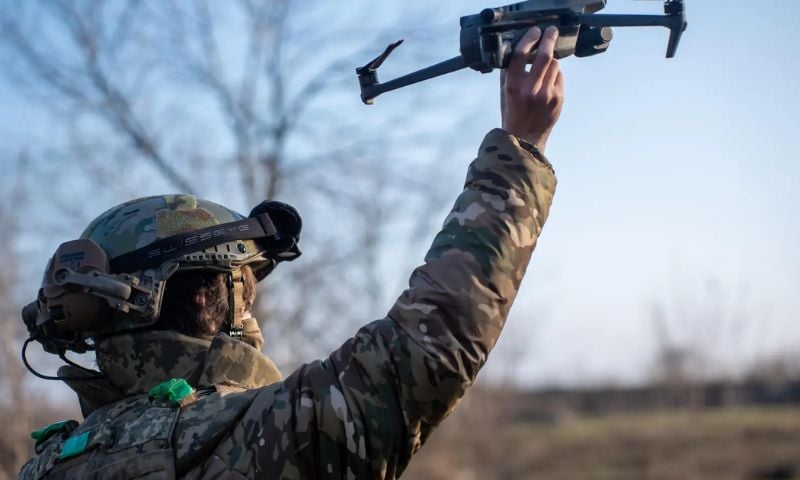
KYIV: The war in Ukraine has transformed military weapons and battlefield tactics more profoundly than any conflict since the end of World War II in 1945, producing a grinding and deadly stalemate that is redefining modern warfare.
Four years into the conflict, analysts say the scale of innovation — particularly in drone warfare, satellite intelligence and defensive systems — has altered conventional military doctrine in ways not seen in decades.
Earlier post-1945 conflicts, including Israel’s wars of 1956, 1967 and 1973, largely relied on World War II-era tactics and weapons. Guerrilla conflicts in Vietnam and Afghanistan echoed lessons already learned in earlier insurgencies.
Meanwhile, US-led wars against Iraq and Panama were so one-sided that they offered limited insight into full-scale combat between evenly matched forces, according to a report published by the ‘Responsible Statecraft’, an online magazine and policy initiative of the Quincy Institute for Responsible Statecraft.
By contrast, Russia and Western-armed Ukraine have fought as near-peer competitors, fielding comparable weaponry, training and troop numbers. The result has been a battlefield dynamic that has exposed both enduring military truths and revolutionary changes.
Early miscalculations
In the war’s opening phase, Russia underestimated the strength and resolve of Ukrainian resistance. Analysts attribute this to flawed intelligence assessments and assumptions that Ukrainian President Volodymyr Zelensky — previously known as a television comedian — would flee or quickly surrender.
Russian forces attempted to seize Kyiv and topple the Ukrainian government, but when that plan failed, they lacked a viable alternative strategy.
Troops were dispersed across multiple objectives, diluting their effectiveness. Ultimately, Russia secured only one major early objective: establishing a land corridor between its territory and Crimea.
Insufficient troop deployments and reluctance to mobilize large numbers of conscripts further limited Russia’s ability to consolidate territorial gains.
Missiles neutralize traditional power
The first month of fighting demonstrated the potency of modern handheld anti-tank and anti-aircraft missiles. Ukrainian forces used these systems to blunt Russia’s armored assaults, attack helicopters and ground-attack aircraft — long central components of Soviet and Western offensive doctrine.
As the war progressed, battlefield dynamics shifted further from 20th-century norms. Satellite intelligence enabled both sides – with Ukraine receiving US support – to monitor troop concentrations and anticipate offensives.
This real-time surveillance capability proved critical in halting Ukraine’s 2023 counteroffensive and slowing subsequent Russian advances.
Drones dominate the battlefield
The most transformative element of the conflict has been the widespread deployment of drones. Both sides have used unmanned aerial vehicles for surveillance, targeting and direct attacks, creating a lethal “no man’s land” stretching more than 15 miles in some sectors.
Visible movement within this zone often results in immediate detection and attack. Even entrenched soldiers can be identified and targeted. Mine-clearing operations – traditionally labor-intensive and exposed – have become nearly impossible under constant drone surveillance.
The result has been a dramatic thinning of infantry formations. Over the past two years, Russian assault units have reportedly been reduced to small groups of two or three soldiers to minimize drone detection. However, such fragmentation affects morale and coordination, making sustained offensive momentum difficult.

Institutional resistance to change
Despite the apparent lessons, experts warn that military institutions may resist adapting. Defense establishments in the United States and Europe remain deeply invested in producing large, sophisticated and expensive weapons platforms.
The influence of the military-industrial complex — combined with political support for traditional defense procurement — reinforces continued spending on tanks, warplanes and advanced systems rather than cheaper drones and mines.
Historical precedent suggests such conservatism can persist. After commanding forces in World War I, British Field Marshal Douglas Haig argued in 1926 that horses would remain as essential as tanks and aircraft – an assertion that soon proved outdated.
Future of offensive warfare
Military history shows that advances favoring defense are eventually countered by innovations restoring offensive capability. During World War I, stalemate and heavy casualties led to the development of tanks and strategic bombers.
Today, analysts foresee the potential emergence of autonomous attack robots capable of sustaining assaults without the psychological limitations faced by human troops. While artificial intelligence could accelerate such developments, experts believe widespread deployment remains years away. For now, drones remain dominant.
Implications beyond Europe
The war’s lessons extend beyond Eastern Europe. One of the most striking developments has been Ukraine’s ability — despite lacking a traditional navy — to cripple elements of Russia’s Black Sea Fleet using land-based missiles and maritime drones.
Strategists say this carries profound implications for any potential conflict over Taiwan. For China, it underscores the risks of launching an amphibious invasion in the face of determined resistance. For the United States, it highlights the vulnerability of naval vessels operating near heavily defended coastlines.
Even without nuclear escalation, such a conflict could devolve into a protracted and bloody stalemate similar to Ukraine’s.
As the war enters its fifth year, its most enduring lesson may not lie solely in weapons or tactics, but in the cautionary message it sends to global powers: the costs of modern war are staggering, and victory — if achievable at all — may come only after immense human and material sacrifice.