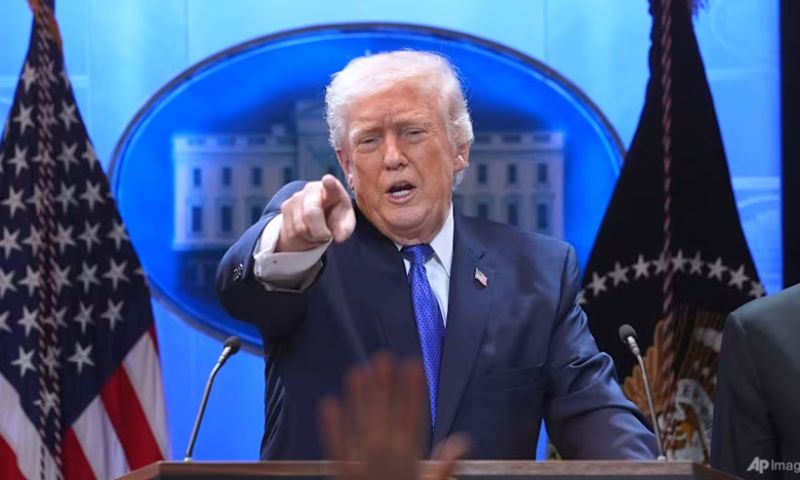



WASHINGTON: Fresh US tariffs on imported goods came into force on Tuesday after the Supreme Court of the United States struck down a broad set of President Donald Trump’s earlier global duties, reshaping his trade agenda.
The new tariffs, initially set at 10 percent, were announced by the White House on Friday and are justified as a response “to deal with the large and serious United States balance-of-payments deficits.”
Trump has since pledged to increase the rate to 15 percent, although exclusions are expected for goods covered by sector-specific investigations and the US-Mexico-Canada trade pact.
The new measure will remain in place for 150 days unless extended by Congress and is widely viewed as a temporary bridge toward a more durable trade framework following the court’s decision.
In a 6-3 ruling, the conservative-majority Supreme Court held that Trump had exceeded his authority by invoking the 1977 International Emergency Economic Powers Act to impose sudden, country-specific tariffs.
According to AFP, the judgment invalidated many of his sweeping duties but left intact sector-based tariffs on products such as steel and automobiles.
As a result, US Customs and Border Protection said it would stop collecting tariffs nullified by the court starting Tuesday, while simultaneously beginning to collect the new 10 percent duty.
According to Erica York, vice president of federal tax policy at the Tax Foundation, the new tariff will apply to approximately $1.2 trillion in annual imports — about 34 percent of total US goods imports.
“The Trump tariffs amounted to an average tax increase per US household of $1,000 in 2025,” York said, adding that even after the court’s intervention, the remaining and newly imposed duties are projected to result in a household burden of $700 in 2026.
Despite the ruling, Trump maintained that the court had granted him “far more powers and strength,” suggesting he could turn to alternative mechanisms such as licensing requirements to pressure foreign governments.
“With his tariff wings clipped, Trump needs a new tool to express displeasure on actions by others,” said Wendy Cutler, a former US trade official and senior vice president at the Asia Society Policy Institute.
“Threatening steep licensing fees is an alternative but it lacks the flair and quantitative nature of tariffs,” she added.
Trump also warned Monday that countries seeking to “play games” following the court decision could face higher duties, a message directed at trading partners that recently negotiated agreements with Washington under the threat of tariffs.
Over the past year, Trump has frequently adjusted tariff rates on allies and rivals alike, often on short notice, using the measures as leverage in trade negotiations.
US Trade Representative Jamieson Greer said on CBS that existing tariff agreements remain valid despite the court’s ruling. “We expect our partners to stand by them,” Greer said.
However, analysts note that Trump’s threatened 15 percent rate would exceed the 10 percent duties faced by some countries, including Britain and Australia, under previous arrangements.
Cutler cautioned that the president’s renewed tariff push could deepen frustration among US trading partners. While immediate retaliation appears unlikely, she said affected countries may intensify efforts to diversify trade relationships away from the United States.
The evolving legal and political battle over tariffs now sets the stage for further uncertainty in US trade policy, as the administration navigates the limits imposed by the Supreme Court while seeking to maintain pressure on global partners.