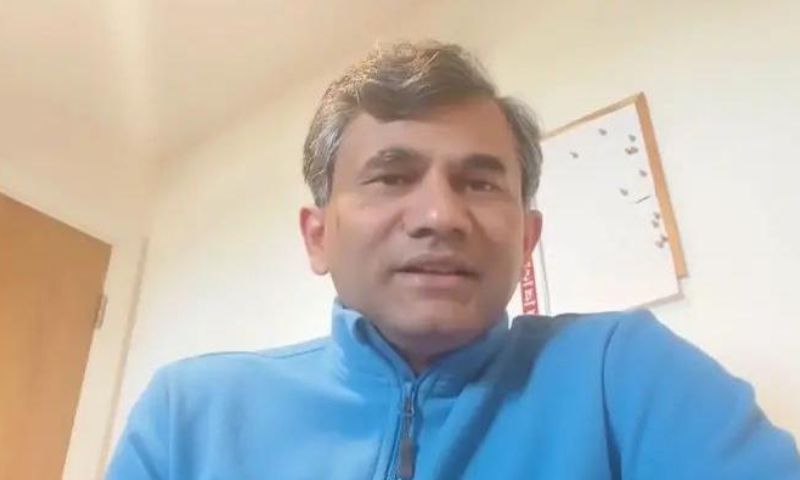



MUMBAI: A British doctor has been unable to leave India for more than a month after police registered a case against him over a social media post concerning a senior politician from the ruling Bharatiya Janata Party (BJP).
Sangram Patil, a UK citizen of Indian origin who works with the National Health Service (NHS), was stopped at Mumbai airport on January 19 while attempting to board a flight to London.
Authorities had issued a lookout circular against him – a notice that prevents individuals under investigation from leaving the country.
Patil is under investigation for allegedly posting “objectionable content” about a BJP leader on Facebook. He has denied any wrongdoing and described the police action as “unlawful”, according to BBC Marathi.
It remains unclear when Patil will be permitted to return to the UK. He has approached a court seeking to have the case against him quashed and the travel restrictions lifted. The matter is scheduled to be heard next on February 27.
“My children and my job are in the UK. International law and Indian law give me the right to move freely. Restrictions have been imposed on that. I am not able to go home,” Patil said. The BBC said it had contacted Mumbai police for comment.
Meanwhile, a spokesperson for the Foreign, Commonwealth and Development Office (FCDO) confirmed that British authorities are supporting a UK national in India and are in contact with local officials but did not provide further details.
According to police, the case stems from a complaint filed by Nikhil Bhamre, who manages the BJP’s social media operations in the western state of Maharashtra, where Mumbai is the capital.
The complaint, registered on December 18, accuses Patil of publishing “objectionable content” targeting a senior BJP leader.
Although the complaint did not explicitly name the leader, it was filed four days after Patil posted a comment on Facebook about Prime Minister Narendra Modi.
The police complaint reviewed by the BBC includes a link to that post. Bhamre alleged that the content could incite hostility between groups that support and oppose the BJP’s ideology.
Police subsequently registered a case under provisions of India’s criminal code related to statements containing false information that could promote enmity or hatred between communities. The offence is bailable and carries a maximum sentence of up to three years.
Patil has rejected the allegations, asserting that his post merely posed a question to government supporters and did not reference any community, rumour or inflammatory material.
“My post is a simple question to government supporters and nothing else,” he said. “It doesn’t involve any community, any rumour or sensational news.”
He stated that he was questioned for more than 10 hours upon arriving in Mumbai on January 10 with his wife, and again for eight hours on January 16.
Patil said he submitted written responses to all police queries and requested that the lookout circular be withdrawn so he could travel back to the UK on January 19.
According to Patil, police informed him that the process to cancel the notice had been initiated. However, he was stopped at the airport on the day of his scheduled departure.
Describing the prolonged questioning as “targeted harassment,” Patil said being interrogated for more than 20 hours over what he characterized as a single line on social media was excessive.
In an affidavit filed on January 30, police defended their actions, stating that the investigation was at a crucial stage and that “the possibility of an organised effort to malign constitutional authority cannot be ruled out”.
Police further told the court that it was a serious matter requiring investigation as to why a foreign citizen visiting India on a tourist e-visa would allegedly post defamatory or inflammatory material about India’s prime minister while residing abroad.
Authorities have urged the court to dismiss Patil’s plea, describing it as “misconceived and premature”.
In a rejoinder submitted last week, Patil denied the accusations. Court filings cited by The Indian Express newspaper reported that he “categorically denied” writing any post naming or referring to the prime minister and argued that “criminal prosecution cannot be founded on subjective political interpretation or perceived sentiment”.
The case has drawn attention amid broader debates over freedom of expression, online speech, and the legal scrutiny of social media activity in India.