
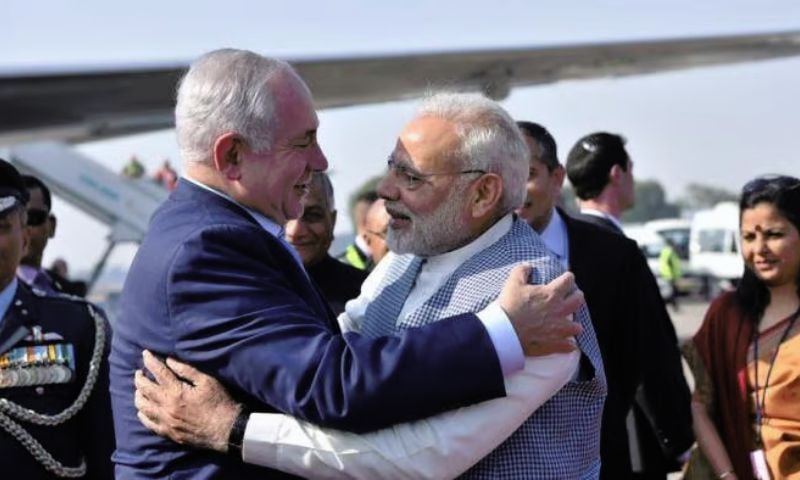
JERUSALEM: India’s Prime Minister Narendra Modi is set to visit Israel on Wednesday, Prime Minister Benjamin Netanyahu announced, underscoring the growing strategic partnership between New Delhi and Tel Aviv.
Speaking at the opening of a cabinet meeting on Sunday, Netanyahu said Modi would address the Knesset, Israel’s parliament, during his visit.
“The Prime Minister of India, Narendra Modi, will arrive here; he will deliver a speech in the Knesset,” Netanyahu said, describing the trip as another step in strengthening bilateral ties.
The Indian government is facing mounting criticism ahead of Prime Minister Narendra Modi’s planned visit to Israel, with human rights groups accusing New Delhi of drawing closer to Tel Aviv despite the ongoing war in Gaza.
Israel’s military campaign, now entering its third year, has caused widespread devastation and drawn intense international scrutiny.
Gaza-based health authorities say more than 72,000 Palestinians have been killed and over 171,000 wounded, many of them women and children, while the United Nations estimates that nearly the entire population of 2.1 million has been displaced at least once, amid persistent shortages of food, water, and medicine despite a fragile truce.
Critics argue that Modi’s visit — expected to focus on defence, technology, and strategic cooperation — risks signaling political endorsement at a time when global pressure on Israel is intensifying.
Hailing the expanding relationship, Netanyahu noted that cooperation between the two countries has intensified across economic, diplomatic, and security domains. “The fabric of relations has grown tighter, and he is coming here so that we can tighten it even more,” he added.
Modi’s 2017 visit to Israel marked the first-ever trip by an Indian prime minister, widely seen as reshaping the trajectory of bilateral relations. Netanyahu made a reciprocal visit to India in 2018, further consolidating political and strategic engagement.
Since then, cooperation has broadened significantly, spanning defence collaboration, advanced technology partnerships, agriculture, and innovation. Security coordination between the two sides has also deepened amid shifting regional and global dynamics.
Indian opposition leaders and civil society groups say India, which historically championed the Palestinian cause and supported Palestinian statehood in international forums, is departing from its traditional diplomatic posture.
In recent UN votes calling for immediate humanitarian ceasefires, India has abstained, drawing criticism from some domestic and international observers.
According to Israeli media reports, defence cooperation and high-technology initiatives are expected to feature prominently during the upcoming talks.
Economic ties have similarly gained momentum. In July 2025, Israel’s Finance Ministry said the two countries were finalising an investment protection agreement, expected to be signed in the coming months.
India has become one of Israel’s key trade partners, particularly in Asia. Bilateral trade reached nearly $4 billion in 2024, reflecting a steady upward trend in commercial engagement.