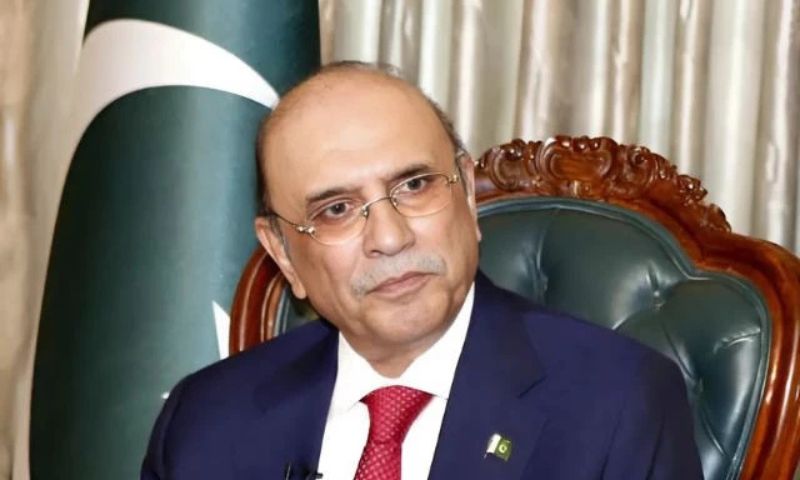
ISLAMABAD: Pakistan’s President Asif Ali Zardari said on Sunday that the country’s tolerance for cross-border terrorism had “reached its limit” as the country conducted precision strikes on terrorist hideouts along the Pak-Afghan border.
President Zardari, in a statement, said Pakistan’s actions against terrorist hideouts along the Pak-Afghan border were rooted in its inherent right to protect its citizens from terrorism emanating from across its borders and followed repeated warnings that went unheeded.
Referring to his statement of 8 February 2026, President Zardari recalled warning the international community that “when terrorist groups are allowed space, facilitation or impunity beyond national borders, the consequences are borne by innocent civilians all over the world”.
He expressed concern over the situation in Afghanistan, saying the Taliban regime had created conditions similar to or worse than those before the September 11, 2001 attacks.
President Asif Ali Zardari says Pakistan’s recent actions reflect its right to defend its people against cross-border terrorism. Citing the latest UNSC report, he warns that those responsible for bloodshed inside Pakistan will not remain beyond reach.
— The President of Pakistan (@PresOfPakistan) February 22, 2026
Concerns over terror sanctuaries in Afghanistan
Zardari said it was a matter of deep concern that the de facto authorities in Kabul, a regime not recognised by the United Nations, had continued to allow terrorist elements to operate from Afghan soil in violation of commitments made under the 2020 Doha Accord.
Under the Doha agreement, the Taliban pledged that Afghan territory would not be used against any country.
President Zardari cited the latest report of the United Nations Security Council Analytical Support and Sanctions Monitoring Team, which stated that several groups, including ISIL-K, Tehreek-e-Taliban Pakistan (TTP), Al-Qaeda, the Eastern Turkistan Islamic Movement, Jamaat Ansarullah and Ittihad-ul-Mujahideen Pakistan, were present in Afghanistan.
According to the report, some of these groups had used or were continuing to use Afghanistan to plan and prepare external attacks.
Zardari said the UN assessment reinforced Pakistan’s long-standing position that the presence and activities of these organisations posed serious threats to neighbouring countries, including Pakistan.
He said Islamabad had exercised restraint for a considerable period and had limited its response to terrorist hideouts near the border areas.
However, he warned that Pakistan was fully aware of where the planners, facilitators and patrons of terrorism were based.
“If bloodshed continues inside Pakistan, those responsible will not remain beyond reach,” he said.
He reiterated that Pakistan sought peace and cooperative relations with its neighbours but stressed that protection of Pakistani lives was “paramount and non-negotiable”.
Precision strikes along border
On Sunday, Pakistan said it had carried out intelligence-based “precision strikes” on seven terrorist camps along the Pakistan-Afghanistan border, killing over 70 terrorists linked to the banned Tehreek-e-Taliban Pakistan and the Islamic State’s regional affiliate.
Pakistan’s Ministry of Information and Broadcasting described the operation as a “retributive response” conducted with “precision and accuracy”.
It said there was “conclusive evidence” that recent suicide attacks, including one at an Imam Bargah in Islamabad and others in Bajaur and Bannu during the holy month of Ramadan, were orchestrated by terrorists acting under the direction of Afghanistan-based leadership.
Press Release
21 February, 2026In the aftermath of recent suicide bombing incidents in Pakistan, including Imam Bargah at Islamabad, one each in Bajaur and Bannu followed by another incident today in Bannu during the holy month of Ramzan, Pakistan has conclusive evidence that…
— Ministry of Information & Broadcasting (@MoIB_Official) February 21, 2026
Pakistan’s State Minister for Interior Talal Chaudhry told Geo News that the targets included camps belonging to Fitna al-Khawarij, its affiliates and Islamic State-Khorasan Province (ISKP), also known as ISIS-K.
“Afghanistan has long been exporting terrorism. Pakistan is taking all actions to secure the life and property of its citizens,” he said.
Chaudhry said at least 70 terrorists had been “neutralised” and added that there was evidence suggesting most of those killed were Pakistani nationals.
The government urged the Afghan Taliban to fulfil its commitments under the Doha Agreement and take verifiable measures to prevent terrorist groups from using Afghan territory to launch attacks.
Terrorist camps targeted
Pakistani officials said the targeted camps were located in border regions opposite Khyber Pakhtunkhwa province.
Afghan media reported explosions in the Bermal area of Paktika province and in districts of Nangarhar province, including Khogyani, Ghani Khel and Behsud.
Separate reports mentioned Murgha Bazaar in Paktia province.
According to Afghan media, jet aircraft carried out the strikes, causing significant damage to the terrorist hideouts.
Social media accounts linked to the banned TTP also reported mass casualties among terrorists.
The escalation comes amid a surge in terrorist violence in Pakistan’s Balochistan and Khyber Pakhtunkhwa provinces since the Taliban returned to power in Kabul in August 2021.
On Saturday, Pakistan’s military said five terrorists, including a suicide bomber, were killed in an operation in Bannu district.
The Inter-Services Public Relations (ISPR), the army’s media wing, said the terrorists had rammed an explosives-laden vehicle into a security convoy, killing a lieutenant colonel and a soldier.
Earlier this month, 11 security personnel were killed in a vehicle-borne suicide attack on a joint security post in Bajaur district near the Afghan border.
Chaudhry said Pakistan had conducted around 70,000 intelligence-based operations inside the country and arrested several terrorists.
He said Islamabad had also pursued diplomatic engagement and military-to-military talks with Afghan authorities.
He added that concerns over terrorist activity in Afghanistan were shared by other countries and cited UN findings that more than two dozen terror groups were operating there.
Pakistan’s Parliamentary Affairs Minister Tariq Fazal Chaudhry said on X that the strikes by the Pakistan Air Force were retribution for innocent lives lost to terrorism.
“Pakistan desires peace, but it will not compromise on its safety, land and people,” he wrote, warning that those who looked at Pakistan “with evil intent” would not be spared.
پاکستان کے خلاف سازشوں کا جال بُننے والوں کو ایک بار پھر واضح پیغام مل چکا ہے یہ سرزمین کمزور نہیں، یہ شہداء کے لہو سے مضبوط ہوئی ہے۔
افغانستان میں بھارتی سرپرستی میں پلنے والے فتنہ الخوارج کے ٹھکانوں پر پاک فضائیہ کی بروقت اور مؤثر کارروائی دراصل اُن معصوم جانوں کا بدلہ ہے جو… pic.twitter.com/9RJFhvb2Bo
— Dr. Tariq Fazal Ch. (@DrTariqFazal) February 22, 2026