


KEY POINTS
- Abbas Araghchi said there is still a “good chance” of resolving standoff with US through diplomacy.
- He said negotiators are drafting the text of a possible agreement.
- Araghchi expects talks with senior US officials to resume on Thursday in Geneva.
- He expressed hope that both sides could finalise key elements and move quickly towards a deal.
- Iran insists it will not abandon uranium enrichment, calling it a sovereign right.
- Araghchi warned that Iran would retaliate if the US launches any attack.
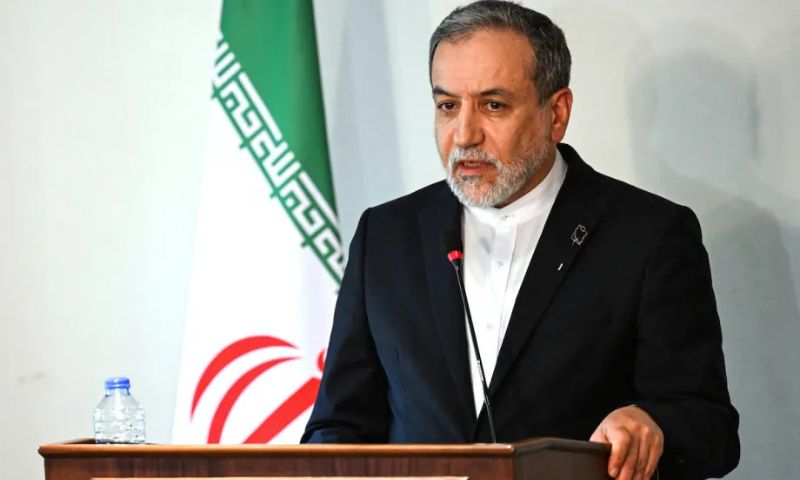
TEHRAN, Iran: Iran’s foreign minister said on Sunday that he thought there was still a “good chance” his country’s standoff with the United States over Tehran’s nuclear programme could be resolved through diplomacy.
“I believe that still there is a good chance to have a diplomatic solution which is based on a win-win game,” Foreign Minister Abbas Araghchi told the US broadcaster CBS. He added that negotiators were “working on the elements of a deal and draft of the text”.
Araghchi reiterated that Iran would not abandon uranium enrichment. “As a sovereign country, we have every right to decide for ourselves, by ourselves,” he said.
The Iranian foreign minister said that he expected talks with senior US negotiators on Tehran’s nuclear programme to resume soon, “probably” on Thursday in Geneva.
Araghchi said the elements of a deal were being worked on, and that he hoped they would be discussed this week.
“I believe that when we meet, probably this Thursday in Geneva again, we can work on those elements and prepare a good text and come to a fast deal,” he said.
Warning of retaliation
At the same time, Araghchi warned that Tehran would retaliate if the US attacked Iran.
“If the US attacks us, then we have every right to defend ourselves,” he said.
“Our missiles cannot hit American soil. So obviously we have to do something else. We have to hit the American base in the region.”
His comments came as Washington expanded its military presence in the Middle East, deploying two aircraft carriers, fighter jets and additional weaponry in what officials describe as a show of force.
US envoy Steve Witkoff said on Saturday that President Donald Trump was questioning why Tehran had not yielded under pressure.
In an interview with Fox News, Witkoff said Trump was “curious” why Iran had not “capitulated” despite the military build-up.
“I don’t want to use the word ‘frustrated,’ because he understands he has plenty of alternatives,” Witkoff said. “But he’s curious as to why they haven’t capitulated.”
He said Trump was seeking clarity on why Iran had not formally declared it would not pursue a nuclear weapon and outlined what steps it was prepared to take.
Talks resume in Geneva
The United States and Iran resumed indirect talks earlier this month in Oman. A second round was held in Geneva last week.
Both sides described the discussions as broadly positive but acknowledged no breakthrough had been achieved.
According to Reuters, two rounds of talks have stalled over core issues including uranium enrichment, missile capabilities and the scope and timing of sanctions relief.
An Iranian official told Reuters that Washington’s proposals on sanctions relief differed from Tehran’s demands.
“Both sides need to reach a logical timetable for lifting sanctions,” the official said. “This roadmap must be reasonable and based on mutual interests.”
When Omani mediators reportedly presented missile-related proposals from the US side, Araghchi declined to open the envelope and returned it, a source familiar with the talks said as cited by Reuters.
After discussions in Geneva, Araghchi said the sides had agreed on “guiding principles”. The White House said significant gaps remained.
On Thursday, Trump warned that Iran has at most 10 to 15 days to reach a deal or face “really bad things”.
He has acknowledged he is considering limited strikes to force an agreement but says no final decision has been made.
Possible compromises on nuclear programme
The United Nations nuclear watchdog estimates Iran possesses more than 440 kg of uranium enriched to up to 60 percent purity, below weapons-grade.
Tehran denies seeking nuclear weapons and insists its programme is peaceful. Western governments say high-level enrichment could provide a pathway to a bomb.
Iran has rejected US demands for zero enrichment but has signalled it may consider partial export of highly enriched uranium, dilution of its highest-purity stock, or the creation of a regional enrichment consortium in exchange for recognition of its right to peaceful nuclear activity.
An Iranian official, cited by Reuters, said the United States had been offered potential investment opportunities in Iran’s oil industry as part of a broader economic package.
However, Tehran insists control of oil and mineral resources would remain under Iranian authority, with foreign firms acting only as contractors.
Regional fears of escalation
Officials across the Gulf and Europe say the risk of conflict is rising, Reuters reported.
According to Reuters, some of Iran’s Gulf neighbours and its regional adversary Israel believe the likelihood of confrontation now exceeds that of a negotiated settlement.
Israeli officials say preparations are under way for possible joint military action with Washington, although no decision has been taken.
US Secretary of State Marco Rubio is due to meet Israeli Prime Minister Benjamin Netanyahu on February 28 to discuss Iran.
A senior US official said it could be mid-March before all American forces are fully in place.
Rising tensions have pushed up oil prices and prompted contingency planning among Gulf oil producers concerned about regional stability.
Defiance in Tehran
Iran’s Supreme Leader Ayatollah Ali Khamenei said this week that Trump would not succeed in destroying the Islamic Republic.
On Saturday, President Masoud Pezeshkian said Iran would not bow to pressure.
“We will not bow down in the face of any of these difficulties,” he said at a ceremony honouring members of Iran’s Paralympics team.
“World powers are lining up with cowardice to force us to bow our heads.”
Former US diplomat Alan Eyre told Reuters that both sides were entrenched. “Both sides are sticking to their guns,” he said.
“Nothing meaningful can emerge unless the US and Iran walk back from their red lines – which I don’t think they will.”