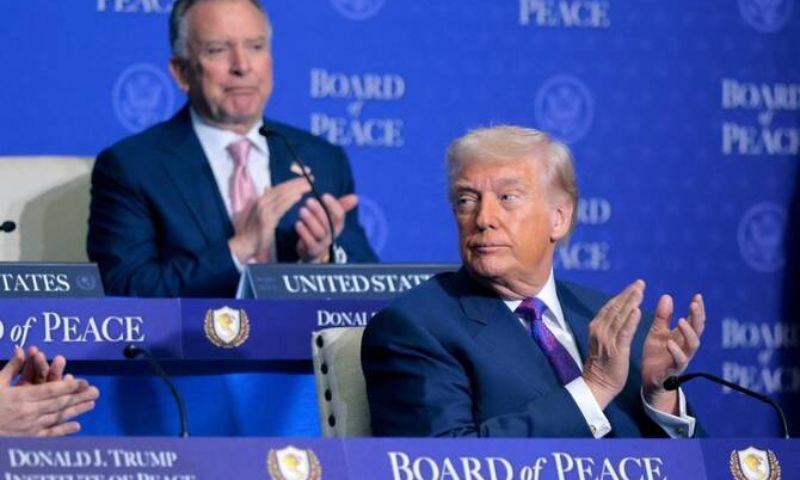
WASHINGTON: Steve Witkoff, the US envoy, said on Saturday that President Donald Trump is questioning why Iran has not “capitulated” despite Washington’s significant military build-up aimed at pressuring Tehran into a nuclear agreement.
The remarks come as the United States and Iran resumed talks in Geneva this week, mediated by Oman, to avoid the possibility of military confrontation.
Washington recently deployed two aircraft carriers, fighter jets, and additional weaponry to the region as a show of force and a warning to Iran.
In an interview with Fox News, Trump’s daughter-in-law, Lara, Witkoff said that the president was “curious” about Iran’s response following his warnings of severe consequences should Tehran fail to strike a deal.
“I don’t want to use the word ‘frustrated,’ because he understands he has plenty of alternatives, but he’s curious as to why they haven’t… I don’t want to use the word ‘capitulated,’ but why they haven’t capitulated,” Witkoff explained.
He added, “Why, under this pressure, with the amount of seapower and naval power over there, why haven’t they come to us and said, ‘We profess we don’t want a weapon, so here’s what we’re prepared to do’? And yet it’s sort of hard to get them to that place.”
According to AFP, Witkoff also confirmed that he had met with Reza Pahlavi, who has not returned to Iran since the 1979 Islamic Revolution that ousted the monarchy.
“I met him at the direction of the president,” he said, without providing further details. Pahlavi, speaking last week in Munich, said he is ready to lead Iran toward a “secular democratic future” following Trump’s comments that regime change would be best for the country.
Meanwhile, Iranian Foreign Minister Abbas Araghchi said that a draft proposal for an agreement with Washington would be ready within days, signaling cautious optimism amid the high-stakes negotiations.
Trump previously stated that Iran had at most 15 days to reach a deal addressing concerns over its nuclear program.
However, Iran’s supreme leader, Ali Khamenei, reiterated on Tuesday that Trump would not succeed in destroying the Islamic Republic.
The West continues to accuse Iran of attempting to acquire nuclear weapons, a charge Tehran denies, though it asserts its right to enrich uranium for civilian purposes.
Iran, for its part, seeks an end to economic sanctions that have significantly strained the country’s economy and contributed to anti-government protests in December.
As talks continue in Geneva, the world watches closely, weighing the prospects of diplomacy against escalating military and political pressure in one of the most sensitive regions globally.