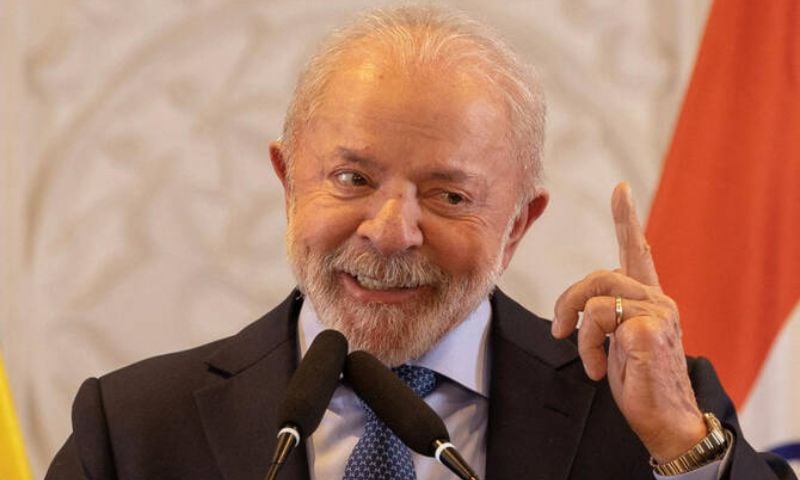



NEW DELHI: Brazil’s President Luiz Inacio Lula da Silva on Sunday urged US President Donald Trump to treat all nations equally, cautioning against global divisions after Washington imposed a 15 percent tariff on certain imports despite an adverse ruling from the Supreme Court of the United States.
Speaking to reporters in the Indian capital, Lula said Brazil did not seek confrontation and hoped bilateral ties would soon return to normal.
“I want to tell the US President Donald Trump that we don’t want a new Cold War. We don’t want interference in any other country, we want all countries to be treated equally,” the Brazilian leader said.
His remarks came after the conservative-majority US Supreme Court ruled six to three on Friday that a 1977 law relied upon by Trump to impose sudden tariffs on individual countries “does not authorize the President to impose tariffs.”
The decision has cast uncertainty over Washington’s recent trade measures, which have unsettled global markets and trade partners, according to AFP.
Lula noted that he would refrain from commenting directly on the judicial decisions of another country but expressed optimism that relations between Brazil and the United States would stabilize.
He confirmed that he is expected to travel to Washington next month for talks with Trump.
“I am convinced that Brazil–US relations will go back to normalcy after our conversation,” said Lula, 80, emphasizing that Brazil’s priority remains domestic development. “We only want to live in peace, generate jobs, and improve the lives of our people.”
The two leaders, Lula and Trump, 79, hold sharply divergent views on key global issues, including multilateralism, international trade frameworks and climate change policies.
Despite these ideological differences, recent developments suggest that diplomatic ties between Brasília and Washington may be improving after months of tension.
Last year, the Trump administration imposed sweeping 40 percent tariffs on Brazilian goods. However, in a recent move seen as conciliatory, Washington exempted key Brazilian exports from those levies, signaling a potential thaw in relations.
Strained ties over Bolsonaro Case
Relations between the two countries had deteriorated in recent months amid controversy surrounding the trial and conviction of former Brazilian president Jair Bolsonaro, a political ally of Trump.
Bolsonaro was sentenced to 27 years in prison for his role in a failed coup attempt following his defeat in Brazil’s 2022 presidential election to Lula.
Trump criticized the proceedings, describing them as a “witch hunt,” and responded by imposing sanctions on several senior Brazilian officials, including a Supreme Court judge.
Addressing the broader diplomatic context, Lula underscored the importance of democratic values. “We are two men of 80 years of age, so we cannot play around with democracy,” he said, referring to himself and Trump.
“We have to take this very seriously. We have to shake hands eye-to-eye, person-to-person, and discuss what is best for the US and Brazil.”
India visit and strategic partnerships
Lula’s remarks were made during his visit to India, where he attended a summit on artificial intelligence and held bilateral talks with Indian Prime Minister Narendra Modi.
The Brazilian leader praised Modi, saying he felt a strong “affinity” with the Indian premier.
India and Brazil agreed to enhance cooperation in critical minerals and rare earth sectors and signed several agreements aimed at strengthening trade and technological collaboration.
“The world doesn’t need more turbulence, it needs peace,” Lula said, reiterating his call for stability and constructive global engagement.
Following his engagements in India, Lula was scheduled to travel to South Korea later Sunday for meetings with President Lee Jae Myung and to participate in a business forum aimed at expanding economic ties.
As the world’s two largest democracies in the Americas navigate political and economic differences, Lula’s upcoming visit to Washington is expected to test whether Brasília and Washington can move past recent disputes and chart a more stable course in bilateral relations.