ISLAMABAD: Pakistan and the United States have formally launched a structured cooperation framework for the future operation, renovation and potential redevelopment of the Roosevelt Hotel in New York
Officials termed it a landmark property owned by Pakistan’s national airline group.
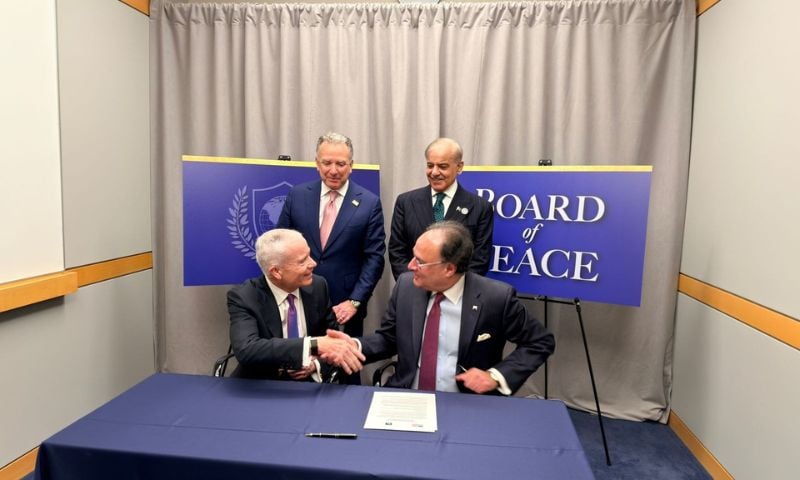
The initiative was formalised through a Memorandum of Understanding (MoU) signed between the US General Services Administration (GSA) and Pakistan’s Ministry of Finance, according to a press release issued by Pakistan’s Finance Division in Washington on Thursday.
The Governments of Pakistan and the United States have formally launched a strategic economic initiative, including collaboration with the U.S. General Services Administration (GSA) regarding the operation, maintenance, renovation, and redevelopment of the Roosevelt Hotel in New… pic.twitter.com/p0Gix5TLFX
— Ministry of Finance, Government of Pakistan (@Financegovpk) February 19, 2026
The Memorandum establishes a time-bound mechanism for jointly evaluating the hotel’s technical, commercial and financial options, with the stated objective of maximising value while ensuring regulatory clarity.
Pakistani Prime Minister Shehbaz Sharif and US Special Envoy Steve Witkoff witnessed the signing ceremony in Washington, underscoring the political backing behind the move.
A symbolically important asset
Located in midtown Manhattan near Grand Central Terminal, the Roosevelt Hotel is one of Pakistan’s most prominent overseas assets.
Opened in 1924, the hotel was acquired by Pakistan International Airlines (PIA) in 2000 through its holding structure.
The property has remained at the centre of debate in Pakistan for years, particularly as the government grappled with financial losses at state-owned enterprises.
In recent reform efforts, the Roosevelt Hotel emerged as a priority asset for restructuring or divestment, second only to the national carrier itself.
Officials say institutional coordination with US authorities is intended to reduce execution risk, streamline compliance with complex New York zoning and municipal regulations, and enhance investor confidence.
Part of a broader privatisation push
The Roosevelt initiative fits in Pakistan’s privatisation and state-sector reform programme.
Facing chronic fiscal deficits, mounting public debt, and repeated International Monetary Fund (IMF) stabilisation programmes, Islamabad has sought to reduce the financial burden of loss-making state-owned enterprises.
Pakistan International Airlines, long considered a flagship but financially troubled carrier, has been undergoing restructuring.
The government recently completed the privatisation of core airline operations, transferring majority ownership and management control to a private investor.
Following that transaction, the state retains ownership of certain legacy assets and liabilities through a restructured holding framework.
These include select real estate holdings, such as the Roosevelt Hotel, as well as residual financial obligations accumulated before privatisation.
Understanding the PIA corporate structure
Pakistan International Airlines has historically operated as a state-owned enterprise under Pakistan International Airlines Corporation Limited (PIACL).
Over time, its structure has evolved to include airline operations, engineering services, and international property assets.
As part of the reform process, airline operations were separated from non-core assets. The privatised entity, PIA, now runs under private management.
The Government of Pakistan continues to hold stakes in remaining non-operational or strategic assets through a state-controlled holding arrangement.
This separation was designed to make the airline commercially viable while allowing the government to monetise high-value properties such as the Roosevelt Hotel, independently.
A new phase in Pakistan-US economic ties
Beyond the asset-specific transaction, the MoU is being viewed as part of a broader reset in Pakistan–United States economic engagement.
After years in which bilateral relations were largely defined by security cooperation, both sides have signalled interest in expanding trade, investment and commercial partnerships.
Officials describe the Roosevelt framework as a practical example of economic diplomacy, leveraging institutional cooperation to unlock value in a cross-border asset while strengthening bilateral ties.
The agreement does not constitute a final sale or redevelopment decision.
Instead, it establishes a structured process to assess feasibility, commercial models and potential transaction pathways.
Any final decision will depend on market conditions, regulatory approvals and alignment with Pakistan’s fiscal strategy.
For Islamabad, the objective remains clear: to extract maximum value from overseas state assets, reduce fiscal pressures and demonstrate credibility in implementing structural reforms.
For Washington, the initiative represents another channel of economic cooperation with a long-standing regional partner.