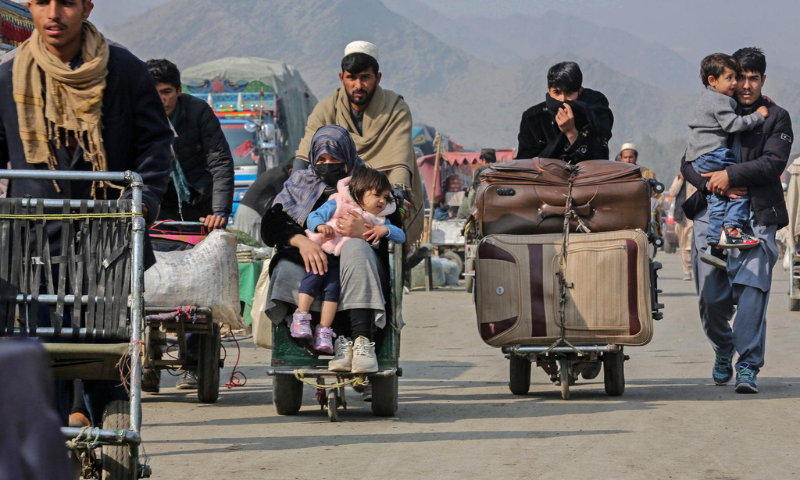
GENEVA/KABUL: The United Nations High Commissioner for Refugees warned Tuesday that the accelerating return of Afghan refugees from Pakistan is testing Afghanistan’s limited capacity to absorb new arrivals amid economic crisis and constrained aid funding.
In a statement issued on Tuesday, the UN refugee agency said large numbers of Afghans are crossing back into their homeland each day, with many reporting that they left Pakistan due to restrictive policies, deteriorating living conditions, or forced deportation.
“At the Afghanistan-Pakistan border, families arrive exhausted and anxious, carrying nothing but concerns about how to rebuild their lives in their homeland,” the United Nations said.
Mounting humanitarian strain
According to UNHCR, returnees face immediate protection risks and urgent humanitarian needs upon arrival. Many lack adequate housing, access to healthcare services, and income-generating opportunities, compounding the challenges of reintegration.
To respond to the growing influx, the agency has strengthened its presence at key border crossings between Afghanistan and Pakistan.
UN teams are conducting registration and vulnerability assessments while facilitating access to essential support services, including emergency assistance and referrals to humanitarian partners.
However, the scale of returns is testing the capacity of aid organizations operating in Afghanistan, which remains one of the world’s most vulnerable humanitarian contexts.
Country already under pressure
The forced returns are occurring at a time when Afghanistan is grappling with multiple overlapping crises, including a prolonged economic downturn, recurring drought conditions, earthquakes, floods, and widespread poverty.
The United Nations has previously cautioned that Afghanistan lacks the institutional and economic capacity to absorb such a large wave of returnees, particularly as international aid funding remains constrained and domestic employment opportunities are limited.
Humanitarian officials warn that without sustained international support, the influx of returnees could deepen existing vulnerabilities, increase pressure on already overstretched public services, and heighten risks for women, children, and other at-risk groups.
Call for coordinated response
UNHCR emphasized the need for coordinated regional and international engagement to ensure that returns are conducted in a safe, voluntary and dignified manner, and that reintegration assistance is adequately funded.
The agency reiterated that protection monitoring at border points remains a priority, particularly for families who may face heightened risks due to lack of documentation, limited resources or specific vulnerabilities.
As thousands continue to cross the border daily, humanitarian agencies are urging greater global attention to the unfolding situation, warning that Afghanistan’s fragile recovery could be undermined without comprehensive and sustained support for returnees.