
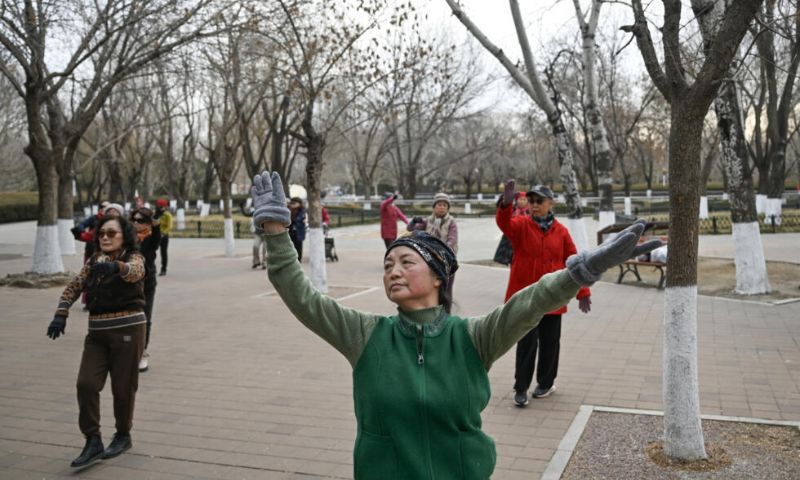



BEIJING: Fifteen years ago, winter along Beijing’s Liangma River meant thick smog and deserted walkways. Today, the riverbanks are alive with families, joggers and pensioners exercising under clearer skies — a visible sign of China’s dramatic progress in curbing air pollution.
The turnaround follows a years-long state-led campaign that mobilised policy, regulation and technology to tackle what was once among the worst air quality in the world.
Authorities relocated heavy industry, shut down or upgraded coal plants, restricted vehicle use in major cities and accelerated the electrification of transport.
Despite the progress, pollution levels in many Chinese cities still exceed limits set by the World Health Organization (WHO). However, the improvement since the height of the so-called “airpocalypse” has been substantial.
Beijing municipality said in January that PM2.5 levels — fine particulate matter capable of entering the lungs and bloodstream — have fallen by 69.8 percent since 2013.
Nationwide, particulate pollution dropped 41 percent between 2014 and 2024, according to the University of Chicago’s Air Quality Life Index (AQLI). The index estimates that cleaner air has increased China’s average life expectancy by 1.8 years.
According to AFP, China’s air quality had deteriorated sharply during its rapid industrial expansion in the 1990s and 2000s, driven largely by coal consumption. Winter temperature inversions often trapped pollutants close to the ground, intensifying smog episodes.
Initial attempts to address the problem included installing desulphurisation equipment at coal-fired power plants and imposing temporary factory closures and traffic restrictions during major events such as the 2008 Beijing Olympics. However, those measures delivered only short-term relief.
Public pressure intensified after the US embassy in Beijing began publishing independent air quality readings, increasing awareness of the health risks. By 2013, some international schools had erected inflatable domes over sports facilities to shield students from toxic air.
That same year, severe haze episodes blanketed several cities. In October 2013, pollution in the northeastern city of Harbin surged to levels 40 times higher than the WHO’s then-recommended limit, bringing transport and schools to a standstill.
Online, the phrase “I’m holding your hand, but I can’t see your face” captured public frustration. Amid mounting concern, China’s ruling Communist Party unveiled a ten-point action plan in 2013, declaring a “war against pollution.”
The strategy expanded nationwide air quality monitoring, imposed strict emissions targets, upgraded industrial technology, and accelerated the closure or relocation of coal mines and power plants. Large cities introduced vehicle restrictions and laid the groundwork for widespread adoption of electric vehicles.
For the first time, binding quantitative air quality targets were introduced with clear deadlines for key regions. According to experts, these measurable goals proved decisive in driving compliance and accountability.
The most significant gains were recorded between 2013 and 2017 in heavily polluted regions, before reforms were broadened nationwide. Analysts say China’s efforts have played a major role in the global decline in air pollution recorded since 2014. Yet challenges remain.
This winter, several Chinese cities — including financial hub Shanghai — frequently ranked among the world’s 20 most polluted urban centres on monitoring platform IQAir.
While 88 percent of days in 2025 were officially classified as having “good” air quality, China’s domestic standard defines “good” as PM2.5 levels below 35 micrograms per cubic metre — significantly higher than the WHO guideline of five micrograms.
China plans to tighten its national standard to 25 micrograms per cubic metre by 2035. Recent data show that nationwide average PM2.5 concentrations declined 4.4 percent year-on-year in 2025.
However, experts note that progress has slowed over the past five years as early, easier reforms — often described as “low-hanging fruit” – have already been implemented.
Research from the Centre for Research on Energy and Clean Air (CREA) indicates that some heavy industries have relocated westward to regions such as Xinjiang, potentially shifting pollution geographically rather than eliminating it. Some cities have even recorded double-digit percentage increases in PM2.5 in recent years.
Environmental analysts argue that the next phase of improvement will depend on structural transformation rather than administrative controls alone.
China has expanded renewable energy capacity rapidly, and coal-fired power generation declined in 2025, offering cautious optimism for further gains.
Experts say sustained improvement will ultimately hinge on reducing reliance on fossil fuels and embedding clean energy at the core of economic development.
While China’s anti-pollution campaign has delivered measurable public health and environmental benefits, officials and researchers agree the battle for consistently clean air is far from over.