
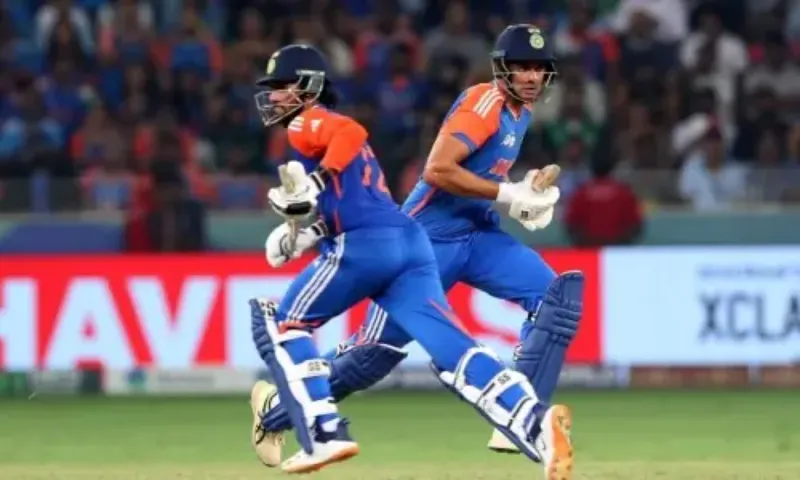
ISLAMABAD: Pakistan’s 61-run defeat to India in the T20 World Cup was shaped by a combination of early batting setbacks, tactical decisions in the field, and India’s clinical execution with both bat and ball.
Chasing 176, Pakistan never recovered after losing three wickets inside the first two overs, while India capitalised on key moments to stay in control and secure a 61-run victory that booked their place in the Super Eight stage.
For Pakistan, the defeat means they must now beat Namibia in their final group-stage encounter on February 18 to keep their tournament hopes alive.
Captain Agha Admits: ‘We Were Chasing the Game’
Pakistan captain Salman Ali Agha, who had won the toss and elected to field first, was left to rue a string of failures across all departments after the match.
“We went with four spinners; they had an off-day. Execution was missing in some parts. With the bat, we did not start well,” Agha admitted during the post-match presentation.
The captain’s decision to bowl first on a tacky Premadasa surface raised eyebrows, particularly given Pakistan’s preparation on similar pitches against Australia at home before the World Cup, where Agha had won all tosses and chosen to bat first.
“If you lose 3-4 wickets in the powerplay, you are always chasing the game,” Agha explained. “In the first innings, it was a bit tacky, and the ball was gripping too. The pitch played better in the second innings, but we did not bowl according to the situation, and we did not apply ourselves with the bat.”
Social Media Erupts as Legends Lambast ‘Pathetic’ Display
The scale of Pakistan’s capitulation triggered a torrent of criticism from former players and cricketing icons, who pulled no punches in their assessment of the team’s performance.
Ramiz Raja, former Pakistan captain and commentator, did not mince words, describing the display as “a bit of a disaster, especially batting.”
“India have been fielding the same bowling attack against Pakistan since the last two or three years, and every time the batsmen have been woefully ordinary,” Raja posted on X. “There was no growth.”
Mohammad Yousuf, another former Pakistan captain, directed his frustration at the senior players, declaring that “time’s up” for Shaheen Shah Afridi, Babar Azam, and Shadab Khan.
“Pakistan’s T20 squad needs new performers, not empty wins against weaker sides,” Yousuf asserted.
Ahmed Shahzad, the former opener, labelled the performance “pathetic cricket” and described it as the “sad story of Pakistan cricket. Same old faces, same old results. Please don’t fool the nation anymore.”
Shahzad urged the team management to inject fresh blood, calling for the inclusion of Fakhar Zaman, Khawaja Nafay, and Salman Mirza. “They should be playing,” he insisted.
Spin Department’s ‘Off-Day’ Proves Costly
Pakistan’s much-vaunted spin attack, which had made history earlier in the day by becoming the first men’s team to deploy six spinners in a T20 World Cup innings, failed to deliver when it mattered most against India’s batting lineup.
While Saim Ayub impressed with career-best figures of 3/25, the experienced duo of Abrar Ahmed and Shadab Khan endured a miserable outing. Abrar conceded 38 runs in his three overs without taking a wicket, while Shadab’s solitary over went for 17 runs.
Captain Agha conceded that his spinners had an “off-day” at the worst possible moment.
Pakistan player Sohaib Maqsood pinpointed the bowling performance as “by far the reason for today’s defeat.”
“It’s not a 180-run pitch, even 140 could have been tough to chase on this pitch,” Maqsood observed on X. He also questioned the decision to bowl first, noting that Pakistan had prepared on similar surfaces against Australia at home before the World Cup and that “Agha won all the tosses and batted first. Why choose to bowl first today?”
Mystery of Faheem Ashraf’s Non-Utilisation
Adding to the confusion surrounding Pakistan’s tactics was the curious case of Faheem Ashraf. The all-rounder, included in the playing XI, was not utilised at all with the ball despite India’s middle-order acceleration and Pakistan’s spinners struggling for control.
With Pakistan using seven bowling options, including six spinners and Shaheen Shah Afridi’s two overs, Faheem’s medium pace remained an unused weapon. The decision raised questions about team balance and tactical flexibility, particularly on a surface where pace-off variations were proving effective.
Batting Collapse: The Same Old Story
If the bowling raised eyebrows, the batting performance evoked despair. Pakistan’s chase never recovered from a catastrophic start that saw them slump to 13 for 3 inside two overs.
Sahibzada Farhan fell for a golden duck in the first over, edging Hardik Pandya to Rinku Singh. Saim Ayub, the hero with the ball, attempted to counterattack but fell LBW to Jasprit Bumrah for 6. Two balls later, captain Salman Agha edged to Pandya, and Pakistan were in tatters.
Babar Azam, the team’s most experienced batter, was trapped LBW by Axar Patel for just 5, leaving Pakistan at 34 for 4. Only Usman Khan offered resistance with a defiant 44 off 34 balls, but his dismissal triggered another collapse that saw the last six wickets fall for 41 runs.
Former England captain Michael Vaughan observed that India “seem to intimidate Pakistan on the cricket field.”
“They are so much better in all facets of the game and have such a better mentality of coping with the huge occasion,” Vaughan noted.
Experts Identify Deep-Rooted Problems
Beyond the immediate post-mortem, cricket analysts pointed to systemic issues plaguing Pakistan cricket.
Indian commentator Harsha Bhogle attributed the performance to excessive pressure from Pakistan’s cricket administration.
“You could see that in how tentative they were,” Bhogle wrote on X, referring to the batters’ approach during the chase.
Sports presenter Zainab Abbas described the game as a “one-sided affair” that was “really indicative of the gap between the two sides over the years.”
“That said, Pakistan did not even come close to playing to its potential, bowled poorly, and batted recklessly,” Abbas continued. “The ones Pakistan have backed and relied on in bilaterals have put up a poor show in tournaments, and not for the first time.”
Qualification Hopes Hang by a Thread
Despite the demoralising defeat, Pakistan’s T20 World Cup campaign is not yet over. The Green Shirts must now regroup for a must-win encounter against Namibia on February 18, with victory essential to secure qualification for the Super Eight stage.
Captain Agha struck a defiant tone, urging his team to move forward.
“In these games, the emotions are always going to be high; we just need to deal with it. We have played enough of these games,” Agha said. “We have a game in a couple of days, and we have to look forward to it. We need to win that and qualify. Then it is a new tournament.”
What’s Next for Pakistan
Pakistan now faces a straightforward equation: beat Namibia on February 18 to secure their place in the Super Eight. However, the manner of this defeat has raised serious questions about the team’s mentality, tactical acumen, and ability to perform under pressure.