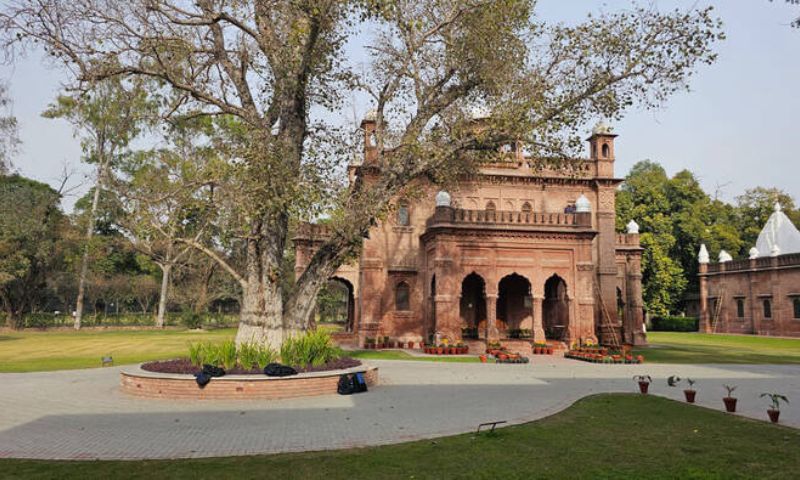



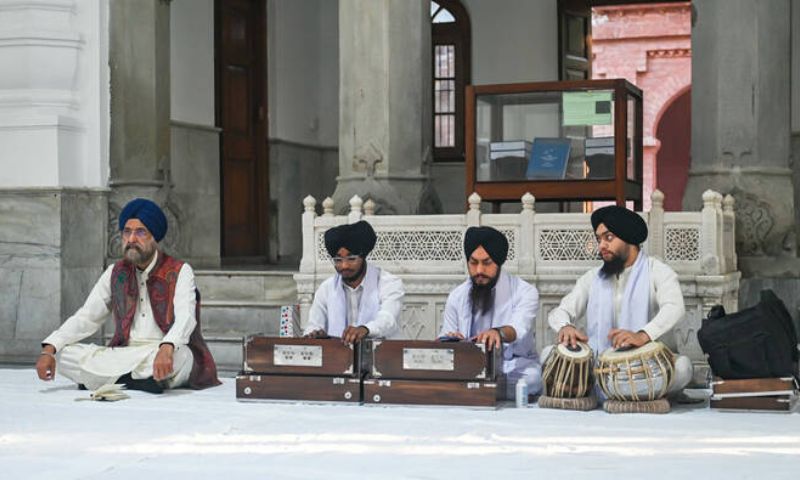
ISLAMABAD: A Sikh temple located inside Lahore’s historic Aitchison College held a prayer on Friday, marking its first service in nearly 80 years since reopening.
Founded in 1886 to educate the sons of royalty and prominent families of Punjab province, Aitchison College has welcomed students from Muslim, Hindu, and Sikh communities.
Following the Partition of India and Pakistan in 1947, Sikh enrollment came to an end, and the gurdwara (Sikh temple) ceased functioning as an active place of worship, though the college continued to preserve the building.
Friday’s prayer ceremony was held as part of the celebrations commemorating the elite institution’s 140th anniversary.
“A historic and emotional Sikh worship service was held at the Gurdwara on the campus of Aitchison College,” the college said in a statement.
A testament to the subcontinent’s shared cultural heritage, the gurdwara at Aitchison College stands as a piece of living history.
Designed by renowned Sikh architect Ram Singh of the then Mayo School of Arts (now the National College of Arts), its foundation stone was laid in 1910 by Maharaja Bhupinder Singh of Patiala—a former Aitchison student himself, having studied there from 1904 to 1908. The Patiala royal family also played a key role in fundraising for its construction.
Completed shortly thereafter, the gurdwara served as a daily prayer space for Sikh pupils attending the college. Today, its legacy endures in the memories of about 15 Sikh alumni now living in India, who fondly recall attending evening prayers there and vividly describe its striking black-and-white marble flooring and castle-like interior architecture.
The gurdwara is not alone in its historical significance; the campus also houses other pre-Partition places of worship, including a mosque built in 1900 by the Nawab of Bahawalpur and a Hindu temple whose foundation stone was laid in 1910 by the Maharaja of Darbhanga.
Over the decades, Aitchison College has cultivated a remarkable legacy, educating prominent figures from across pre-Partition Punjab and modern South Asia.