When the Pakistan Super League was launched in 2016, it was imagined as more than a commercial T20 property. It was a corrective project: to restore cricket’s centre of gravity back to Pakistan, city-based loyalties and passionate fan communities, mirroring the emotional fabric that underpins the world’s most successful franchise competitions.
PSL’s six initial franchises were anchored to distinct urban identities across Pakistan. These teams were meant to transcend matchday cricket, creating a sense of pride, nostalgia and belonging among local supporters — the same cultural essence seen in European football’s club loyalties and top-tier T20 competitions.
Start of new era of PSL
After a decade of stability and success, the PSL’s expansion through the auctioning of its 7th and 8th franchises was positioned by the PCB as a marker of growth, renewed investor confidence, and the start of a new era.
The 7th team, later branded Hyderabad Houston Kingsmen, entered the auction at a base price of PKR 1.1 billion and was eventually sold for PKR 1.75 billion.
The 8th franchise, subsequently named Sialkot Stallionz, began with a higher base valuation of PKR 1.7 billion and was secured for PKR 1.85 billion.
Multan Sultans entered HBL PSL in 2018 as its 6th franchise, and crucially, the league’s only representation from South Punjab.
After the franchise’s contract was not renewed by its previous owner, Ali Tareen, the PCB—citing a favourable commercial climate—opted to place the team back on auction.
South Punjab’s only PSL franchise
On 9 February, the bidding for the PSL’s 6th team was held with a record base price of PKR 1.82 billion, the highest ever set for a franchise in the league’s history.
The winning bidder, who belonged to Rawalpindi, bought it for PKR 2.45 billion and was subsequently permitted by the PCB to change both the city affiliation and the team’s identity.
The franchise was relocated to Rawalpindi, effectively bringing an end to Multan Sultans as a distinct PSL brand.
What made the decision particularly jarring was the manner in which the process had been positioned.
The auction was marketed—and widely perceived—as a bidding exercise for Multan Sultans.
It was assumed that prospective owners were competing to acquire an established team with an existing fan base and regional identity, not a licence to rebrand altogether.
The announcement of the name change came as a shock, especially in South Punjab, where Multan Sultans had built a strong emotional following, and among supporters who had come to associate the franchise with the city’s cricketing resurgence.
In practical terms, it has left Multan and Faisalabad, two cities with international-standard stadiums and proven cricketing audiences, without PSL representation.
How other leagues anchor identity
In the Indian Premier League, franchises are city brands, immovable assets. IPL expanded from eight to ten teams in 2022, it did so by adding two new cities, not by relocating existing sides or erasing established fan bases.
Moreover, all 10 teams have their own home grounds, and they decorate those grounds according to their branding rules.
All eight teams in the BBL are owned by Cricket Australia, yet each represents a fixed metropolitan region. Each of them has a home ground.
The SA20, despite being a relatively new league, understood this from day one.
All six franchises are owned by IPL parent companies—yet each team is firmly rooted in South African cities like Cape Town, Durban and Pretoria. Even if ownership is global, identity remains local. All of them have their home stadiums.
Against this backdrop, PSL’s recent decisions feel increasingly unpopular and divergent.
More than a name change
Multan Sultans was an established brand, built a loyal following in South Punjab, reached multiple finals, and turned Multan Cricket Stadium into one of the league’s most reliable venues.
Multan gave the best hospitality to the PSL teams. The stadium remained mostly house full.
Faisalabad, meanwhile, remains another conspicuous absentee despite Iqbal Stadium’s history of sell-out internationals.
But it never had its PSL franchise. For people of South Punjab, this felt less like expansion and more like exclusion.
Why did PCB do this?
From the PCB’s perspective, the rationale is not entirely opaque. The board is under constant financial pressure, with annual budgets dependent on broadcast revenues and ICC distributions.
Auctioning franchises offers immediate liquidity. After recent auctions, PCB will receive USD 31 million annually from the PSL franchise as a fee. Money received from media rights, broadcasting deals, and sponsorship deals are additional.
It receives almost USD 35 million from ICC according to its present revenue-sharing model. So, the new team’s bidding gives PCB some financial muscle and less dependency on the ICC fund.
To give the best options to owners so that they will bid the maximum, PCB allowed the new owner of Multan Sultans to change the city name. As the new owner belonged to Rawalpindi, he changed the city names as soon as he won the bidding war.
“We grew up on the streets of Satelite Town, Banni, 6th Road and Raja Bazar; therefore, we named our team Rawalpindi,” the owner of the Rawalpindi franchise said after the bidding ended.
Public and expert reaction
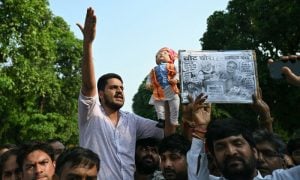
The backlash has been swift and emotionally charged. Social media campaigns are calling for a boycott of PSL matches in South Punjab.
What about South Punjab?, they have no representation now?
The PCB should reject this. Despite being from Rawalpindi myself, I think this is unfair. https://t.co/srTbLWYn9H
— Mohsin Ali (@Mohsin_o2) February 9, 2026
Usman wrote on X: “I’m sorry, but this option should never have been given. I know they paid a huge amount—PKR 245 crore—so technically they can do what they want, but still, the auction was for Multan. Where did Rawalpindi come from?”
Fahim Akhtar questioned the decision, asking: “Will the people of Multan or South Punjab now travel to Multan Cricket Stadium to watch matches featuring Lahore, Islamabad, Rawalpindi, Sialkot, Karachi, Quetta, Hyderabad and Peshawar? Why has Multan been removed from the PSL?”
Hassan expressed his frustration, writing: “Multan Sultans did a lot for cricket in South Punjab.
It had a home stadium and provided genuine regional representation. First, the owner was pushed out, and now an entire region has lost its place in the PSL.
Tbh it’s unfair on Multan and Faisalabad 2 of the biggest cities to not have any representation in PSL
— Hass 🏆 🏆 🏆 (@GokboruWolf) February 9, 2026
Former players and analysts have been more measured but no less critical. Several have pointed out that franchise instability discourages serious long-term investment.
Others have warned that PSL risks diverging from the city-rooted league model that has been quite successful in other countries.
Missed opportunity: Expansion, not replacement
For a country of 240 million people, the idea that Pakistan cannot sustain 9 or 10 PSL teams feels increasingly untenable. The IPL did not dilute its product by expanding; it deepened it.
A structured expansion to include Multan and Faisalabad as separate franchises, while retaining existing identities, would have aligned PSL with global best practice and unlocked new regional markets.
Moreover, stadiums in Hyderabad, Sialkot, Peshawar and Quetta should be renovated and used as their home grounds. Twin cities need a new stadium in Islamabad that can become the home ground of Islamabad United.
More teams and more stadiums mean more matches, more inventory and broader national engagement.