
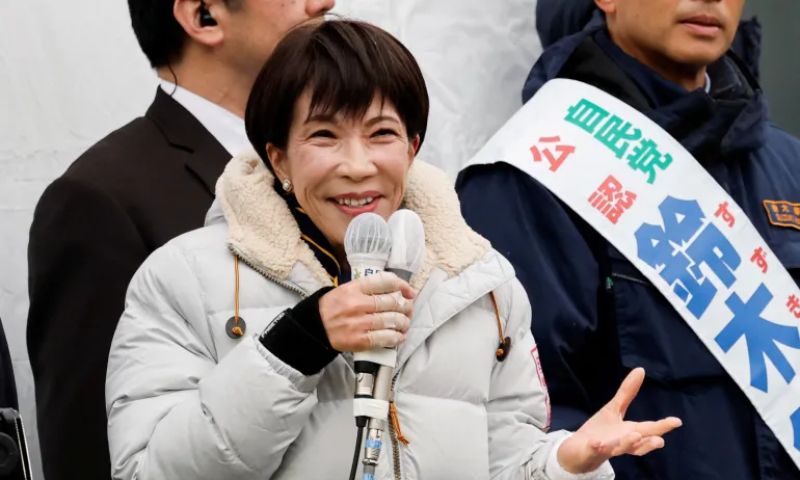
TOKYO: Japanese stocks surged to record highs Monday following Prime Minister Sanae Takaichi’s election triumph, signaling optimism among investors about the country’s economic prospects under its first female leader.
Experts noted, however, that balancing voter expectations with market stability will be a delicate task.
Takaichi’s conservative Liberal Democratic Party (LDP) achieved its best result since its founding in 1955, winning a two-thirds majority in Sunday’s snap lower house election, according to Japanese media.
At 64, Takaichi leveraged her popularity since taking the helm of a struggling LDP in October, becoming Japan’s fifth premier in five years, according to AFP.
On Monday, the Nikkei 225 briefly jumped more than five percent, surpassing 57,000 points for the first time, while the yen strengthened against the dollar.
Analyst Kyle Rodda of Capital.com noted that the victory provides Takaichi “the mandate she was looking for for her big-spending agenda.”
He added that equities are “poised to benefit from higher fiscal spending but interest rates that remain accommodative and negative in real terms.”
SPI Asset Management’s Stephen Innes said politically, the win gives Takaichi freedom of action, removing the need to negotiate every decision down to the lowest common denominator.
While inflation has been a past concern for voters—households felt the impact of rising prices, including a doubling in the cost of rice in 2025—the new administration aims to address these pressures.
After a $135-billion stimulus last year, economists note that Takaichi’s policy room is carefully watched due to Japan’s high debt, which exceeds twice the size of its GDP, the largest ratio among major economies.
The yen’s recent weakness has spurred speculation about potential interventions, possibly in coordination with U.S. authorities. Takaichi’s remarks earlier this month highlighting benefits for exporters from a weaker yen added to currency market attention.
During the campaign, Takaichi proposed suspending the consumption tax on food, a move that initially affected long-term Japanese bond yields.
On Sunday, she told local media that discussions on such measures would continue, estimating potential revenue impacts of 5 trillion yen ($32 billion) annually.
“Most parties are in favor of reducing the consumption tax… I strongly want to call for the establishment of a supra-party forum to speed up discussion on this, as it is a big issue,” Takaichi said.
She reiterated a commitment to a “responsive and proactive” fiscal policy and emphasized that both public and private sectors must invest to build a resilient economy.
Tetsuo Kotani from the Japan Institute of International Affairs noted that voter expectations will be closely watched, and stressed the administration will need to balance fiscal and social priorities carefully.
Takaichi has also pledged to increase defense spending as part of commitments to U.S. President Donald Trump, aiming for a more self-reliant security strategy.
Analysts caution that personnel shortages linked to Japan’s low birth rate may limit the speed of fundamental defense improvements.
Marcel Thieliant at Capital Economics indicated that major new spending or tax cuts are unlikely immediately, viewing recent fiscal expansion as primarily an effort to bolster public support ahead of the election.
With Upper House elections not due until 2028, further major fiscal moves are not anticipated.
Hiroshi Shiratori, a politics professor at Hosei University, observed that Takaichi seeks to emulate former Premier Shinzo Abe’s “Abenomics” of robust spending and lower interest rates.
“But Abenomics occurred during deflation and a stronger yen,” Shiratori said. “Now, inflation and a weaker yen create different dynamics, and markets are mindful of potential fiscal impacts, even if voters do not yet see the full picture.”