


NEW YORK: The Organization of Islamic Cooperation (OIC) has renewed its call for a definitive settlement of the Jammu and Kashmir dispute and the Palestine question in accordance with relevant United Nations Security Council (UNSC) resolutions, underscoring that lasting peace is essential for meaningful social and economic development.
Addressing a side-event held on the margins of the 64th session of the UN Commission for Social Development at UN Headquarters, OIC Permanent Observer to the United Nations Ambassador Hameed Opeloyeru highlighted the deep and lasting impact of wars and protracted conflicts on societies.
He noted that conflict disproportionately affects civilians and vulnerable groups, including women, children, youth, and persons with disabilities, while also causing displacement and widespread damage to social and physical infrastructure, according to the Sabah News Agency.
Ambassador Opeloyeru emphasized that the OIC maintains a strong peacebuilding support framework, reflected in the mandates of its Contact Groups on Palestine, Muslims in Europe, the Rohingya, Jammu and Kashmir, and Afghanistan.
He said the OIC’s peacebuilding and social development initiatives are focused on restoring the inalienable national rights of the Palestinian people, achieving a definitive settlement of the Jammu and Kashmir dispute in line with UNSC resolutions, and securing the rights of the Rohingya people of Myanmar, among other priority issues affecting OIC member states.
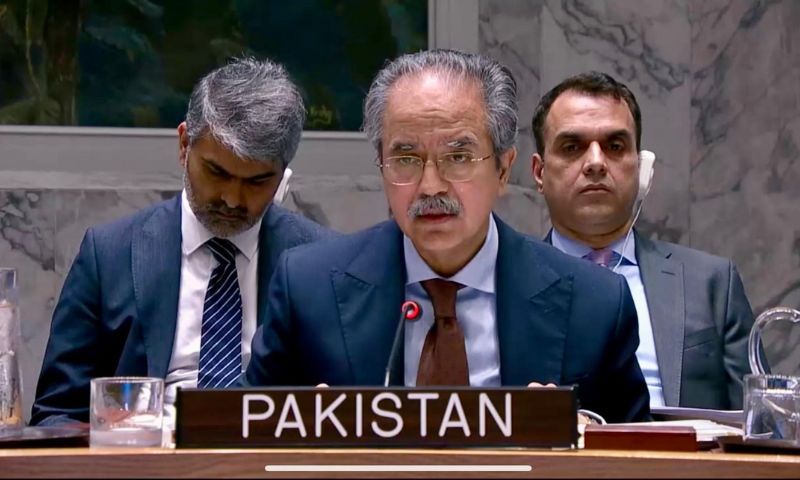
In his opening remarks, Pakistan’s Permanent Representative to the UN, Ambassador Asim Iftikhar Ahmad, who presided over the event, described the situation in Indian Illegally Occupied Jammu and Kashmir (IIOJK) as one of prolonged occupation spanning more than seven decades.
He said this condition has permeated every aspect of daily life, from education and employment to mobility, freedom of expression, and hope itself.
Referring to the heavy military presence in the region, Ambassador Asim portrayed the lived reality of Kashmiris as marked by interrupted childhoods, constrained aspirations, and a future overshadowed by uncertainty, stressing that development cannot take root where dignity is denied and voices are silenced.
He further noted that civilian life in Jammu and Kashmir has been subjected to extraordinary militarization, citing enforced disappearances, extrajudicial killings, arbitrary detentions, and a culture of impunity.
He said these practices have fractured families, traumatized communities, and eroded social trust, leaving deep psychological scars across Kashmiri society.
Speaking at the event, Ambassador Ahmet Yildiz, Turkey’s Permanent Representative to the UN and Chair of the OIC Council of Foreign Ministers, reaffirmed support for a fair and lasting resolution of the Kashmir issue in line with the UN Charter and relevant resolutions.
He emphasized that dialogue between the parties is essential to restoring peace and stability in the region and said that resolving the Kashmir dispute would contribute to broader prosperity and sustainable development across South Asia and beyond.
Ambassador Yildiz described Jammu and Kashmir as a conflict-affected region where nearly eight decades of unresolved dispute have created profound social development challenges.
He noted that prolonged tensions, human rights concerns, economic hardship, and infrastructural deficiencies have deepened the humanitarian dimension of the conflict.
Marking Kashmir Solidarity Day, he stressed that fulfilling the aspirations of the Kashmiri people is vital for achieving lasting peace and enabling social and economic progress.
Ambassador Tofig F. Musayev, Permanent Representative of Azerbaijan to the United Nations, highlighted the severe social and humanitarian consequences of conflict and occupation, including displacement, food insecurity, disrupted education, and long-term psychological harm, particularly to children.
He reaffirmed Azerbaijan’s consistent support for the people of Palestine and Kashmir in their pursuit of the right to self-determination as mandated by UNSC resolutions.
Dr. Ghulam Nabi Fai, Chairman of the World Forum for Peace and Justice, focused on the social development implications of the Kashmir conflict, arguing that sustainable development is impossible under conditions of prolonged occupation, militarization, and insecurity.
He noted that frequent curfews, communication shutdowns, and the persistent risk of escalation between two nuclear-armed neighbors have disrupted everyday life.
He also cited the impact of legal frameworks such as the Public Safety Act (PSA) and the Unlawful Activities Prevention Act (UAPA), which he said grant broad immunity and undermine accountability, adversely affecting education, healthcare, cultural life, social cohesion, and mental well-being.
Dr. Fai drew attention to the impact of conflict on children, stating that fear and insecurity have reshaped the very concept of childhood in Kashmir.
He said tens of thousands of children have lost one or both parents, exposing them to psychological trauma, social stigma, and economic hardship. Citing Save the Children, he noted that the number of orphans in Kashmir rose from 35,000 in 1995 to 80,000 in 2007.
Highlighting the gendered impact of conflict, Dr. Fai said violence against women remains a major obstacle to social development in Kashmir.
He referred to documentation by UN Special Rapporteurs and international human rights organizations indicating the persistence of such violence with impunity.
He also discussed the plight of “half-widows,” women whose husbands have disappeared but have not been declared dead, noting estimates by the U.S. State Department of 8,000 to 10,000 enforced disappearances in the region.
Referring to emblematic cases such as Kunan-Poshpora, Dr. Fai said the long-term social stigma faced by survivors illustrates the compounded trauma caused by conflict and patriarchal norms.
He also highlighted the significant economic costs of militarization, citing estimates by the Kashmir Chamber of Commerce and Industry that place losses at approximately Rs 50,000 crore (USD 5.5 billion) in the two years following August 5, 2019, with projected losses exceeding Rs 200,000 crore (USD 27.5 billion) over a longer period.
Dr. Fai urged the UN Commission for Social Development to encourage the Government of India to allow visits by the UN Special Rapporteur on Violence against Women and the Special Rapporteur on the Sexual Exploitation of Children to conduct independent assessments and report to the UN Human Rights Council.
Drawing parallels between Palestine and Jammu and Kashmir, Palestinian academic, writer, and journalist Dr. Abdulhamid Siyam described both regions as enduring symbols of life under occupation and denial of self-determination.
He said that without political will to protect essential infrastructure such as schools, hospitals, and legal identity, international conferences risk merely documenting tragedies rather than preventing them. He emphasized that real solidarity requires accountability.
Speaking from lived experience in the West Bank, Dr. Siyam said meaningful social development is impossible amid occupation, displacement, and systemic dismantling of society.
He highlighted mass displacement, denial of education, movement restrictions, daily humiliation, and entrenched impunity as defining features of life in Gaza and the West Bank.
Aamer Ahmad Atozai, from the Consulate General of Pakistan in New York, said that as Kashmir Solidarity Day is observed, Pakistan recalls the plight of the people of Indian Illegally Occupied Jammu and Kashmir, who continue to face repression, human rights violations, and denial of fundamental rights.
He reaffirmed Pakistan’s commitment to advocating for a just and peaceful resolution of the Jammu and Kashmir dispute in accordance with the will of the Kashmiri people and UNSC resolutions, pledging continued engagement with partners to ensure social development efforts reach the most vulnerable.
In his closing remarks, the Consul General acknowledged members of the Kashmiri community present at the UN event, noting that many carry the lived reality of separation, loss, and prolonged uncertainty.
He said that despite divided families and disrupted livelihoods, the Kashmiri people have shown remarkable resilience and dignity, preserving their identity, culture, and peaceful aspirations.
The event was moderated by Ms. Saima Saleem, Counsellor at the Pakistan Mission to the United Nations and an accomplished diplomat, who served as emcee.