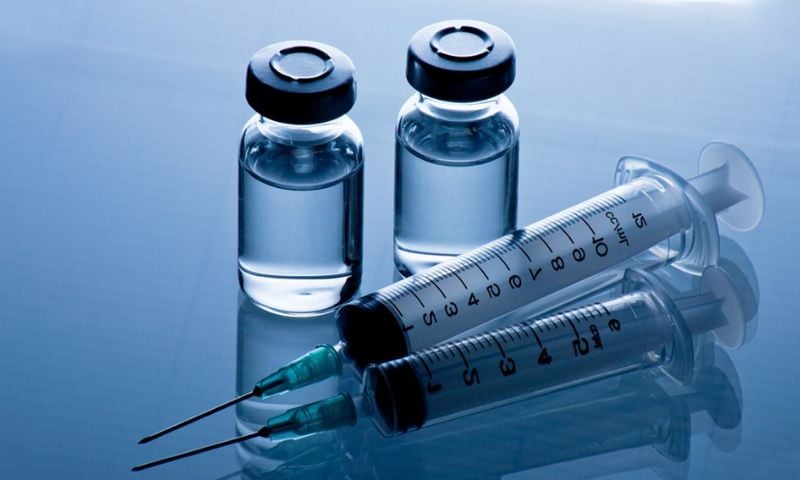



ISLAMABAD: Pakistan says it is “very close” to finalising an agreement with Saudi Arabia that would allow the country to begin local production of vaccines, a move officials say could transform national health security and significantly reduce long-term costs.
According to Health Minister Syed Mustafa Kamal, negotiations with Riyadh have reached an advanced stage and the vaccine manufacturing could begin within the next three years if the agreement is signed.
An 11-member Saudi delegation, led by Nizar Al-Hariri, senior adviser to the Kingdom’s minister of industry, arrived in Pakistan a few days ago and held discussions with health officials on setting up vaccine manufacturing facilities in the country.
The talks come as part of Pakistan’s broader effort to strengthen its healthcare resilience and industrial capacity. The country of more than 240 million people currently imports all vaccines used in its national immunisation programme, relying heavily on international partners to help shoulder the costs.
“We have not yet reached the agreement, but we are reaching toward the agreement,” Arab News reported on Wednesday quoting Health Minister Syed Mustafa Kamal.
He said Pakistani authorities have been in contact with the Saudi government on the project for the past six to seven months, describing steady progress.
Pakistan currently provides free vaccines for 13 diseases, importing them at an annual cost of around $400 million. According to the health ministry, international partners cover about 49 percent of this amount, with the remaining cost borne by the government.
However, this external funding is expected to end after 2030, a looming deadline that has accelerated Islamabad’s push for domestic production.
Kamal said local manufacturing would significantly reduce Pakistan’s reliance on imports and better prepare the country for the post-donor era. He said vaccine manufacturing would begin much earlier than previously anticipated once the agreement is signed.
He explained that production would be rolled out in phases. Within the first year, Pakistan could begin packing and filling vaccines, followed by more advanced stages in the second year.
“By the third or fourth year, we could go to the seeds’ production and other indigenous vaccines,” he said. “The entire thing should be done here in Pakistan.”
The project is expected to be a joint partnership between Pakistan and Saudi Arabia, with the possibility of Indonesia joining at a later stage. Kamal noted that the precise structure of the agreement is still being finalised.
Explaining why Pakistan is keen on partnering with Saudi Arabia, Kamal highlighted the Kingdom’s achievement of the World Health Organization’s Maturity Level Four (ML-4)—the highest regulatory standard for medicines and vaccines.
“Well, Saudi Arabia has done a tremendous job,” he said. “They are working on this issue, on this local vaccine production for the last 10 years.”
Pakistan currently holds an ML-2 certification and aims to move up the regulatory ladder. Saudi technical support, Kamal said, could help Pakistan move closer to international pre-qualification standards, a key requirement for exporting vaccines globally.
The minister reiterated that the drive for local production is closely linked to the expected end of donor support after 2030. “When this support ends, the government would have to pay around $1.2 billion to import vaccines,” he said.
Pakistan’s annual vaccine requirement stands at about 130 million doses, a scale Kamal said is not sufficient for cost-effective mass production unless output is increased. “Unless and until we have 300 to 400 million doses, then it becomes a viability,” he explained.
To achieve that scale, Pakistan plans to export vaccines once domestic production is established, building on its existing pharmaceutical export base.
“Pakistani medicines are going all over the world,” Kamal said. “Africa, Europe, the Middle East, Central Asian countries. So, the same way, we will be marketing our vaccine to different parts of the world as well.”
He added that the government has already introduced leading Pakistani pharmaceutical firms to the Saudi delegation, opening the door for business-to-business partnerships. According to Kamal, tangible progress on local vaccine production could be seen within three years.