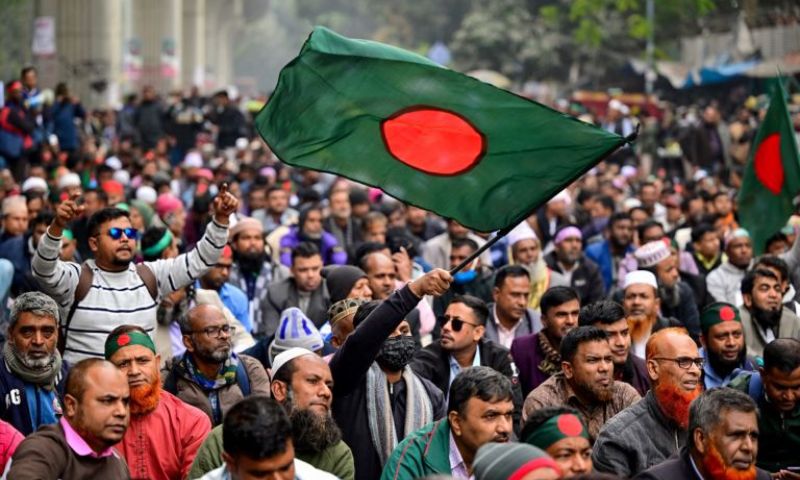



DHAKA: Bangladesh is preparing for a pivotal general election on February 12, nearly two years after a student-led uprising toppled long-time Prime Minister Sheikh Hasina and ended the Awami League’s 15-year grip on power.
The vote is widely seen as a turning point not only for Bangladesh’s fragile democracy, but also for the strategic calculations of India, Pakistan, and China.
The country is currently governed by an interim administration led by Nobel Peace Prize laureate Muhammad Yunus. With the Awami League barred from contesting the polls over its role in the violent 2024 crackdown—where around 1,400 protesters were killed—the political battlefield is now dominated by the Bangladesh Nationalist Party (BNP) and Jamaat-e-Islami Bangladesh (JIB).
Both parties began campaigning in late January amid heightened political tension and sporadic violence, according to Al Jazeera.
Hasina, now 78 and living in exile in India, was tried in absentia by Bangladesh’s International Crimes Tribunal in November 2025 and sentenced to death.
India has so far refused to extradite her, further straining bilateral ties. Hasina has denounced the upcoming vote, warning that “a government born of exclusion cannot unite a divided nation.”
Analysts say her removal has triggered a major realignment in Bangladesh’s foreign policy. “Bilateral relations with India have witnessed a historic low, in contrast to a warm rapprochement with Pakistan. Strategic ties with China have deepened significantly,” said Khandakar Tahmid Rejwan, a lecturer at the Independent University, Bangladesh.
Under Hasina, Dhaka cultivated close ties with New Delhi, kept Islamabad at arm’s length, and pursued a carefully balanced partnership with Beijing. Since 2024, that pattern has reversed or evolved—raising the stakes for all three regional powers as Bangladesh heads to the polls.
India: Strategic Loss and Cautious Re-engagement
For decades, India viewed Bangladesh as a cornerstone of its South Asia security strategy. Before Hasina’s ouster, India was Bangladesh’s largest Asian trading partner, exporting $11.1bn worth of goods between April 2023 and March 2024 and importing $1.8bn in Bangladeshi products.
That relationship has deteriorated sharply since 2024. Trade restrictions, rising anti-India sentiment, protests following the murder of activist Osman Hadi, and allegations of mistreatment of Bangladesh’s Hindu minority have all added to the strain.
Tensions even spilled into sports diplomacy, culminating in Bangladesh’s expulsion from the ICC Men’s T20 World Cup and Pakistan’s subsequent boycott of its match against India.
“India suffered a significant strategic loss when Hasina was ousted,” said Michael Kugelman of the Atlantic Council. New Delhi remains uneasy about the interim government, which it believes has been influenced by Islamist groups perceived as hostile to Indian interests.
Still, India has cautiously reopened channels. Prime Minister Narendra Modi met Yunus on the sidelines of a BIMSTEC summit last year, reaffirming India’s support for a “democratic, stable and inclusive Bangladesh.” External Affairs Minister S. Jaishankar has also signalled goodwill ahead of the elections.
India’s preference? Analysts say New Delhi would be most comfortable with a BNP-led government, while a Jamaat victory would raise political and security concerns. Yet with polls suggesting a tight race, India has hedged its bets—engaging both BNP and Jamaat leaders in recent months.
Pakistan: Opportunity in Political Change
Since Hasina’s fall, Pakistan-Bangladesh relations have shown renewed momentum, with both countries seeking to move beyond decades of strained ties shaped by the events of 1971.
Prime Minister Shehbaz Sharif has met Yunus twice, while senior Pakistani officials have pushed to revive defence, trade and diplomatic ties.
In the past year alone, Dhaka and Islamabad have resumed direct trade, restarted direct flights after 14 years, and held military and defence dialogues—developments unthinkable just a few years ago.
“Pakistan wants to heighten India’s security concerns by developing closer strategic ties with Bangladesh,” Rejwan explained, noting that Islamabad’s own economic constraints limit what it can offer beyond defence and cultural diplomacy.
Analysts say Pakistan would welcome either BNP or Jamaat coming to power, but a Jamaat-led government would be Islamabad’s ideal outcome. Even so, Pakistan remains wary of any post-election government in Dhaka rebuilding strong ties with New Delhi, which could undermine Islamabad’s recent gains.
China: Stability, Investment, and Strategic Reach
China, meanwhile, appears to be the most confident external player ahead of the election. Beijing has maintained strong relations with Bangladesh regardless of which party is in power and moved quickly to embrace Yunus’s interim government.
Since 2024, China has committed around $2.1bn in investments, loans, and grants, expanded infrastructure cooperation, and offered assistance with the Rohingya refugee crisis in Cox’s Bazar. Discussions over possible fighter jet purchases have also taken place, though no deal has been finalised.
“China was pragmatic about Hasina’s ouster and among the first to support the interim government,” Rejwan said. “Sino-Bangladesh relations were strong under Hasina and are even stronger now.”
Chinese officials have met leaders from both BNP and Jamaat in the past year, signalling Beijing’s preference for inclusive engagement rather than backing a single political force.
For Beijing, the priority is political stability—protecting its investments and expanding its strategic footprint in South Asia, a region long seen as India’s sphere of influence. Unlike India, China has largely avoided overt involvement in Bangladesh’s internal politics and is expected to work closely with whoever emerges victorious.
A Vote with Regional Consequences
As Bangladesh approaches election day, the outcome will shape not only its domestic trajectory but also the balance of power in South Asia. India hopes for a reset, Pakistan sees a rare opening, and China is positioning itself as a steady, indispensable partner.
Whoever wins in Dhaka will inherit a divided nation—and a foreign policy landscape more complex, competitive, and consequential than at any time since independence.