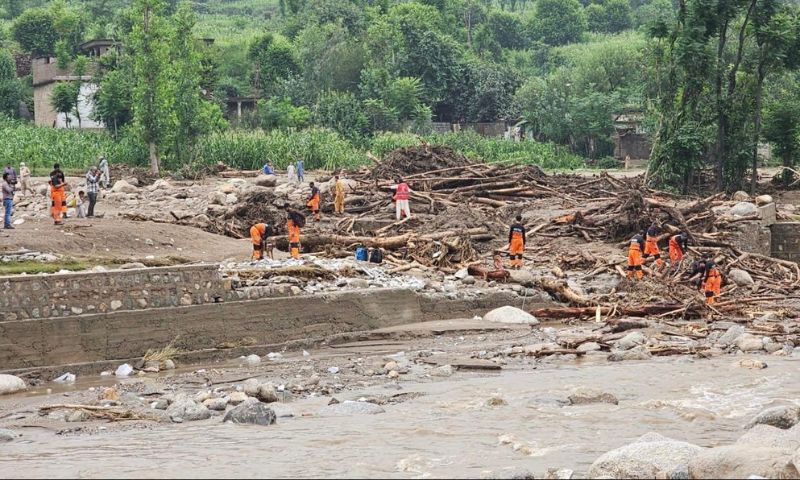
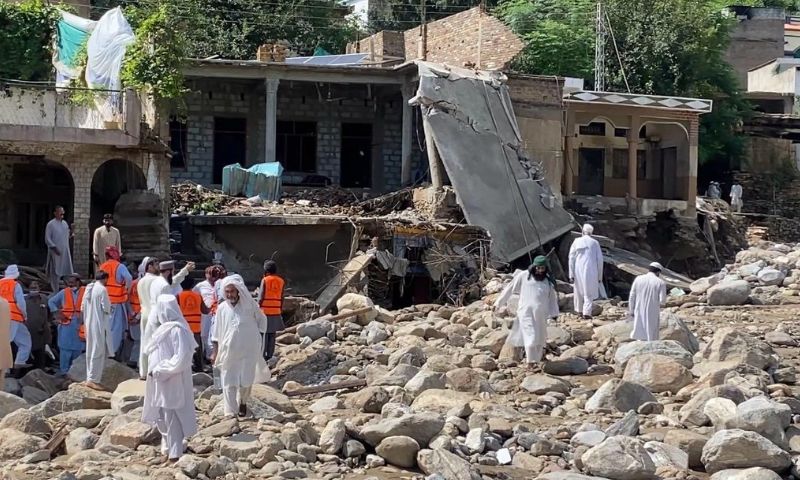
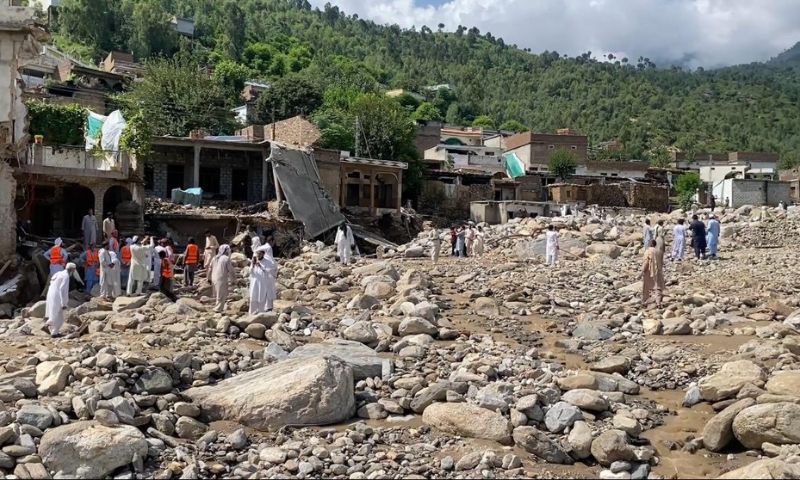
PESHAWAR, Pakistan: When 52-year-old farmer Abdur Rahman lost his mud house and standing crops to a sudden flash flood in Upper Dir last summer, he had only minutes to grab his children and flee, caught completely off guard.
Overnight, the flash flood, triggered by intense rainfall and glacial melt, wrought destruction, sweeping away parts of his home, livestock and standing crops, leaving his family with no option but to seek refuge in a nearby school building.
Many residents reported they received no early warning, no evacuation alert; they heard only the deafening roar of water, a phenomenon that has become a disturbingly routine occurrence for communities living along Khyber Pakhtunkhwa’s vulnerable river systems.
Climate chaos across KP
Rahman’s loss is not an isolated incident. Across Khyber Pakhtunkhwa (KP), climate-induced disasters — from flash floods and landslides in the northern districts to intensifying heatwaves in the south — are striking with alarming regularity, exposing the province as Pakistan’s most fragile climate frontline.
Official climate data bears out the claim of prolonged heatwaves. According to Pakistan Meteorological Department (PMD) and Khyber Pakhtunkhwa’s Provincial Disaster Management Authority (PDMA) assessments, southern districts of Khyber Pakhtunkhwa — including Dera Ismail Khan, Tank, Bannu, Lakki Marwat and Karak — have recorded a steady and consistent rise in average temperatures over the last two to three decades.
The presence of major rivers and mountainous terrain further exacerbates the impact of climate change, increasing both the frequency and severity of disasters.” – Anwar Shehzad, PDMA Spokesperson
Summer temperatures now frequently exceed historical averages by as much as 3–5°C, while the frequency and duration of heatwaves have risen sharply.
PDMA data shows that heatwave episodes in southern Khyber Pakhtunkhwa have become more frequent since 2010, contributing to heatstroke cases, water stress, crop losses and heightened mortality risks, particularly among elderly populations and outdoor labourers, who bear the brunt.
PDMA Spokesperson Anwar Shehzad sees Khyber Pakhtunkhwa’s vulnerability rooted in a deadly mix of geography and climate change.
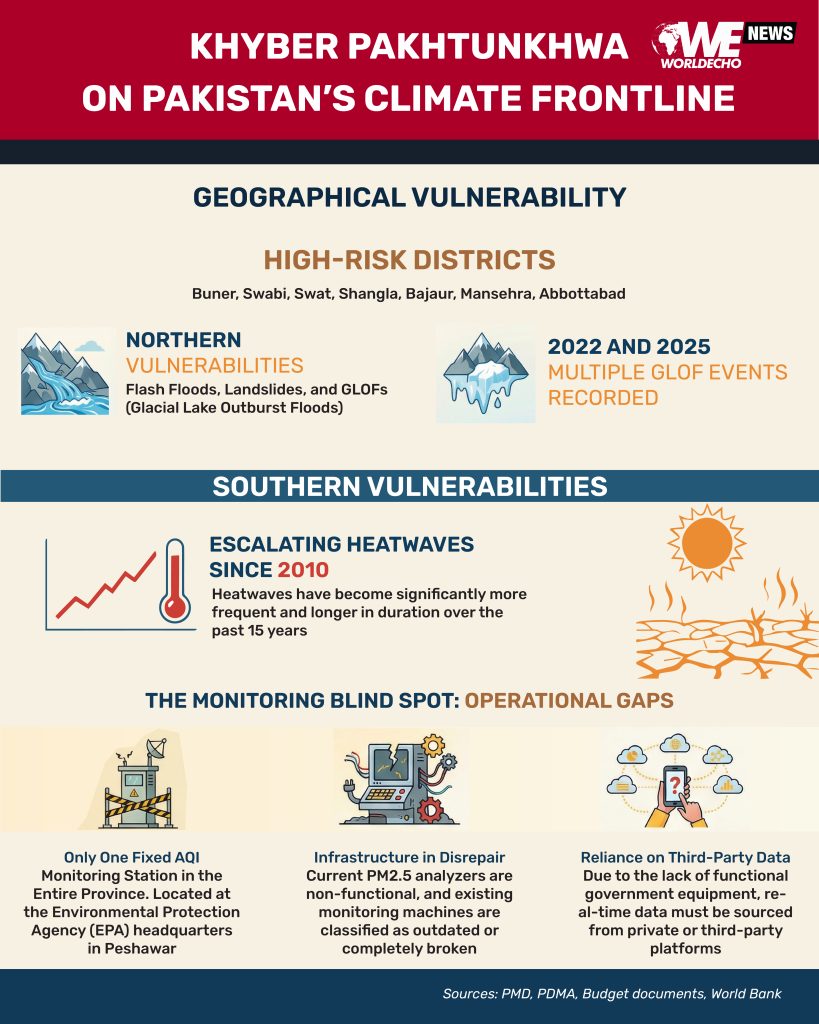
The province’s geographical diversity, he says, makes it highly prone to flash floods, landslides and glacial lake outburst floods (GLOFs), while extreme weather patterns, unpredictable rainfall and prolonged heatwaves have further stacked the odds against it.
GLOF wreaks havoc
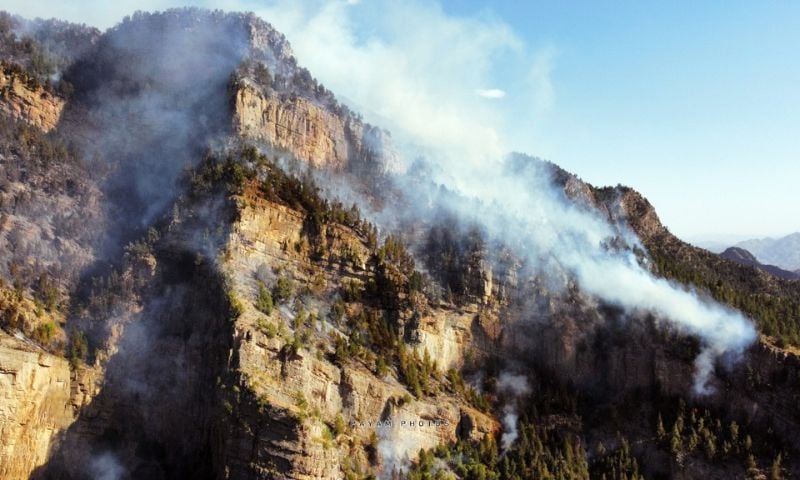
PDMA records show multiple GLOF incidents in recent years, particularly in Upper Chitral, Lower Chitral, Upper Dir, Swat, Kohistan and Mansehra, painting a grim picture.
Between 2022 and 2025 alone, several GLOF events damaged homes, irrigation channels, power infrastructure and roads in Chitral and Upper Dir, forcing evacuations and bringing livelihoods to a grinding halt.
“The presence of major rivers and mountainous terrain further exacerbates the impact of climate change, increasing both the frequency and severity of disasters,” Shehzad adds, underscoring the scale of the challenge.
Lowest funds, highest vulnerability
Despite this vulnerability, official budget documents reveal a stark contradiction: the Khyber Pakhtunkhwa Environmental Protection Agency (KP-EPA) has been allocated the lowest environmental budget among all four provinces — even lower than Balochistan.
Khyber Pakhtunkhwa has a Climate Change Policy 2022 and an approved action plan, but implementation is often derailed by financial instability and the absence of a dedicated domestic climate finance mechanism.” – Latifur Rehman, Spokesperson for the Climate Change and Environment Department
Responding to criticism over low allocations, spokesperson for the provincial Climate Change and Environment Department, Latifur Rehman, says that the provincial environmental budget reflects “a delicate balancing act of competing fiscal priorities and structural challenges.”
“Khyber Pakhtunkhwa has a Climate Change Policy 2022 and an approved action plan, but implementation is often derailed by financial instability and the absence of a dedicated domestic climate finance mechanism.”
The absence of such a mechanism, officials acknowledge, limits Khyber Pakhtunkhwa’s ability to ring-fence funds, co-finance international climate projects, or keep long-term adaptation programmes afloat.
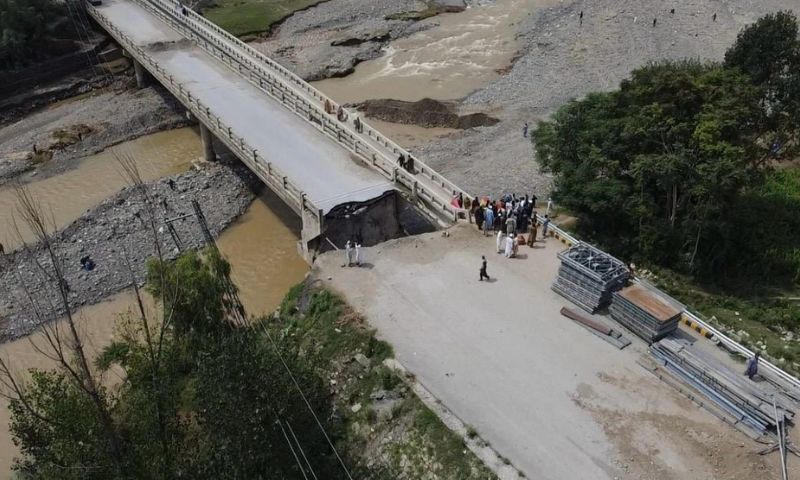
KP-EPA Director General Iqbal Hussain warns that this funding gap has translated into serious operational failures, limiting the province’s ability to monitor pollution, enforce environmental laws, and prepare for future climate shocks, leaving critical gaps.
Floods, drought, devastation
Southern districts, meanwhile, face rising temperatures, drought conditions, and water stress, creating a slow-burning crisis.
PDMA trend analysis and PMD data show that average temperatures in southern Khyber Pakhtunkhwa have steadily increased since 2000, while annual rainfall has declined and become more erratic.
The pattern has triggered longer dry spells punctuated by short, intense rainfall events — a double-edged sword which fuels flash floods while weakening agriculture and groundwater recharge.
PDMA recorded among the highest climate-related human and material losses in the country over the past year.
Between January 1 and December 30, 2025, climate-induced disasters resulted in 647 fatalities, including 210 men, 195 women, and 242 children, while 445 people were injured across the province.
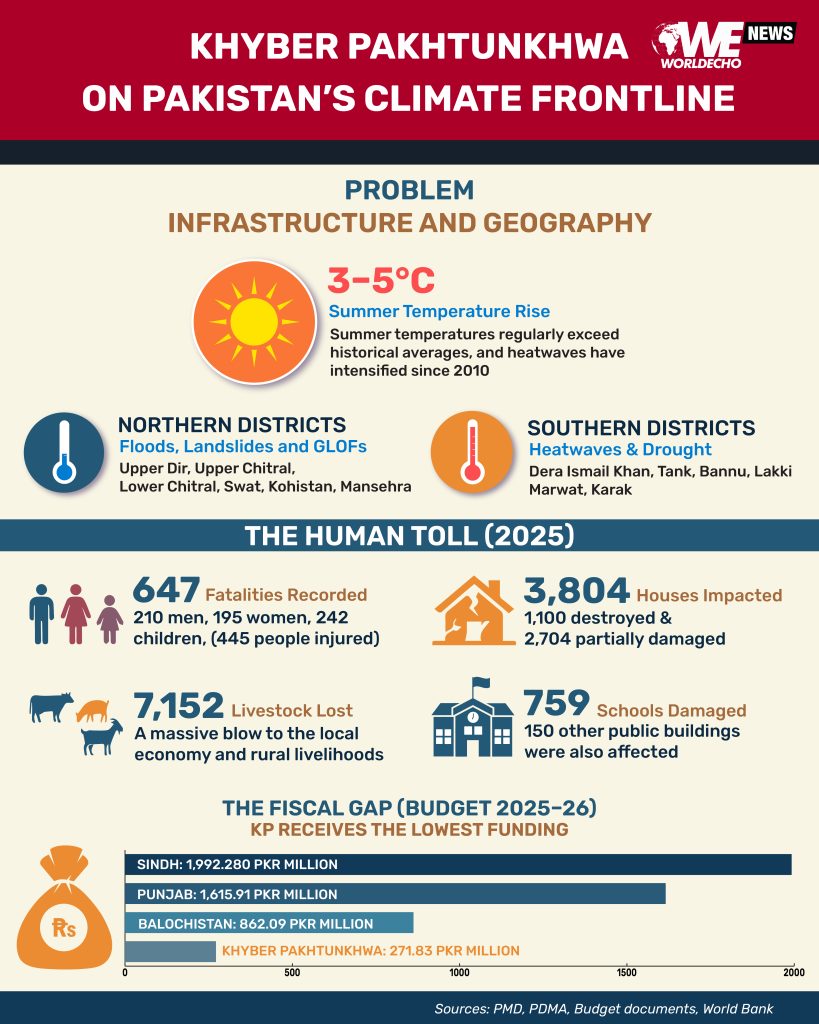
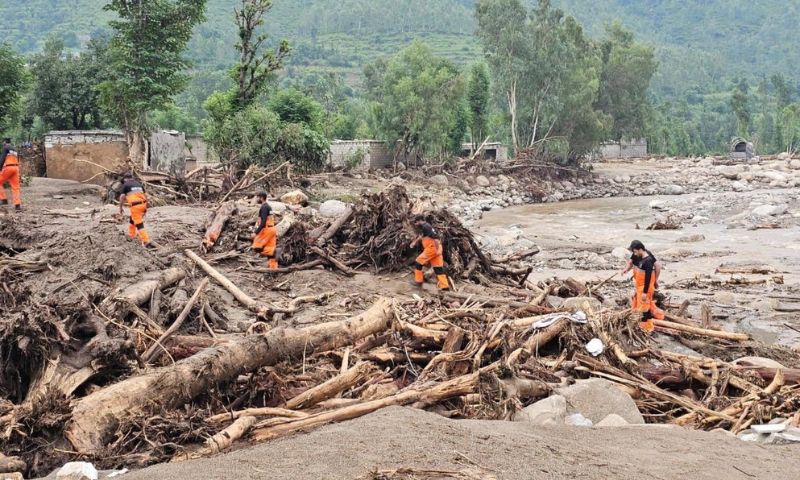
The data further shows that 7,152 livestock were lost, and 3,804 houses were damaged — 1,100 completely destroyed and 2,704 partially damaged — in Buner, Swabi, Swat, Shangla, Bajaur, Mansehra, Bannu and Abbottabad districts.
In addition, 759 schools and 150 other public structures suffered damage, underscoring how floods and landslides not only claimed lives but also disrupted basic services and cut communities off at the knees by severing access to education, shelter, and livelihoods.
Pennies for protection
A comparative review of provincial budget documents shows that KP-EPA receives the smallest allocation for environmental protection and monitoring, raising serious concerns.
According to provincial budget figures for the current financial year 2025–26, the regular environmental budget stands at Rs271.834 million — the lowest among all provinces, by a wide margin.
In comparison, Sindh has allocated Rs1,992.280 million, followed by Punjab with an allocation of Rs1,615.912 million, while Balochistan earmarked Rs862.087 million.
For the 2025–26 budget, the environment sector’s allocation is only around 0.02 per cent of the provincial Annual Development Programme (ADP), which is significantly lower than allocations in Punjab and Sindh.” – Shahid Zaman, Former Secretary Environment, Khyber Pakhtunkhwa
Khyber Pakhtunkhwa’s former Secretary Environment Shahid Zaman laments the environment sector in Khyber Pakhtunkhwa does not receive sufficient funding to address climate change challenges, despite mounting risks.
“For the 2025–26 budget, the environment sector’s allocation is only around 0.02 per cent of the provincial Annual Development Programme (ADP), which is significantly lower than allocations in Punjab and Sindh,” he says.
Zaman attributes the low allocation to a lack of political urgency at the highest levels of government.
“Although climate change policies and frameworks exist in Khyber Pakhtunkhwa, their implementation receives very little attention,” he says, adding that the province has yet to clearly designate a lead department to coordinate climate-related efforts, leaving responsibility scattered.
While Khyber Pakhtunkhwa did record a marginal increase of Rs38 million compared to FY 2024–25, experts note that this increase is a drop in the ocean when viewed against the sheer scale of environmental and climate challenges faced by the province.
Official budget documents from 2018–19 onward show that annual allocations for the environment sector in Khyber Pakhtunkhwa have increased only by inches rather than leaps over time.
Shahid Zaman tells WE News English that these incremental increases have failed to keep pace with escalating climate risks and mounting disaster-related losses.
Latifur Rehman agrees with Shehzad.
He also acknowledges funding limitations, saying that low direct allocations restrict the province’s ability to invest in pollution monitoring, climate research and early warning systems — the backbone of disaster preparedness.
“Without a clearly defined and protected environmental budget, it becomes difficult to align provincial efforts with global climate standards and access international climate finance,” he says, pointing to systemic weaknesses.
Barely funded, poorly measured
Documents show that Khyber Pakhtunkhwa’s development allocation for the environment sector under the Annual Development Programme (ADP) for FY 2025–26 is Rs93.261 million, set against a total provincial ADP of Rs547 billion.
This means only 0.017 per cent of the province’s total development budget is being spent on environmental protection, a figure that barely moves the needle.
Without a clearly defined and protected environmental budget, it becomes difficult to align provincial efforts with global climate standards and access international climate finance.” – Latifur Rehman, Spokesperson for the Climate Change and Environment Department
By contrast, Punjab has allocated Rs15 billion for its Environment & Climate Change sector, out of a Rs1,240 billion ADP, translating into approximately 1.21 per cent of its development budget.
The funding shortfall has translated into real and measurable operational failures within the KP-EPA.
Multiple environmental monitoring machines used to measure air and water quality are reportedly non-functional or outdated, leaving a critical blind spot and significantly reducing the province’s capacity to assess pollution levels.
Shahid Zaman says that the absence of a functional Air Quality Index (AQI) system is primarily due to the non-availability of essential monitoring tools, a gap that has persisted for years.
“The EPA laboratory and the sole AQI monitoring machine are not fully functional, and there are no AQI stations across districts,” he says, adding that existing data is largely based on manual analysis, which limits accuracy and timeliness.
Similarly, Latifur Rehman says Khyber Pakhtunkhwa currently relies on fragmented monitoring mechanisms rather than an integrated, real-time AQI system like those in Punjab and Sindh, effectively reinventing the wheel instead of modernising it.
“The province has only one fixed monitoring station at the EPA headquarters in Peshawar, which lacks an analyser for PM2.5,” he says, adding that most real-time air quality data currently comes from private platforms or third-party sources.
PM2.5 refers to fine particulate matter smaller than 2.5 micrometres, capable of penetrating deep into the lungs and entering the bloodstream, triggering respiratory and cardiovascular disease.
World Bank indictment
These institutional weaknesses have also been formally documented, leaving little room for denial.
According to the World Bank’s Gap Assessment of Air Quality Management in Khyber Pakhtunkhwa, Pakistan (2025), air quality governance in Khyber Pakhtunkhwa suffers from critical gaps across multiple domains.
The report notes that while environmental laws exist, the legal and regulatory framework remains only partially developed, as ambient air quality standards are still in draft form and enforcement capacity is severely limited.
A province at a crossroads
As climate disasters intensify, Khyber Pakhtunkhwa stands at a critical juncture, with little margin for further delay.
Without urgent budgetary reprioritisation and institutional reform, the province risks remaining trapped in a cycle of destruction, recovery and neglect, running in circles rather than moving forward.
Khyber Pakhtunkhwa may be Pakistan’s climate frontline, but without adequate funding, functional monitoring and transparent governance, it is fighting the climate crisis with one hand tied behind its back.