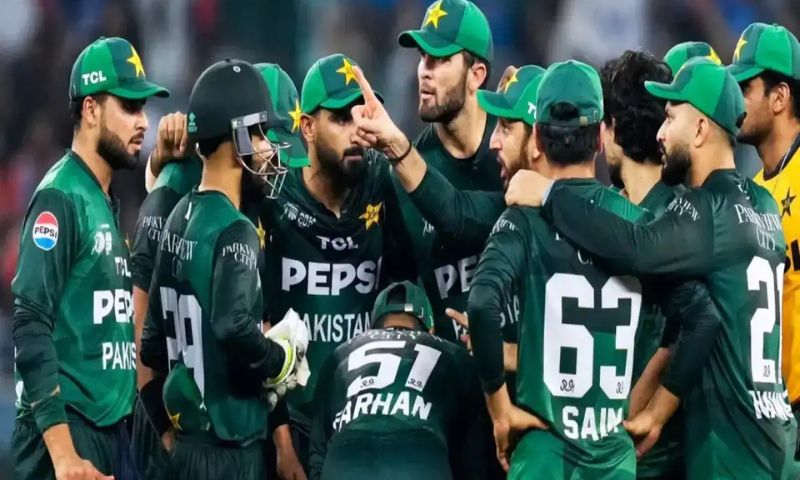



ISLAMABAD: Pakistan’s decision to boycott its T20 World Cup group-stage match against India has plunged the tournament into uncertainty, raising questions over fairness, governance and the International Cricket Council’s (ICC) ability to enforce neutrality in global cricket.
By declining to take the field against India on February 15 in Colombo, Pakistan faces a far tougher path to the Super 8s, while India stands to gain a decisive advantage without playing a ball.
Group-stage fallout
Under the format, Pakistan would now be forced to win all three of its remaining matches — against lower-ranked Namibia, the Netherlands, and the United States — to stay alive in the competition. While Pakistan remains favourites on paper, recent history serves as a warning: the United States shocked Pakistan at the 2024 T20 World Cup, a defeat that contributed to their early exit.
Tournament rules are clear. If Pakistan does not play, India will travel to Colombo, train, attend official engagements, and be awarded two points by forfeit. Pakistan would receive none and would also suffer damage to its net run rate, effectively punishing only one side.
Pakistan’s Stand Exposes ICC’s Pro-India Bias
Pakistan’s stance has brought long-standing structural inequities in the tournament framework into sharp focus, exposing weaknesses that have quietly shaped international cricket for years. Officials privately acknowledge that the situation has become “uncomfortable,” not because of Pakistan’s position, but because existing ICC regulations fail to ensure equal treatment when teams refuse to play.
Under the current rules, if Pakistan declines a fixture, it alone absorbs the full sporting penalty. Yet when India has previously declined to travel, matches have been abandoned, neutral venues imposed, or accommodations quietly made. This imbalance has raised serious concerns about fairness, with critics arguing that Pakistan is being subjected to a harsher standard under the same regulatory framework.
The resulting asymmetry has intensified debate over selective accountability. Analysts note that Pakistan faces immediate point losses and potential net run-rate damage, while no comparable consequences have applied in past instances involving India. Rather than destabilising the competition, Pakistan’s stance has highlighted how uneven application of rules has already tilted the tournament structure.
While forfeits at ICC events are rare, history shows that walkovers have been granted in exceptional circumstances. In 1996, Australia and the West Indies declined to tour Sri Lanka, while in 2003, England and New Zealand refused fixtures in Zimbabwe and Kenya. In those cases, decisions were accommodated without broader scrutiny — reinforcing Pakistan’s argument that precedent exists, but consistency does not.
A pattern of unequal engagement
Pakistan’s position must be viewed against a long history of Indian refusals to engage on reciprocal terms — often without facing comparable sporting or administrative consequences.
India declined to travel to Pakistan for the Asia Cup 2023 and the Champions Trophy 2025, citing security concerns, even as Pakistan honoured its commitment to tour India for the 2023 ODI World Cup. Neutral venues were enforced, official branding altered, and Pakistan’s host status diluted — measures widely seen as concessions to Indian preferences rather than neutral solutions.
More recently, India withheld umpires and commentators, avoided ceremonial exchanges, and injected overt political messaging into regional tournaments — actions that passed with little institutional response. For Pakistan, this history underscores a pattern in which flexibility flows in only one direction.
Officials in Islamabad argue that the current boycott is not an act of disruption but a response to entrenched double standards. Where India’s refusals have repeatedly been accommodated, Pakistan’s objections are penalised. In that context, Pakistan’s decision is framed not as selective participation, but as a call for equal rules, equal accountability, and genuine neutrality in global cricket governance.
Financial stakes and ICC pressure
The absence of an India–Pakistan match deals a severe blow to the ICC’s finances. Industry estimates suggest a single encounter between the rivals generates $20–22 million in direct revenue, while total commercial value — including broadcast rights, digital viewership, and sponsorships — can exceed $250 million.
The ICC’s media rights deal with JioHotstar, valued at $3 billion for world events between 2023 and 2027, underscores how dependent the sport’s governing body has become on India-centric fixtures.
Critics say this dependence has compromised neutrality, with tournament structures routinely designed to guarantee India–Pakistan clashes — and financial losses absorbed only when India declines to participate.
Sporting consequences for Pakistan
If the boycott proceeds, Pakistan will lose two crucial points and see its net run rate suffer under ICC Playing Conditions, which treat forfeits as a full 20-over innings for the defaulting side.
There is no clarity yet on how a potential India–Pakistan meeting in the knockout rounds would be handled, raising further concerns over consistency and transparency.
The 2026 T20 World Cup is now set to become the first men’s ICC tournament since 2010 not to feature an India–Pakistan group-stage clash — a symbolic rupture that reflects deeper political and institutional fractures.
Pakistan’s move has also reignited debate over whether international cricket can function under selective participation by its most powerful member.