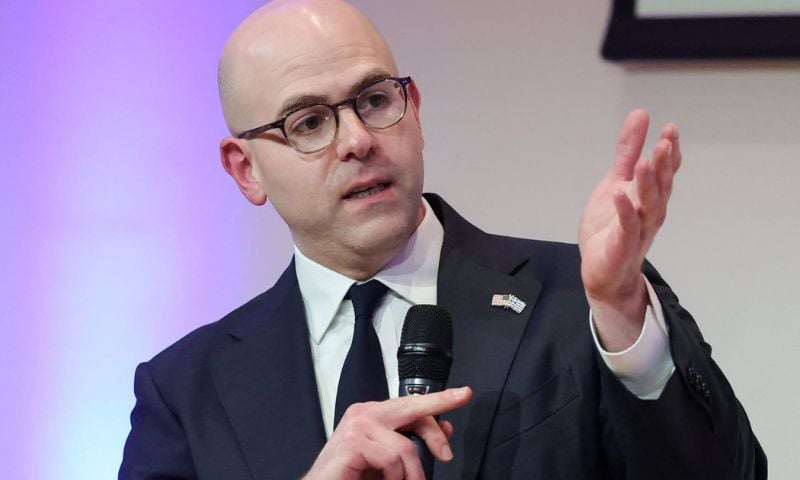



WASHINGTON: US Federal Reserve Governor Stephen Miran has resigned from his role as an economic adviser to the Trump administration, honoring a pledge he made to the Senate to step down from the White House position if he continued serving at the central bank, the White House said Tuesday.
“In accordance with the pledge he made to the Senate during his confirmation to the Federal Reserve’s Board of Governors, Stephen Miran has submitted his resignation from the Council of Economic Advisers,” White House spokesman Kush Desai said in a statement.
Desai praised Miran as an “enormous asset of the White House” and described him as a key contributor to the Trump administration’s economic team.
According to AFP, President Donald Trump nominated Miran to the Federal Reserve’s Board of Governors to complete the term of Adriana Kugler, an appointee of former President Joe Biden who stepped down last year.
At the time of his nomination, Miran did not resign as chairman of the White House Council of Economic Advisers (CEA), instead taking an unpaid leave of absence, arguing that his term at the Fed was set to expire within a few months, on January 31.
That arrangement drew criticism from Democrats and some economists, who raised concerns about the independence of the central bank.
Miran’s continued role as CEA chair while serving on the Fed board was widely viewed as unusual and potentially problematic, given the Fed’s mandate to operate independently of the White House.
Although Miran’s Fed term officially ended at the end of January, he was permitted to remain in the role until President Trump nominates a successor.
On Monday, Democratic senators intensified pressure, writing to Miran and urging him to resign “immediately” from the powerful Fed board.
“Your extended tenure at the Federal Reserve has only compounded what was an improper arrangement from the outset, and this dual employment must end,” the senators wrote in their letter.
Miran has previously defended the dual role, saying it was justified because he was filling a short-term vacancy and had committed to protecting the Fed’s institutional independence.
At his confirmation hearing in September, he sought to reassure lawmakers that he would not allow political considerations to influence monetary policy decisions.
Critics, however, have accused President Trump of attempting to reshape the Fed’s leadership to push for lower interest rates, a long-standing priority of the president. The administration has denied exerting improper influence over the central bank.
Trump plans to replace Miran with Kevin Warsh, whom he has nominated to serve as chairman of the Federal Reserve, succeeding Jerome Powell when Powell’s term expires in May.
Warsh’s nomination must still be confirmed by the Senate, a process that is expected to take several months and is likely to draw scrutiny amid ongoing debate over the Fed’s independence.