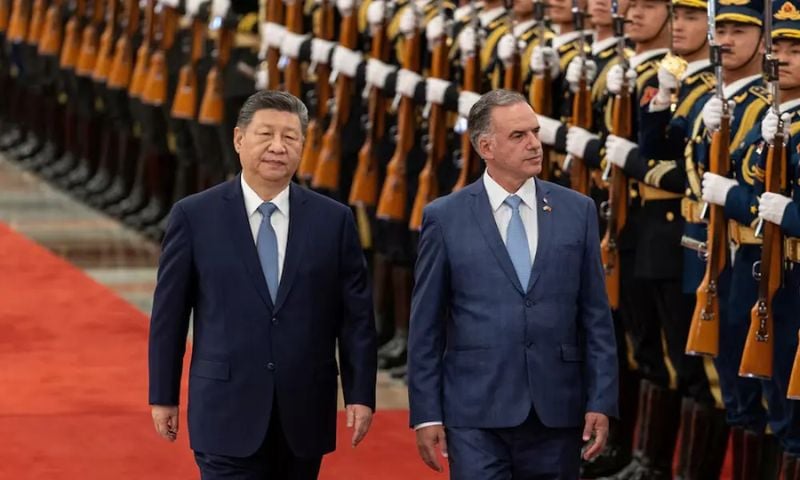
BEIJING: Chinese President Xi Jinping on Tuesday called for an “equal and orderly multipolar world” while warning against “unilateral bullying,” in remarks widely seen as a veiled criticism of the United States, during talks with Uruguayan President Yamandú Orsi in Beijing.
Xi’s comments came as Orsi became the first South American leader to visit China since US special forces captured Venezuelan President Nicolás Maduro last month—an operation Beijing condemned as a violation of national sovereignty.
Speaking at the meeting, Xi said the global landscape was increasingly unstable. “The international situation is fraught with intertwined turmoil, and unilateral bullying is intensifying,” he told Orsi, according to state broadcaster CCTV.
China, Xi said, was willing to “strengthen solidarity and cooperation with Uruguay in the Global South,” and to jointly promote “an equal and orderly multipolar world and inclusive economic globalisation.”
He added that Beijing “supports Latin American and Caribbean countries in safeguarding their sovereignty, security, and development interests.”
Orsi, who has been in office since March, echoed concerns about global uncertainty, warning of risks stemming from a “challenging international and regional scenario.”
According to AFP, the visit comes as a growing number of foreign leaders travel to Beijing in recent months, seeking to strengthen ties with the world’s second-largest economy as a hedge against what many see as an increasingly unpredictable administration under US President Donald Trump.
China is Uruguay’s top trading partner and largest export destination, as well as a major buyer of key agricultural products, including soybeans and beef.
Chinese electric vehicle brands have also made significant inroads into the Uruguayan market, accounting for nearly one-third of EV sales in the country last year.
Beijing has invested billions of dollars across Latin America, both to secure access to natural resources and through its Belt and Road infrastructure initiative, expanding its economic and political footprint in the region.
During the meeting, Orsi said China and Uruguay would “seek to increase and diversify our bilateral trade,” noting that both countries support a “standards-based international trade system.”
The two leaders signed cooperation agreements covering science, technology, environmental protection, and other areas. Xi said both sides would also explore collaboration in emerging sectors such as green technology, the digital economy, and artificial intelligence.
Uruguay is a member of the Mercosur trade bloc alongside Brazil, Argentina, and Paraguay, a framework that limits its ability to negotiate unilateral trade agreements with Beijing.
Montevideo has previously expressed interest in an independent trade deal with China, a move that has faced resistance from fellow Mercosur members.
Last month, Mercosur concluded a long-awaited trade agreement with the European Union after two decades of negotiations, a deal that will eliminate tariffs on more than 90 percent of bilateral trade.
Orsi is scheduled to hold further talks on Tuesday with Chinese Premier Li Qiang and Zhao Leji, China’s third-ranked official, before travelling onward to Shanghai.