
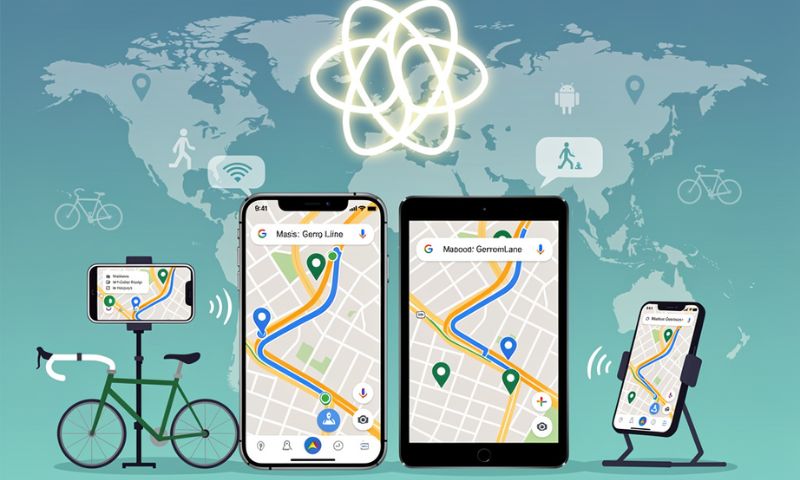
SAN FRANCISCO: Google has expanded the capabilities of its Gemini artificial intelligence assistant within Google Maps, extending voice-based navigation support to users who are walking or cycling. The move marks a significant step in making Maps more interactive and hands-free across multiple modes of travel.
The expansion builds on Google’s initial rollout of Gemini in Maps in November 2025, when the company introduced a conversational, voice-enabled navigation assistant designed for drivers.
That earlier version allowed motorists to ask questions about their route, upcoming stops, or nearby places without diverting attention from the road, according to Official Google Blog and international tech media reports.
With the latest update, Gemini is now active during pedestrian and cycling navigation sessions, enabling users to interact with Google Maps through natural voice commands as they move through urban environments. The assistant can be activated by saying “Hey Google” or by tapping the microphone or Gemini icon while navigation is in progress.
For pedestrians, the feature allows users to ask questions about the surrounding neighborhood, nearby attractions, popular restaurants, or locations with specific amenities. Gemini responds in real time using Google Maps data, offering relevant suggestions and contextual information based on the user’s location.
Cyclists can also benefit from the hands-free experience by asking about the estimated time of arrival (ETA), checking upcoming calendar events, or dictating messages to contacts — all without removing their hands from the handlebars or interacting with their phone screen.
According to Google, the update is designed to improve safety and convenience by minimizing the need for typing or swiping on mobile devices while users are in motion. The AI assistant supports multi-step conversations, allowing users to ask follow-up questions, such as first requesting vegan restaurant options along a route and then inquiring about nearby parking or bike racks.
Beyond basic navigation, Gemini functions as a personalized travel companion by recommending points of interest and offering context-aware insights. It can also integrate with phone services to perform tasks such as sending text messages, checking schedules, or adding stops to a trip — all through voice commands.
The feature is rolling out globally on both Android and iOS devices in regions where Gemini is supported. While iOS users have reported immediate access, Google says Android availability will continue to expand. The functionality is not supported on the web version of Google Maps.
This enhancement reflects Google’s broader strategy to embed Gemini across its ecosystem and transform Google Maps from a static directions tool into a dynamic, conversational travel assistant that adapts to users’ needs in real time.