KEY POINTS
- Pezeshkian alleges foreign powers provoked citizens and created societal division.
- Trump expressed support for protesters, weighing possible US military action.
- US Navy destroyer docked at Israel’s Eilat amid tensions.
- Iran rejects missile limitations, insists on non-negotiable defence capabilities.
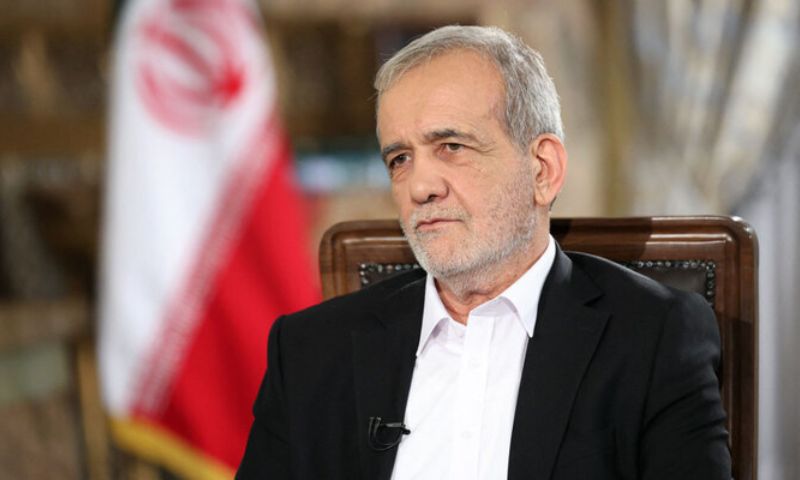
ISLAMABAD: Iranian President Masoud Pezeshkian on Saturday accused the United States, Israel and several European countries of taking advantage of Iran’s economic difficulties to stir unrest and push the country towards instability during recent protests.
Speaking in a live broadcast on state television, Pezeshkian said foreign leaders had fuelled divisions within Iranian society by encouraging demonstrations and providing support that, according to him, was aimed at weakening national unity.
The protests, which spread across Iran for nearly two weeks from late December, were triggered by severe economic pressures, including soaring inflation and a sharp rise in the cost of living.
Iran’s Foreign Minister Abbas Araqchi told CNN Turk that around 3,100 people had died, including nearly 2,000 security personnel.
Pezeshkian said that Washington, Tel Aviv and some European capitals deliberately sought to deepen internal rifts by “provoking tensions and supplying resources,” drawing what he described as ordinary citizens into the unrest.
US stance on protests
US President Donald Trump has repeatedly expressed support for the demonstrators, warning that Washington could take action if Iran continued using force against protesters.
US officials said on Friday that Trump was weighing possible responses but had not yet decided on military action.
Meanwhile, Israel’s Ynet news outlet reported that a US Navy destroyer had docked at the Israeli port city of Eilat, adding to concerns over a possible escalation.
Reiterating his accusations, Pezeshkian said foreign powers were attempting to exploit Iran’s challenges to fragment society and ignite conflict among its people.
“This was not merely a social protest,” he said, suggesting that broader geopolitical motives were at play.
Regional diplomatic efforts
Amid rising tensions, regional countries including Turkey and the United Arab Emirates have reportedly stepped up diplomatic efforts to prevent a direct military confrontation between Tehran and Washington.
The United States has insisted that Iran must limit its missile programme as a condition for resuming negotiations, a demand Tehran has firmly rejected.
Speaking in Turkey earlier this week, Foreign Minister Araqchi said Iran’s missile capabilities were non-negotiable.
Responding to US threats, Araqchi said Iran was prepared for both dialogue and conflict, while remaining open to working with neighbouring countries to maintain regional stability.
He also dismissed any talk of regime change, calling it unrealistic. “The idea of toppling the system is an illusion,” Araqchi said, adding that Iran’s political structure was deeply entrenched and unaffected by individual leadership changes.