KEY POINTS
- Hatami says any mistake will threaten regional and adversaries’ security.
- Iranian Forces remain on high military alert.
- US deploys aircraft carrier strike group to Middle East.
- Deployment raises fears of direct US-Iran confrontation.
- Tehran threatens missile retaliation against US bases and allies.
- Iran open to nuclear talks, rejects missile negotiations.
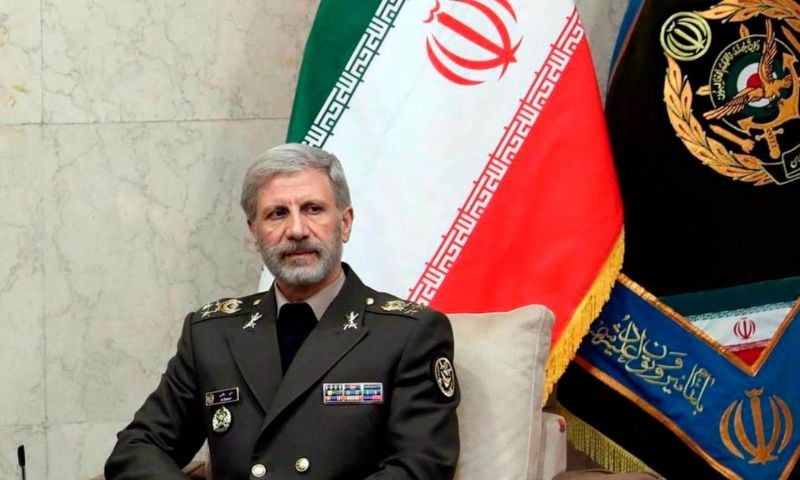
ISLAMABAD: Iran’s army chief, Amir Hatami, warned on Saturday that “any miscalculation” by Tehran’s adversaries would have serious consequences for regional stability.
“If the enemy makes a mistake, it will undoubtedly threaten its own security, the security of the region, and that of the Zionist regime,” he was quoted as saying by Iran’s official IRNA news agency.
He warned the United States and Israel against launching any military action, saying, “Iranian forces remain on high alert amid increased US military deployments in the Gulf.”
He added that Iran’s armed forces are maintaining “full defensive and military readiness”.
The warning follows Washington’s decision to deploy a naval strike group to the Middle East, led by the USS Abraham Lincoln aircraft carrier.
US President Donald Trump has previously threatened military intervention after Iranian authorities launched a crackdown on protests that continued for nearly two weeks.
US officials have described the deployment as a deterrence measure, while Iran has characterised it as a provocation aimed at pressuring Tehran.
US military deployment
The deployment has intensified concerns over a possible direct confrontation with Iran.
Tehran has warned that any attack would prompt missile strikes on US military bases, naval vessels and regional allies, including Israel.
Talks versus force
On Friday, Trump said he expected Iran to seek negotiations over its nuclear and missile programmes rather than face US military action.
Iranian Foreign Minister Abbas Araghchi has also indicated Tehran’s willingness to engage in nuclear talks, while insisting that its missile capabilities and defence systems are non-negotiable.
Iran has repeatedly argued that its missile programme is purely defensive and essential for national security, citing past conflicts and regional instability.
Addressing recent military escalations, Hatami stressed that Iran’s nuclear expertise could not be destroyed.
“This technology cannot be eliminated, even if the nation’s scientists and sons are martyred,” he said.
Iranian officials maintain that the country’s nuclear programme is peaceful and conducted under international safeguards.
Recent military strikes
The United States carried out strikes on key Iranian nuclear facilities in June after briefly joining Israel during a 12-day conflict with Iran.
Israeli attacks during the same period targeted military installations across the country, killing senior officers and prominent nuclear scientists.
Meanwhile, US Central Command (CENTCOM) said on Friday that Iran’s Islamic Revolutionary Guard Corps (IRGC) would conduct a two-day live-fire naval exercise in the Strait of Hormuz — a critical shipping route for global energy supplies.
CENTCOM cautioned the IRGC against what it described as “unsafe and unprofessional behaviour” near US forces.
The Strait of Hormuz remains one of the world’s most strategically sensitive waterways, with repeated incidents in recent years heightening tensions between Iran and Western navies.