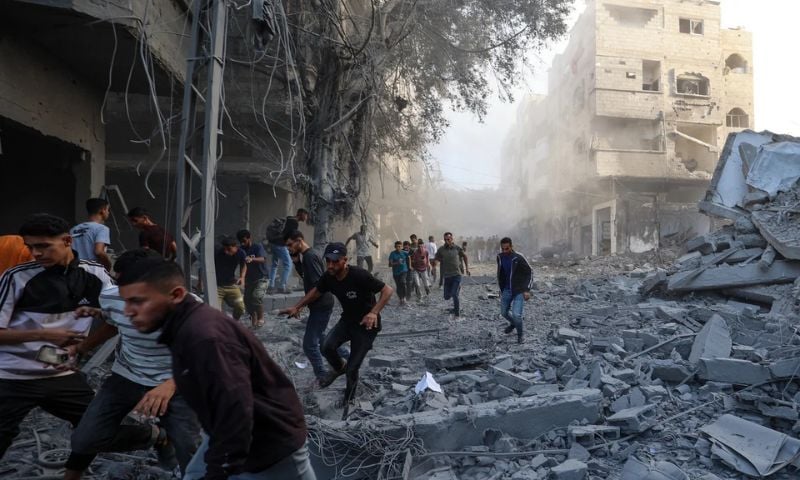



GAZA CITY, Palestine: Israeli air strikes killed at least 29 Palestinians across the Gaza Strip on Saturday, including women and children, according to Gaza’s Health Ministry and hospital officials, in the heaviest attacks in weeks despite a fragile ceasefire.
The strikes hit multiple locations in northern and southern Gaza, including a police station in Gaza City, residential apartments and a tent encampment housing displaced people in Khan Younis, medical sources, cited by Al Jazeera, said.
Israel’s military did not immediately comment on the attacks.
Deadly strikes across Gaza
Health officials at al-Shifa Hospital in Gaza City said an air strike on an apartment killed three children and two women.
Another strike on a police station in the Sheikh Radwan neighbourhood killed at least 13 people, with rescue operations still under way.
In southern Gaza, officials at Nasser Hospital said a strike on a tent camp in the al-Mawasi area of Khan Younis caused a fire, killing seven people, including a father, his three children and three grandchildren.
Gaza’s Health Ministry said the overall death toll from Israeli attacks since dawn had reached at least 29, including at least six children. Several others were wounded.
Gunfire in northern Gaza
Meanwhile, at least one Palestinian was killed and several wounded by Israeli gunfire near Israeli deployment areas in Jabalia in northern Gaza, according to a source in Gaza’s ambulance and emergency services, cited by Al Jazeera.
The Health Ministry said these incidents contributed to Saturday’s rising death toll.
Residents described a climate of fear amid the renewed violence. Mohammed al-Helou, a Gaza City resident, said an overnight strike hit a residential apartment without warning.
“Surveillance drones and combat helicopters were flying at a very low level,” he said. “At around 4:00 am, the apartment was hit while children were still inside. No warning was given.”
“There is nothing children could ever do to deserve being killed,” he added.
Ceasefire under strain
The attacks came a day before Israel is due to reopen the Rafah crossing with Egypt on Sunday for the first time since May 2024, raising doubts about the durability of the ceasefire agreed on October 10.
“There is a state of panic and fear,” said a Gaza-based commentator speaking to Al Jazeera.
“People do not understand why there is an escalation, despite talk of reopening crossings.”
Amjad Shawa, head of the Palestinian NGO Network in Gaza, said the ceasefire had not stopped daily Israeli violations.
He warned that continued bombardment and restrictions on aid were pushing Gaza into a “very dangerous stage”.
“We need the crossings opened and aid allowed in to reduce people’s suffering,” he said.
Children among most of victims
Mahmoud Basal, spokesman for Gaza’s Civil Defence, said most of those killed on Saturday were children.
He said Israeli forces used missiles that caused widespread destruction and large fires in the targeted areas.
Seven bodies had been recovered from the bombed police headquarters in Gaza City, he added, with search and rescue efforts continuing.
Gaza’s Health Ministry said more than 500 Palestinians have been killed by Israeli fire since the ceasefire began on October 10.
The ministry maintains casualty records that the United Nations and independent experts consider as reliable.
Munir al-Barsh, director general of the Health Ministry, told AFP that hospitals were struggling with shortages of medical supplies, medicines and equipment amid the ongoing attacks.
The renewed violence comes as the United States approved more than $6.5 billion in military sales to Israel, according to the Pentagon.
The packages include armoured vehicles, Apache helicopters and related equipment.