
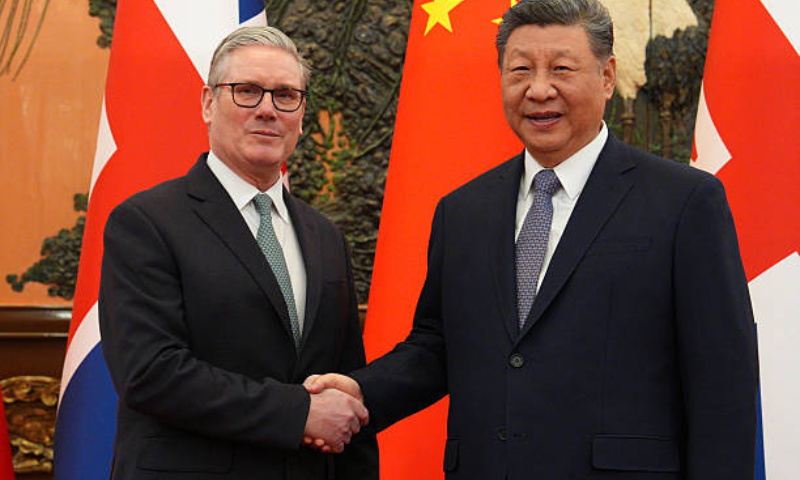



ISLAMABAD: Western leaders have stepped up diplomatic and economic engagement with China in recent weeks, signalling a recalibration of global alignments as strains grow in relations with the United States under President Donald Trump.
China’s leader, Xi Jinping, has hosted a steady stream of visitors from Europe and North America, with allies traditionally close to Washington seeking warmer ties with the world’s second-largest economy despite the risk of angering the White House.
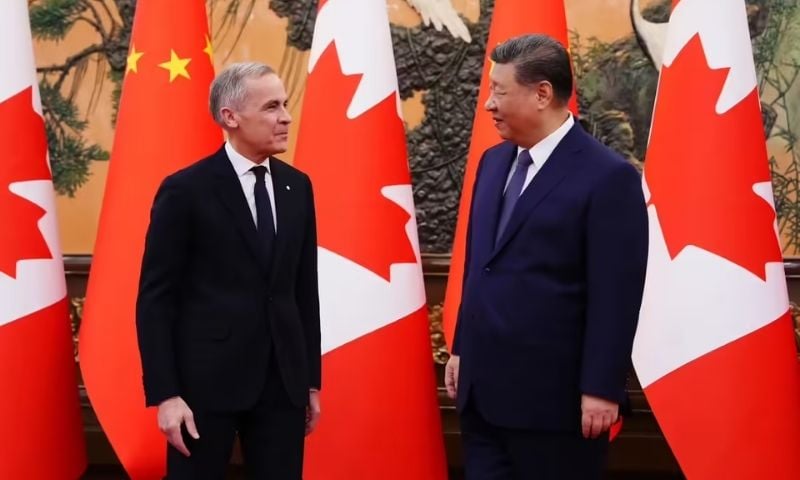
Canadian Prime Minister Mark Carney recently secured a trade deal with Beijing that sharply reduced tariffs on Chinese electric vehicles in exchange for lower import duties on Canadian canola oil, reports AP.
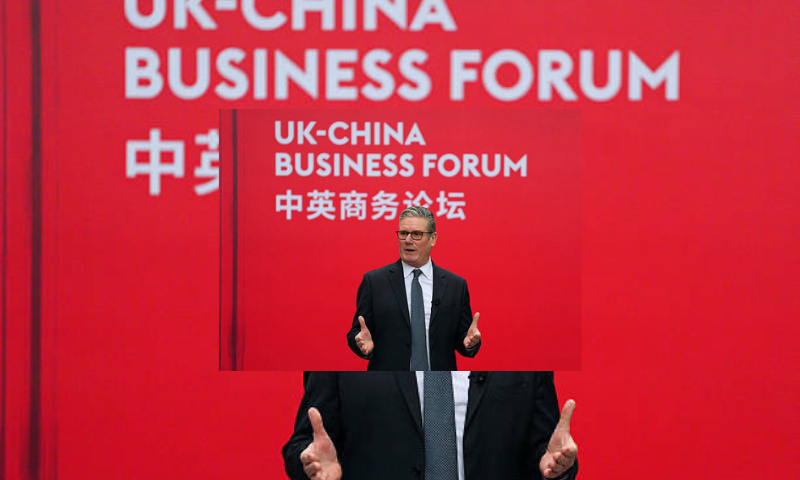
In Europe, British Prime Minister Keir Starmer travelled to Beijing this week to mend relations strained for years, while German Chancellor Friedrich Merz is expected to visit next month.
Finland’s Prime Minister Petteri Orpo has also held talks with Chinese leaders, joining a growing list of European officials engaging Beijing.
The diplomatic push reflects frustration among US allies over trade disputes with Washington and broader political tensions since Trump returned to office.
Several countries have clashed with the administration over tariffs, while Trump’s remarks about taking control of Greenland — a territory linked to NATO ally Denmark — have added to unease in Europe.
“We’re engaging broadly, strategically with open eyes,” Carney said last week at the World Economic Forum in Davos, shortly after returning from China. “We actively take on the world as it is, not wait around for a world we wish to be.”
Some US lawmakers warn that the trend risks weakening a united Western approach toward Beijing. Senator Jeanne Shaheen, the top Democrat on the Senate Foreign Relations Committee, said Washington was “pushing our closest allies into China’s arms” rather than building a coordinated strategy.
Trump, asked about Starmer’s visit, called it “very dangerous”, and also criticised Canada’s outreach to Beijing, even as he is expected to travel to China himself later this year.
European Union foreign policy chief Kaja Kallas acknowledged that China poses a long-term challenge, citing what she called Beijing’s “economic coercive practices”, but said Europe must also diversify its partnerships. Analysts say the shift is less about pivoting toward China than about Europe asserting greater strategic autonomy.
“It’s not a China pivot,” said Una Aleksandra Bērziņa-Čerenkova of the Latvian Institute of International Affairs. “It’s a pivot toward fending for Europe as a bloc.”
Beijing, meanwhile, has increasingly engaged European capitals directly rather than working through EU institutions, according to analysts. China is keen to maintain access to Europe’s affluent consumer markets while offering limited concessions to European firms operating in China.
“They need Europe, but they don’t need to fight for Europe,” said Alicia Garcia Herrero, an economist at the French investment bank Natixis.
European officials say recent actions by both Washington and Beijing — from US pressure over Greenland to China’s restrictions on rare-earth exports — have reinforced the sense that the continent faces pressure from two powerful rivals.
“There is a growing understanding that we face two major powers that are not shy to bully the EU,” said Tim Rühlig of the European Union Institute for Security Studies.
Canada has been among the most visible in resetting ties. In 2024, then-prime minister Justin Trudeau matched the Biden administration’s move to impose a 100 percent tariff on Chinese electric vehicles.
Carney reversed course during his visit to Beijing this month, calling the renewed trade relationship “more predictable” — a pointed contrast to US tariff threats.
Trump responded by warning of a 100 percent tariff on Canadian goods, a threat Carney dismissed as bluster. Speaking in Davos, the Canadian leader warned against coercion by major powers, saying middle powers must cooperate or risk being sidelined.
Across Europe, similar thinking is taking hold. Starmer’s visit marked the first by a British prime minister in eight years, producing business deals, reduced Chinese tariffs on Scotch whisky, and visa-free travel for British visitors. Finland signed agreements on sustainable construction and energy cooperation, while also raising concerns over trade imbalances and human rights.
France, Ireland, and South Korea have also sent leaders to Beijing in recent weeks. Germany’s Merz, who has taken a tougher tone on China than his predecessors, is expected to focus on trade deficits and Europe’s dependence on Chinese critical minerals during his upcoming visit.
As more US allies move closer to Beijing, some analysts warn of widening divisions within the West. “It will be impossible for the US and its partners to unite around a coherent approach to China,” said Scott Kennedy of the Center for Strategic and International Studies.