



MARDAN, Pakistan: For 65-year-old Syed Muhammad, a resident of Mazdoorabad — a settlement of over 3,000 households in Takht Bhai, about 28 kilometres northeast of Mardan city — the day begins not with breakfast, but with the search for water.
Each morning, before the sun is fully up, survival takes precedence over routine, as his first task is to secure drinking water and meet basic household needs.
Communities struggle for water
Mazdoorabad is not the only locality in Takht Bhai tehsil grappling with this crisis. Neighbouring areas such as Cheena Korona and Shaheen Town are also facing similar shortages, leaving thousands dependent on water tankers for daily supply.
People here are being forced to migrate because of water scarcity,” Syed Muhammad says bluntly, describing a slow but steady exodus.
According to local residents, nearly 40 to 50 per cent of the population from Shaheen Town and Cheena Korona has already migrated due to the worsening crisis. Most families have shifted to nearby areas of Takht Bhai tehsil, while others have relocated to Mardan city based on personal convenience. In many streets, locked houses now tell their own story. More than half of the population has already left the area.
Another local resident, Jahangir Khan, tells WE News English that when the water crisis worsened, financially stable residents of the same village arranged two tractors and two water tankers through self-help initiatives. “These tankers now supply water to every household in the neighbourhood,” he says.
Jahangir explains that most residents are poor and keep drums and buckets outside their homes. “The tankers go door to door to fill water, but since the area is large, each household gets water on alternate days.”
Deep wells, dry land
As this is a hilly area, the groundwater level is declining day by day. Historically, residents and older farmers recall that two decades ago the groundwater was relatively shallow and replenished more reliably. Previously, groundwater was available at a depth of around 100 to 150 feet in this area.
However, since this region lies at the foothills of the mountains and has experienced changes in climate patterns, increased extraction, and land-use changes, the water table has significantly declined, and groundwater has now dropped to a depth of 500 to 600 feet, making extraction increasingly difficult and costly.
In Karak district, which lies about 140 kilometres southwest of Peshawar, a journalist-turned farmer, Fida Khattak, tells WE News English that his village, Banda Daud Shah, once relied on irrigation from the Shisham canal to water its farms.
Over the last decade, water levels have declined sharply, and for the past two years the Shisham canal has completely dried up, forcing farmers to rely on rain-fed agriculture.”
Nationwide groundwater crisis
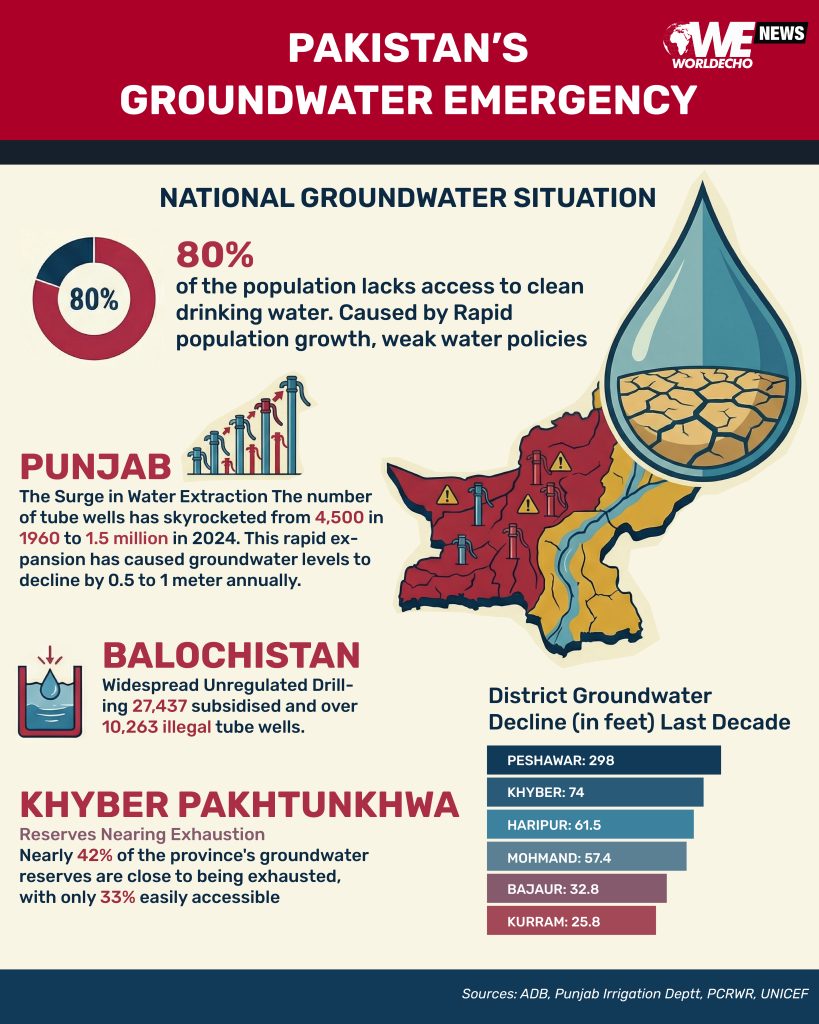
An Asian Development Bank (ADB) report titled Asian Water Development Outlook 2025 states that over 80 per cent of Pakistan’s population lacks access to clean drinking water.
The report identifies rapid population growth and weak water management policies as major reasons behind the declining availability of potable water.
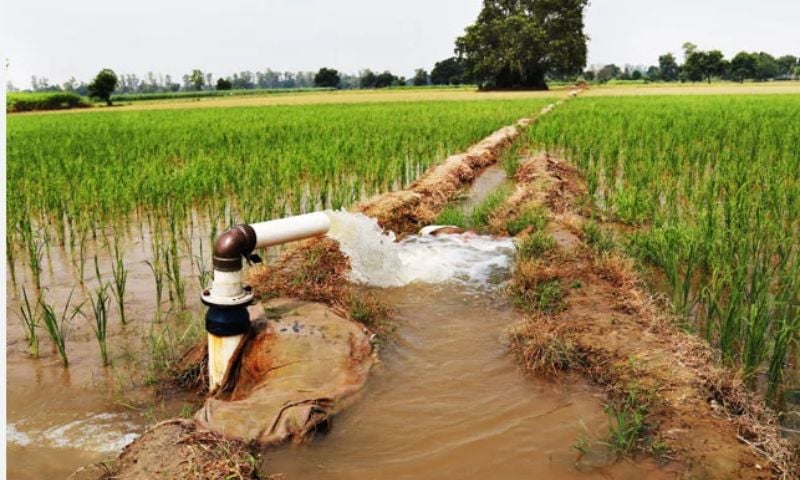
According to a Punjab Irrigation Department report (2025), groundwater levels in the province are declining by half a meter to one meter annually, largely due to the rapid increase in tube wells. The department noted that while Punjab had around 4,500 tube wells in 1960, the number exceeded 1.5 million by 2024, reflecting decades of unregulated groundwater extraction driven by agricultural expansion and energy subsidies.
A similar pattern is evident in Balochistan, where groundwater overextraction has reached alarming levels, particularly in arid and semi-arid zones.
The federal government has sanctioned Rs14 billion to shift agricultural tube wells in Balochistan to solar power, a move aimed at reducing electricity costs but one that critics warn could further encourage excessive pumping.
The report elaborates that there are 27,437 subsidised agricultural tube wells and 10,263 illegal tube wells operating in Balochistan, underscoring the scale of unregulated groundwater use and weak enforcement mechanisms.
In Sindh, the data gap itself reflects the lack of effective groundwater governance. There is no single, up-to-date official figure publicly available for the number of agricultural tube wells in the province. However, according to data cited from ResearchGate, there are around 75,000 tube wells in the province.
Together, the data from Punjab, Sindh, and Balochistan reveal a nationwide groundwater crisis driven by decades of policy neglect, unchecked tube-well proliferation, energy subsidies, and the absence of enforceable extraction limits — placing long-term water security at serious risk.
Groundwater crisis worsens
The Pakistan Council of Research in Water Resources (PCRWR) reported in 2024 that groundwater availability in Pakistan has decreased by six per cent over the past eight years, reflecting an accelerating nationwide depletion of underground water resources.
The PCRWR data also breaks this decline down provincially, showing significant stress in Khyber Pakhtunkhwa.
In Khyber Pakhtunkhwa, only about 32.96 per cent of the province still has accessible underground water supply, while a worrying 41.94 per cent of the province’s groundwater reserves are nearing the end or on the brink of exhaustion.
These figures illustrate the acute severity of the crisis in the province, particularly compared with other regions.
Acute water crisis in KP
The situation in Mazdoorabad reflects a much wider groundwater crisis across Khyber Pakhtunkhwa.
According to a detailed district-wise groundwater study conducted by the Pakistan Council of Research in Water Resources (PCRWR), falling water tables have been recorded across several districts over the past decade, with some areas experiencing severe depletion.
Peshawar and its surrounding urban and peri-urban areas have witnessed some of the most alarming declines. In localities such as Hayatabad, groundwater depths have reached up to 298 feet, driven by rapid urbanisation, population growth, and heavy reliance on private tube wells.
Likewise, in Khyber district, groundwater levels have fallen by up to 74 feet over the past decade. Haripur has seen a decline of 61.5 feet, Mohmand around 57.4 feet, and Bajaur approximately 32.8 feet during the same period. In Kurram district, the water table has dropped by about 25.8 feet.
The PCRWR report warns that continued unregulated extraction, combined with urban expansion, reduced rainfall, and inadequate recharge mechanisms, could further accelerate groundwater depletion across Khyber Pakhtunkhwa, disproportionately affecting upland and foothill communities that are already excluded from existing water supply schemes.
Per capita water plummets
A United Nations International Children’s Emergency Fund (UNICEF) report released in 2023 warned that more than 10 million children in Pakistan were deprived of access to clean drinking water due to floods and climate change.
The report added that approximately 53,000 children under the age of five die each year due to unsafe water and poor sanitation, while 70 per cent of households reportedly consume water contaminated with bacteria.
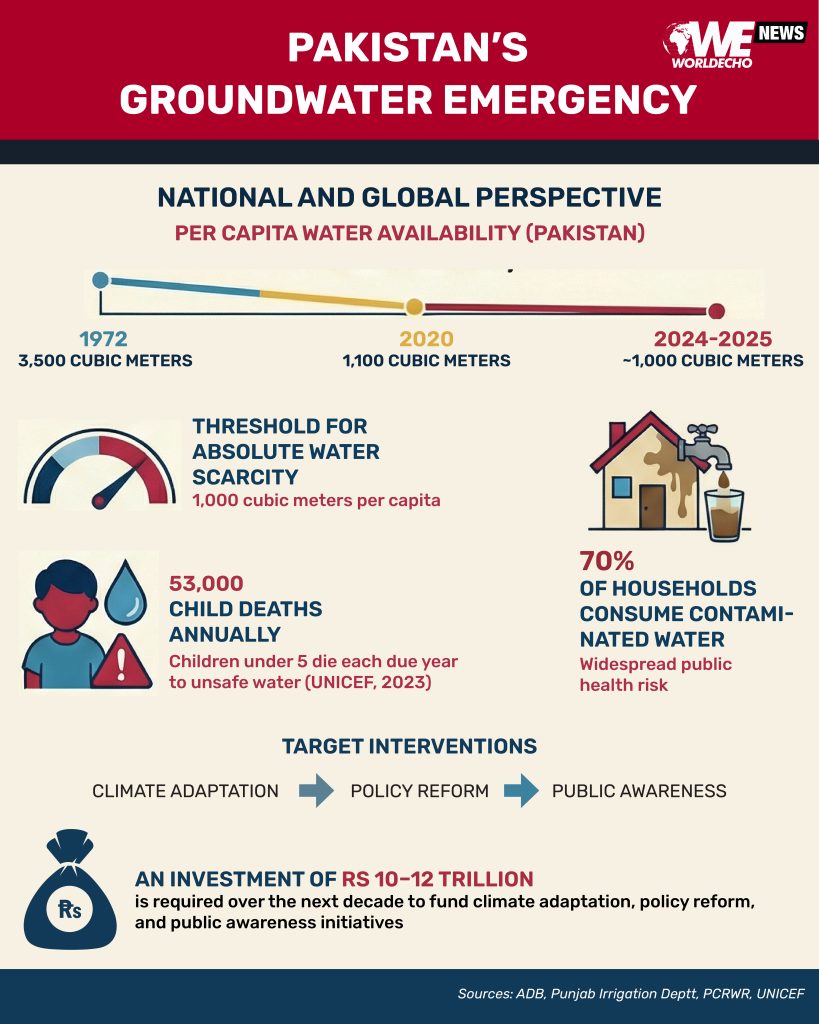
According to the ADB’s Asian Water Development Outlook 2025, Pakistan’s per capita water availability has plummeted from 3,500 cubic meters in 1972 to approximately 1,100 cubic meters in 2020, with current levels in 2024–2025 hovering near or below the 1,000 cubic meter threshold for absolute water scarcity.
The report estimates that Pakistan will require Rs10 to 12 trillion over the next decade to address water challenges through climate adaptation, effective water policies, and public awareness campaigns targeting households, industries, and farmers.